
Bitcoin News Today: Rift Trades 20-Minute Risk for Faster, Cheaper Bitcoin Swaps


 Aime Summary
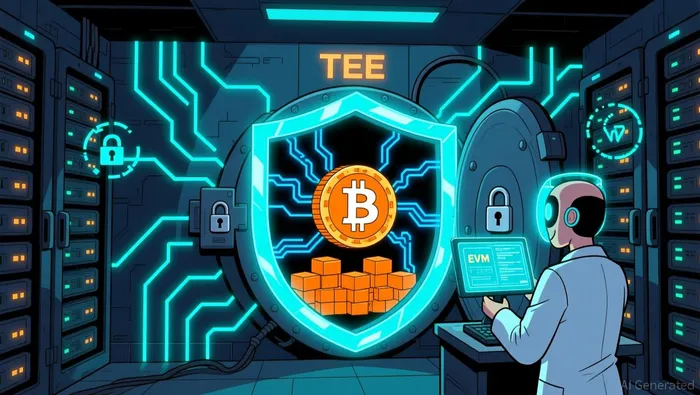
Rift, a blockchain startup, has launched a peer-to-peer trading protocol that enables Bitcoin-to-Ethereum Virtual Machine (EVM) swaps using trusted execution environments (TEEs), positioning itself as a capital-efficient alternative to existing cross-chain solutions. The platform, which charges 10 basis points in taker fees with zero maker fees, leverages hardware enclaves to hold native BitcoinBTC-- for a 20-minute window while verifying the settlement of the opposing trade leg, according to a Bingx report. CEO Samee Siddiqui emphasized that the system eliminates the need for multisignature wallets, synthetic tokens, or proof-of-stake chains, instead relying on the TEE to act as an escrow mechanism, as detailed in a Blockworks piece.
The protocol's design shifts the traditional trust model by validating transactions within a secure enclave, releasing funds only after sufficient block confirmations are received, according to a Phemex article. This approach minimizes the attack surface and reduces reliance on staked capital, a departure from models like THORChain's RUNE-bonded AMM or RenBTC's synthetic token approach, as noted in the Blockworks coverage. Siddiqui acknowledged the inherent risk of a 20-minute window—“If the machine blows up, anything in those 20 minutes is potentially lost”—but argued the tradeoff is justified for faster, cheaper, and less capital-intensive swaps, as described in the Blockworks coverage.
 Rift's fee structure, with 10 bps taker fees, undercuts the 40–60 bps typically seen on platforms like Coinbase, as noted in the Blockworks coverage. The startup's focus on backend integration rather than consumer-facing interfaces further distinguishes it. Siddiqui outlined a strategy to plug into existing wallets and decentralized exchange (DEX) aggregators, prioritizing liquidity efficiency and leveraging assets like cbBTC for ETH-side routing, as reported in the Blockworks coverage. This "API-first" approach aims to embed Rift's protocol into high-volume swap interfaces, avoiding the need for a standalone frontend, according to a KuCoin announcement.
The market for Bitcoin-EVM interoperability is crowded, with competitors like ThresholdT-- Network and Near Intents already offering trustless solutions, as noted in the Blockworks coverage. However, Rift's use of TEEs—rather than zero-knowledge proofs—provides flexibility and simplifies auditing, according to Siddiqui, as reported in the Blockworks coverage. The startup previously explored a zero-knowledge BTC light client but pivoted to TEEs for their practicality, as described in the Blockworks coverage.
By targeting DEX aggregators and wallet providers, Rift aims to streamline on-chain Bitcoin trading without introducing new layer-1 protocols or wrapped tokens, as reported in the KuCoin announcement. Siddiqui's broader vision hinges on DEXs displacing centralized exchanges (CEXs), a shift he deems critical for the crypto space's long-term viability, as described in the Blockworks coverage.

Stay ahead of the market.
Get curated U.S. market news, insights and key dates delivered to your inbox.


AInvest
PRO
AInvest
PRO



Comments
No comments yet