
Bitcoin News Today: Quantum Countdown: 5-Year Alarm vs. 20-Year Defense Buffers


 Aime Summary
Chamath Palihapitiya, the venture capitalist and former Facebook executive, has reignited debate over Bitcoin's vulnerability to quantum computing, predicting that the technology could crack the cryptocurrency's cryptographic defenses within five years. His warnings contrast sharply with those of Adam Back, a BitcoinBTC-- pioneer and Blockstream CEO, who argues that the threat remains decades away and manageable through existing post-quantum encryption standards according to Back's analysis. The clash highlights a broader industry divide over the timeline and feasibility of quantum attacks, as well as the readiness of blockchain protocols to adapt according to CryptoSlate.
Palihapitiya's assessment hinges on rapid advancements in quantum hardware, particularly Google's Willow quantum chip, which he claims could achieve 8,000 stable logical qubits-a threshold he believes sufficient to break Bitcoin's SHA-256 encryption using Grover's algorithm according to Palihapitiya's claims. He cited a study suggesting that such a system could render RSA-2048 obsolete and extend the same logic to Bitcoin's cryptographic architecture. "The earliest risk will appear within 24 months," Palihapitiya warned, urging developers to prioritize quantum-resistant upgrades according to his warning. His stance aligns with other skeptics, including SolanaSOL-- co-founder Anatoly Yakovenko, who previously estimated a 50% chance of quantum threats materializing by 2030 according to Palihapitiya's analysis.
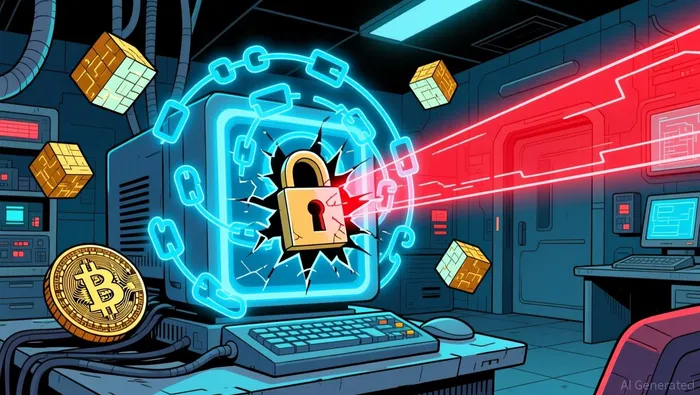 Back, however, dismissed these timelines as alarmist, emphasizing the gap between theoretical models and practical quantum capabilities. "Cryptographically relevant quantum computers are likely 20-40 years away," he stated on social media, pointing to the National Institute of Standards and Technology's (NIST) recently standardized SLH-DSA signature scheme as a ready solution according to his statement. Bitcoin, he argued, has ample time to integrate post-quantum algorithms through soft-fork upgrades, ensuring resilience long before quantum machines pose a tangible risk according to CryptoSlate. Back also noted that even if quantum threats accelerate, the Bitcoin network's decentralized governance model allows for phased migration to quantum-safe protocols, minimizing disruption .
The debate is further complicated by the distinction between physical and logical qubits. While systems like Caltech's neutral-atom array boast over 6,000 physical qubits, error correction and stability remain major hurdles. Quantinuum's Helios system, for instance, requires two physical qubits to produce one logical qubit, underscoring the immense engineering challenges ahead according to Back's analysis. IBM, which aims to deploy fault-tolerant quantum computers by 2029, has yet to achieve the thousands of stable logical qubits needed to break current encryption standards according to Palihapitiya's claims.
Industry observers highlight additional layers of complexity. The "harvest now, decrypt later" strategy-where adversaries store encrypted data for future decryption-poses a risk to long-term privacy but is less relevant to Bitcoin's transactional model, which relies on real-time key validation according to Back's analysis. Meanwhile, migration efforts are already underway. Proposals like BIP-360 advocate for hybrid address types that support both classical and post-quantum signatures, enabling a gradual transition . Developers such as Jameson Lopp have outlined multi-year plans to incentivize users to move funds to quantum-resistant addresses without forcing abrupt changes .
As quantum research progresses, stakeholders are balancing urgency with pragmatism. While Palihapitiya's warnings reflect a worst-case scenario, Back's emphasis on existing safeguards and Bitcoin's adaptive governance offers a counterpoint. The outcome may hinge on how swiftly the industry adopts post-quantum standards-a process that, according to NIST, could take a decade . For now, the debate underscores both the potential risks and the robustness of Bitcoin's evolving security framework.

Entender rápidamente la historia y los antecedentes de diferentes monedas conocidas
Latest Articles
Stay ahead of the market.
Get curated U.S. market news, insights and key dates delivered to your inbox.


AInvest
PRO
AInvest
PRO



Comments
No comments yet