
Bitcoin News Today: PowerBank Activates 3.79 MW Solar Project to Fund Bitcoin Treasury Strategy
 Aime Summary
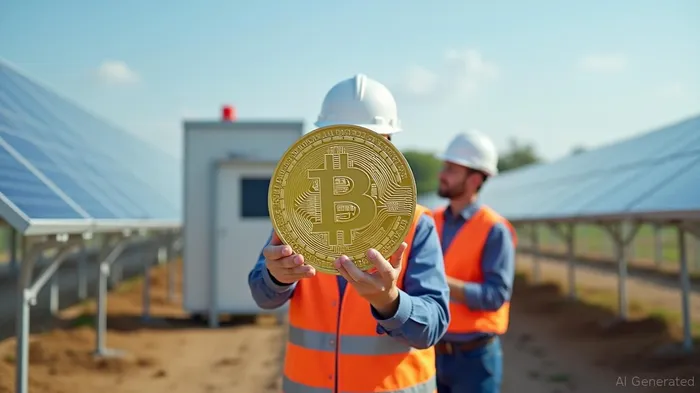
PowerBank Corporation (NASDAQ: SUUN; Cboe CA: SUNN, FSE: 103) has activated its 3.79 MW Geddes Solar Project in New York, marking the debut of its Bitcoin treasury strategy. The project, constructed on a repurposed landfill site, now supplies clean energy to approximately 450 homes annually [1]. Net cash flows from the project will be allocated to Bitcoin purchases, creating a hybrid model that links energy generation with digital assetDAAQ-- investment. This initiative aligns with PowerBank’s broader strategy to leverage renewable energy assets for financial innovation, as outlined by CEO Dr. Richard Lu: “Geddes is our launchpad into a bold, dual-track strategy that fuses clean energy leadership with financial innovation” [1]. The company emphasized that Bitcoin purchases will depend on market conditions, cash flows, and regulatory factors, with no acquisitions made as of the release date. Custody frameworks for Bitcoin remain under evaluation.
The Geddes Solar Project exemplifies PowerBank’s environmental transformation goals by converting underutilized land into productive energy assets. The 3.79 MW utility-scale ground-mounted solar facility is part of the company’s broader portfolio, which includes over 100 MW of completed projects and a 1+ GW development pipeline across North America [1]. Solar Simplified, a partner in community solar operations, manages customer-facing activities, enabling PowerBank to focus on scaling its renewable energy infrastructure.
PowerBank’s Bitcoin treasury strategy represents a non-correlated, asymmetric upside asset for its financial portfolio. The company aims to retain earnings from high-performance projects in a store of value with long-term appreciation potential. This approach mirrors broader industry trends where renewable energy firms are exploring Bitcoin as a reserve asset to diversify income streams. However, the strategy carries inherent risks, including Bitcoin’s volatility and the uncertainties of implementing a new financial model. The company acknowledges these challenges in its forward-looking statements, noting that outcomes could vary materially from expectations [1].
The project’s operational and financial structure underscores PowerBank’s scalability ambitions. By treating Bitcoin as a treasury asset, the company aims to extend this strategy to other solar and battery storage projects within its Independent Power Producer (IPP) portfolio. The Geddes site’s off-take to the local grid supports community energy needs, reinforcing PowerBank’s role in advancing sustainable infrastructure while exploring digital asset integration.
PowerBank’s approach reflects a strategic inflection point for the renewable energy sector. By pairing clean energy generation with Bitcoin investments, the company positions itself at the intersection of environmental sustainability and financial innovation. The Geddes Solar Project’s success will hinge on the stability of its energy output, the efficiency of its Bitcoin allocation framework, and the broader adoption of cryptocurrency as a reserve asset by energy firms. As the market evolves, PowerBank’s dual-track strategy could influence how renewable energy companies balance operational growth with portfolio diversification [1].
Source: [1] PowerBank’s 3.79 MW Geddes Solar Project Goes Live, Powering New Bitcoin Treasury Strategy (https://coinmarketcap.com/community/articles/6888bc66cbe08374be309e2d/)

Stay ahead of the market.
Get curated U.S. market news, insights and key dates delivered to your inbox.


AInvest
PRO
AInvest
PRO



Comments
No comments yet