
Bitcoin News Today: MSTR Absorbs Crypto's Hedging Pressure, Exposing Market Fragility


 Aime Summary
MicroStrategy (MSTR) has emerged as an unconventional yet critical tool for crypto investors seeking to hedge against market downturns, according to Tom Lee, chairman and CEO of Bitmine Immersion. The stock has plummeted 43% in recent weeks as institutional traders increasingly short it to offset losses in cryptocurrency holdings, a strategy driven by the lack of robust on-chain hedging mechanisms. Lee described MSTRMSTR-- as "the most important stock watch right now" due to its role as a proxy for BitcoinBTC--, citing its liquidity and the company's holdings of nearly 650,000 BTC. This dynamic has created a paradox: while MSTR's volatility reflects broader crypto market fragility, it also underscores deeper structural weaknesses in liquidity and risk management tools.
The shift to shorting MSTR stems from the collapse of crypto-native hedging options. Derivatives for Bitcoin and Ethereum lack sufficient liquidity, leaving institutional investors with limited avenues to protect their longs. Instead, traders have turned to MSTR's equity options, which offer a liquid alternative. "Somebody can use MSTR's option chain to hedge all of their crypto," Lee said, emphasizing that the stock is "absorbing all the hedging pressure" from the crypto industry. This phenomenon has intensified since the October 2025 market crash, which erased $20 billion in value and crippled liquidity across exchanges. Market makers, often referred to as the "central bank" of crypto, have yet to restore pre-crash depth, leaving altcoins, miner stocks, and Bitcoin proxies like MSTR vulnerable to outsized declines.
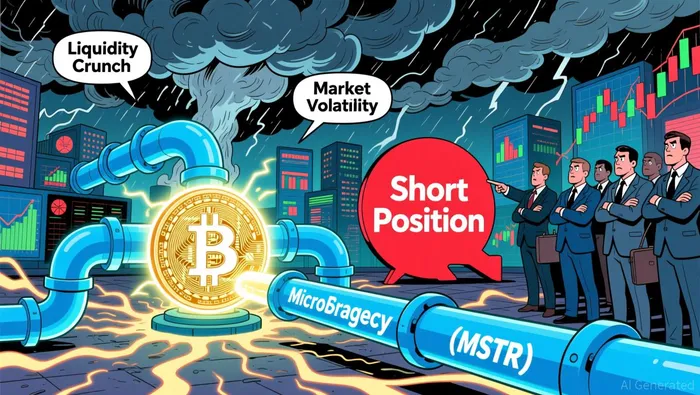 The October crash exposed systemic vulnerabilities that persist despite recent stabilization. According to a CoinDesk Research analysis, order-book depth for Bitcoin and Ethereum remains 30-25% below pre-crash levels, while stablecoin supply has contracted by $840 million since November 15. These trends amplify volatility risks, as even routine trades can trigger sharp price swings. Lee linked MSTR's struggles to this fragile ecosystem, arguing that its role as a "pressure valve" for hedging has made it a focal point for market stress. "It really crippled market makers," he said, noting that liquidity remains thin across key sectors.
Critics argue that MSTR's reliance on Bitcoin's performance makes it an imperfect hedge. The company's stock price, while correlated with BTC, is also influenced by traditional equity market dynamics, including earnings reports and broader macroeconomic factors. For example, MSTR's Q3 earnings report in October 2025 highlighted a 14% decline in share price amid a sharp drop in its market-cap-to-nav (mNAV) ratio. Despite this, Lee's analysis suggests that MSTR's unique position-straddling crypto and equity markets-has made it indispensable for investors seeking to navigate the current liquidity crunch.
The broader implications of this trend remain uncertain. While some analysts view the hedging strategy as a temporary workaround, others, like Lee, see it as a symptom of deeper flaws in crypto's infrastructure. Crypto's market plumbing remains fragile, he said, warning that the reliance on MSTR reflects a lack of mature risk management tools. With the year-end approaching, traders must contend with a market where routine transactions carry outsized risks, and the path to long-term stability remains unclear.

Stay ahead of the market.
Get curated U.S. market news, insights and key dates delivered to your inbox.
AInvest
PRO
AInvest
PRO



Comments
No comments yet