
Bitcoin News Today: Kenneth Rogoff Admits Bitcoin's Growth Defied Traditional Economic Models
 Aime Summary
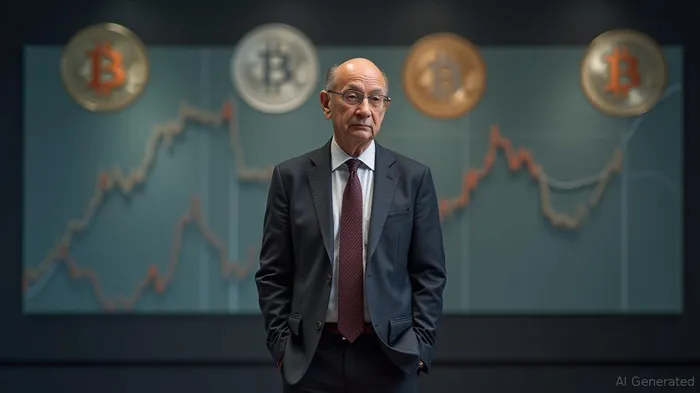
Kenneth Rogoff, a renowned Harvard economist, has publicly admitted to misjudging the trajectory of BitcoinBTC--, a prediction that once drew widespread attention. In 2018, he famously stated that Bitcoin was “more likely” to fall to $100 rather than rise to $10,000. However, by 2025, Bitcoin had surged far beyond his forecast, trading well above $100,000 [1]. This dramatic deviation from his initial assessment has sparked renewed debate over the accuracy of traditional economic models in evaluating digital assets [2].
Rogoff now acknowledges that he underestimated three key factors influencing Bitcoin’s growth. First, he believed the U.S. would introduce clear and sensible crypto regulation early on. In reality, the regulatory landscape has remained inconsistent and reactive, yet the market has continued to expand despite the lack of clarity [1]. Second, he did not foresee how quickly institutional investors and everyday users would adopt Bitcoin, treating it not just as a speculative asset but also as a store of value [2].
Perhaps most notably, Rogoff admitted he failed to appreciate Bitcoin’s resilience against fiat currencies. He had assumed that government-backed money would maintain dominance, but Bitcoin’s performance in regions with inflation or economic instability has demonstrated its utility as an alternative medium of value [3]. The cryptocurrency has defied many traditional expectations, showing that digital assets can serve practical roles beyond speculation [4].
This misjudgment highlights the broader challenges in forecasting the behavior of cryptocurrencies, a market characterized by rapid innovation and speculative investment. Rogoff’s revised stance underscores the limitations of conventional financial frameworks in assessing decentralized assets. It also reflects the growing divide between mainstream economic analysis and the evolving crypto landscape [3].
As Bitcoin continues to gain traction globally, the incident serves as a cautionary tale for financial professionals and analysts. It emphasizes the need for flexibility and continuous adaptation in the face of unpredictable market developments. The cryptocurrency’s performance has not only surprised experts but also reshaped public perceptions of digital assets in global finance [4].
The discussion around Rogoff’s misjudgment is part of a larger conversation about the role of digital currencies in the modern economy. While no specific figures on Bitcoin’s 2025 price were provided, the general trend has clearly outpaced earlier predictions. This highlights the importance of rethinking traditional economic assumptions in the context of rapidly evolving financial technologies [1].
Source:
[1] Bitcoin Prediction: Harvard Economist Rogoff Reflects on ... (https://www.bitget.com/news/detail/12560604920226)
[2] Harvard economist Rogoff reflects on missed Bitcoin ... (https://coinness.com/en/news/81486)
[3] OSL Trading Moments: The market predicts that BTC may ... (https://www.mexc.co/fil-PH/news/osl-trading-moments-the-market-predicts-that-btc-may-fall-to-77000-before-returning-to-a-bull-market-and-altcoins/378)
[4] Access Protocol - HUB (https://hub.accessprotocol.co/en)

Stay ahead of the market.
Get curated U.S. market news, insights and key dates delivered to your inbox.


AInvest
PRO
AInvest
PRO



Comments
No comments yet