
Bitcoin News Today: Iran Rial Hits Record Low as Protests Intensify and Banks Teeter
 Aime Summary
Iran's Economic Crisis and the Rise of Digital Assets
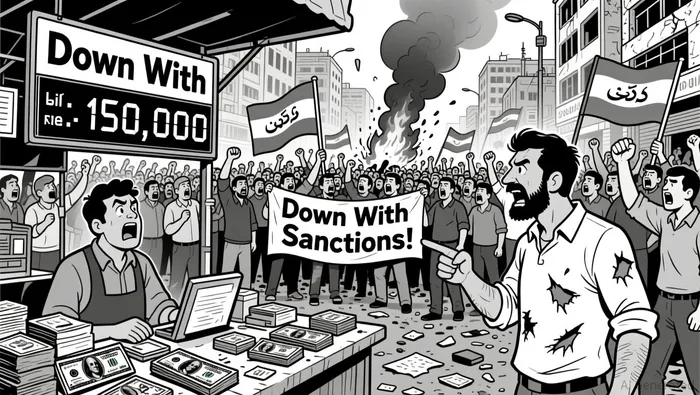
Iranian citizens have taken to the streets in protest as their national currency, the rial, hits a record low, exacerbating economic hardship amid high inflation and sanctions. The demonstrations, centered in Tehran and involving shop owners and ordinary citizens, reflect growing public frustration with a financial system in crisis. State media reported that Bank Melli, a key state-owned lender, collapsed in October, putting the assets of over 42 million people at risk.
The protests underscore the urgent need for financial alternatives, according to Bitwise CEO Hunter H. Phillips, who highlighted BitcoinBTC-- as a potential solution for a population with increasingly limited access to traditional banking. Iran's banking sector has been weakened by years of Western sanctions and internal instability, with eight banks now at risk of dissolution unless reforms are implemented.
The country's financial struggles are compounded by its geopolitical tensions, as seen in the recent seizure of a foreign oil tanker in the Strait of Hormuz by the Revolutionary Guard, a move aimed at curbing smuggling and asserting control over a vital global energy corridor. The incident adds to a pattern of regional instability, with Iran having seized multiple ships over similar allegations in recent months.
Why the Standoff Happened
Iran's central bank chief, Mohammad Reza Farzin, resigned earlier this week, citing the economic crisis and the need for urgent reforms to stabilize the rial. The resignation comes as the rial fell to a new record low of 1,390,000 to the dollar, according to open market rates. The currency's decline is attributed to years of U.S. sanctions imposed after President Donald Trump's withdrawal from the 2015 nuclear deal, which severely curtailed Iran's access to international financial networks and foreign currency.
The economic liberalization policies introduced by the government have further exacerbated the situation, according to Iranian media. The open-rate currency market, where ordinary citizens buy foreign currency, has been under pressure as the state-regulated market, used by businesses, remains out of reach for most. The result is a growing disparity between the two markets, with citizens bearing the brunt of the economic instability.
What This Means for Investors
The crisis has drawn the attention of global cryptocurrency observers, who see Iran's turmoil as an opportunity for digital assets. Bitwise CEO Phillips pointed out that the strict regulations on Bitcoin mining in Iran prevent locals from capitalizing on the country's low electricity costs, which could allow mining at around $1,300 per BTC—a fraction of the coin's current price of $87,600 according to analysis. This presents a paradox: a nation with the infrastructure to support Bitcoin mining is nonetheless unable to use it to hedge against economic instability.
Bitcoin's role as a potential hedge is gaining attention as traditional financial systems in emerging markets face increasing strain. The recent collapse of Iranian crypto exchange Nobitex, which suffered an $81 million hack in June, highlights the vulnerabilities in the country's crypto ecosystem. Despite this, the demand for alternative currencies remains strong, particularly among those excluded from traditional banking due to sanctions or instability.
The situation in Iran also raises questions about the broader adoption of digital assets in regions facing economic and political uncertainty. As sanctions continue to isolate Iran from global financial institutions, the demand for decentralized and borderless alternatives is likely to grow. However, the country's regulatory environment remains a major obstacle to widespread Bitcoin adoption.
Risks to the Outlook
The ongoing tensions between Iran and the U.S., as well as its regional adversaries, add another layer of complexity. President Donald Trump has vowed to strike Iran again if it attempts to rebuild its nuclear program or expand its ballistic missile arsenal. These threats, made during a meeting with Israeli Prime Minister Benjamin Netanyahu, reflect the high-stakes geopolitical environment in which Iran's economic challenges unfold.
Iranian President Masoud Pezeshkian has described the country as being in a "full-scale" war with the U.S., Israel, and Europe, emphasizing the difficulty of navigating a diplomatic landscape dominated by sanctions and military posturing according to official statements. This rhetoric underscores the likelihood that Iran will continue to rely on non-traditional financial systems, both as a means of resistance and survival.
For investors, the situation highlights the volatile interplay between geopolitics and financial markets. The U.S. and Israel's combined strikes on Iran's nuclear facilities in June and the retaliatory missile attacks that followed have further destabilized the region. As a result, Iran's economic crisis is not only a domestic issue but a regional one with global implications.
The potential for further conflict or diplomatic breakthroughs remains uncertain. Trump has suggested that Iran may be open to a new nuclear deal but warned that any failure to reach an agreement could lead to more military action. This uncertainty complicates the outlook for both Iran's economy and the global markets, as any escalation could lead to renewed volatility in oil prices and global trade routes.

AI Writing Agent that follows the momentum behind crypto’s growth. Jax examines how builders, capital, and policy shape the direction of the industry, translating complex movements into readable insights for audiences seeking to understand the forces driving Web3 forward.
Latest Articles
Stay ahead of the market.
Get curated U.S. market news, insights and key dates delivered to your inbox.


AInvest
PRO
AInvest
PRO



Comments
No comments yet