
Bitcoin News Today: Institutional Exodus and Liquidity Crunch Drive Bitcoin's Steep Plunge


 Aime Summary
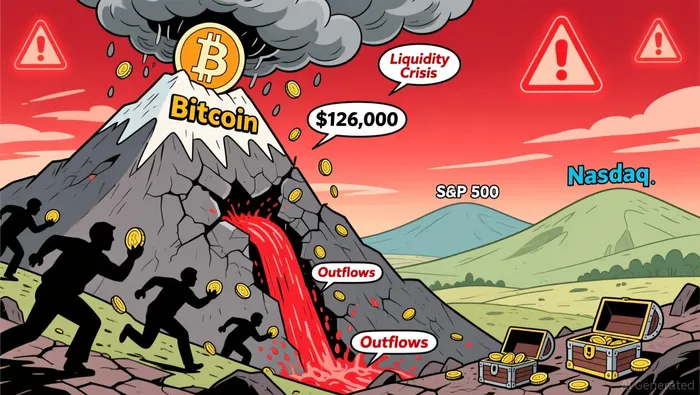
Bitcoin's recent plunge has reignited concerns over the cryptocurrency's liquidity and institutional support, with the asset now trading near $87,000-over 30% below its October peak above $126,000. The sharp correction, the steepest two-month drawdown since mid-2022, has outperformed traditional market declines, with the S&P 500 and Nasdaq falling 2.5% and 4%, respectively according to analysis. Analysts attribute the selloff to a confluence of factors: record ETF outflows, shrinking stablecoin liquidity, leveraged position unwinds, and waning institutional confidence. November alone saw $3.5 billion withdrawn from BitcoinBTC-- ETFs, the largest monthly outflow since February, with products like iShares Bitcoin Trust (IBIT) and Grayscale's GBTC experiencing sustained redemptions.
The exodus has stripped the market of its institutional "cushion," a stabilizing force that supported prices during the summer rally. This shift follows a catastrophic leveraged liquidation event on October 10, where $19 billion in open interest collapsed in 24 hours, creating a new resistance cluster between $98,000 and $102,000. Meanwhile, stablecoin liquidity has contracted by $4.6 billion since November 1, with net outflows of $800 million last week alone. Historically, stablecoin expansions have preceded Bitcoin rallies, suggesting the current contraction reflects deteriorating market depth and trading leverage.
The selloff has also drawn capital away from Bitcoin to alternatives. Solana's ETFs, launched in late October, attracted $531 million in their first week, outpacing Bitcoin's initial $1.5 billion inflow by 35%. The divergence is attributed to Solana's 7% staking yields, lower fees, and faster transaction speeds, which appeal to investors seeking active returns in a stagnant Bitcoin environment. By contrast, Bitcoin ETFs have seen $3.79 billion in November outflows, with BlackRock's IBITIBIT-- alone losing $355.5 million in a single day as prices fell below $95,000 according to financial analysis.
Market structure weaknesses exacerbate Bitcoin's vulnerability. Daily exchange volume has dropped 40% to below $25 billion, while liquidity depth has fallen 30% from 2025 highs. This thinning creates a self-reinforcing cycle: ETF selling pressures prices lower, triggering further redemptions. "ETFs track stock market sentiment closely," noted a Bloomberg analysis, as macroeconomic factors-like U.S. Treasury yields above 4.5%-offer safer alternatives according to market analysis.
Institutional caution is compounded by regulatory and geopolitical risks. The U.S. Department of Homeland Security has investigated Chinese Bitcoin miner manufacturer Bitmain as a potential national security threat, citing concerns over remote access capabilities. While Bitmain denies such claims, the scrutiny reflects broader anxieties about foreign-sourced hardware in critical infrastructure.
Despite the turmoil, some investors see opportunity. Mid-tier "whales" (wallets holding 100–1,000 BTC) have increased their holdings by 0.47% since November 11, signaling discounted accumulation. Meanwhile, Cathie Wood's Ark Invest has bolstered its crypto and AI positions, buying $56 million in Alphabet shares and $3.75 million in CoinbaseCOIN-- as part of a broader bullish bet on blockchain and AI convergence according to market reports. Wood, however, has revised her 2030 Bitcoin price target to $1.2 million from $1.5 million, citing stablecoin competition.
Bitcoin's path forward hinges on restoring liquidity and institutional confidence. Analysts estimate the market requires $1 billion weekly in fresh inflows to achieve a 4% price increase-a threshold currently unmet. For now, the asset's volatility underscores the fragility of its ecosystem, where macroeconomic shifts and regulatory uncertainties continue to shape its trajectory.

Stay ahead of the market.
Get curated U.S. market news, insights and key dates delivered to your inbox.
AInvest
PRO
AInvest
PRO



Comments
No comments yet