
Bitcoin News Today: Institutional ETF Rebalancing Tests Bitcoin's Crucial Support Levels


 Aime Summary
Bitcoin's critical price risk has been flagged by analysts, with a potential 25% dip looming if the asset fails to reclaim key support levels amid shifting institutional dynamics. The recent volatility, marked by a sharp 12% selloff to $80,000 in November 2025, has reignited concerns over market stability. While institutional buyers are rebuilding positions through ETF inflows, the interplay between profit-taking and technical breakdowns suggests a precarious balance for BitcoinBTC--.
The U.S. spot Bitcoin ETF ecosystem has become a focal point for institutional activity, with BlackRock's iShares Bitcoin TrustIBIT-- (IBIT) remaining the dominant vehicle despite recent outflows. Texas's $5 million purchase of IBITIBIT-- shares in November 2025, alongside plans to shift to self-custodied Bitcoin, underscores growing government interest in the asset. However, the state's interim reliance on ETFs highlights structural limitations, as BlackRock's product does not qualify under Texas's reserve criteria for direct BTC ownership. This divergence between ETF exposure and physical Bitcoin holdings is mirrored in broader institutional behavior, where profit-taking has replaced accumulation during recent rallies.
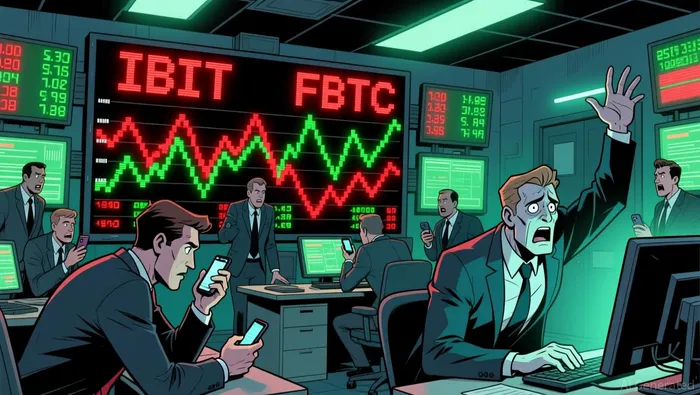
Market data reveals a shift in institutional strategy: while Bitcoin rebounded from $80,000 to $87,600, IBIT posted one of its largest single-day redemptions of the quarter, losing over $66 million in two days. Simultaneously, Fidelity's FBTC captured $171 million in inflows, signaling a rotation between ETFs rather than a flight from the asset class. Analysts interpret this as tactical rebalancing, with investors prioritizing performance gains over aggressive upside chasing. Yet, sustained outflows from IBIT during a price recovery could signal early-stage distribution, where institutional players sell incrementally while retail buyers prop up the market.
 Technical indicators further amplify the risk of a deeper correction. Coinpedia's analysis notes that Bitcoin's price action since 2024 has been confined to a broadening ascending wedge, a pattern historically prone to breakdowns. A slip below the $80,000 thresholdT-- could trigger a 25% decline toward $53,489, as bulls struggle to defend the 2024 high of $70,000–$75,000. This scenario is compounded by macroeconomic pressures, including the Federal Reserve's high-rate environment, which continues to dampen speculative appetite despite expectations of a December rate cut.
Institutional resilience, however, offers a counterpoint. Abu Dhabi's sovereign wealth funds tripled their IBIT holdings in Q3 2025, while November 2025 saw a $238 million inflow into Bitcoin ETFs, reversing weeks of outflows. These moves, coupled with Harvard's $443 million IBIT allocation, suggest long-term confidence in Bitcoin's reserve asset potential. Yet, the divergence between institutional and retail sentiment remains stark: while older, low-turnover investors stabilize the market, retail traders continue trimming exposure, exacerbating liquidity imbalances.
The path forward hinges on ETF inflow persistence and macroeconomic catalysts. If the Fed confirms rate cuts and Bitcoin ETFs return to pre-2024 inflow levels, the asset could reclaim $95,000 by early 2026. Conversely, a failure to break above $90,000–$92,000 resistance risks entrenching bearish momentum, with Abu Dhabi's strategic accumulation and Asian institutional buying unable to offset broader market fragility.

Stay ahead of the market.
Get curated U.S. market news, insights and key dates delivered to your inbox.
AInvest
PRO
AInvest
PRO



Comments
No comments yet