
Bitcoin News Today: Institutional Confidence vs. Speculative Swings: Crypto's High-Stakes Balancing Act
 Aime Summary
Major altcoin whale activity has intensified across global markets, with institutional investors, sovereign entities, and high-stakes traders making strategic moves that highlight both the opportunities and risks in the evolving crypto landscape. These transactions span BitcoinBTC-- accumulation, EthereumETH-- staking, and leveraged trading in altcoins like ZcashZEC--, underscoring a broadening institutional and governmental embrace of digital assets.
Hilbert Group AB, a Nasdaq-listed investment firm, initiated its long-term Bitcoin treasury accumulation strategy in November 2025, purchasing the asset at an average cost of $84,568. The firm emphasized a disciplined, multi-year approach, leveraging market volatility to build Bitcoin holdings gradually. CEO Russell Thompson described the strategy as "conservative and long term," aligning with Hilbert's role as an institutional digital asset manager. This move reflects growing confidence in Bitcoin's utility beyond speculative trading, with Hilbert planning to apply yield-generating strategies to its treasury holdings.
Meanwhile, Bhutan has deepened its integration into the Ethereum ecosystem, staking 320 ETH (worth $970,820) via institutional validator Figment.io. The staking activity, linked to 10 new Ethereum validators, marks the country's largest Ethereum-related transaction since May 2025. Bhutan's government also announced plans to migrate its National Digital Identity (NDI) system from Polygon to Ethereum by early 2026, aiming to enhance security and transparency. With 6,154 BTC (valued at $560 million) already in its reserves, Bhutan's dual focus on staking and infrastructure positions it as a pioneer in blockchain-driven governance.
However, not all whale activity has been bullish. 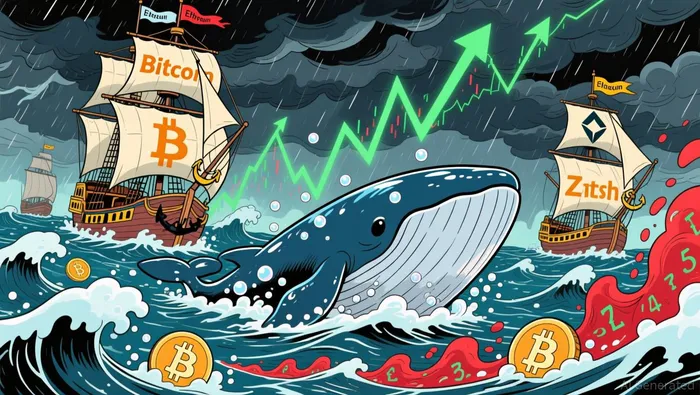 A Zcash (ZEC) trader suffered a $2.38 million loss after leveraged long positions were liquidated following a 6.6% price drop to $474. The incident, one of the largest single-asset wipeouts recorded on HyperTracker, highlights the risks of high-leverage trading in volatile markets. ZEC's price decline was exacerbated by bearish sentiment, with a long/short ratio of 1/1.92 indicating a dominance of short positions. Such liquidations not only impact individual traders but also amplify market volatility, as seen in ZEC's recent 1,000% rally driven by halving expectations and institutional interest.
Other altcoins showed mixed signals. Aave (AAVE) edged higher to $179, extending a four-day recovery from $147 support. The AaveAAVE-- Horizon real-world asset (RWA) lending market saw a 56% month-on-month increase in supply, reaching $581 million, as institutional adoption of tokenized assets gains traction. Conversely, ChainlinkLINK-- (LINK) faced resistance at $14 despite a 3.9% rebound, with whale selling and declining futures open interest signaling caution according to market analysis. On-chain data revealed 31.05 million LINKLINK-- tokens redistributed by whales over three months, a pattern historically linked to market tops.
The interplay between institutional accumulation and speculative trading continues to shape crypto markets. Metaplanet, for instance, drew a $130 million loan to expand its Bitcoin holdings and income-generating operations. Such moves underscore the blurring lines between traditional finance and digital assets, as firms deploy capital to capitalize on yield opportunities.
As whale activity intensifies, market participants must navigate both strategic opportunities and heightened risks. The coming months will test whether disciplined accumulation, like Hilbert's Bitcoin strategy, can outperform the volatility triggered by leveraged bets and macroeconomic shifts.

Stay ahead of the market.
Get curated U.S. market news, insights and key dates delivered to your inbox.


AInvest
PRO
AInvest
PRO



Comments
No comments yet