
Bitcoin News Today: Influencer's Meme Coin Lawsuit Exposes Market's Volatility and Legal Risks


 Aime Summary
Bitcoin's decline below $90,000 has sent ripples through the cryptocurrency market, with memeMEME-- coins bearing the brunt of the downturn. The broader crypto market, which had seen a 1.37% rise in the past 24 hours to $3.16 trillion, remains volatile as investors reassess risk amid uncertainty surrounding the Federal Reserve's upcoming monetary policy decisions. Meanwhile, a high-profile legal sagaSAGA-- involving a Solana-based meme coin has intensified scrutiny on the sector, highlighting ongoing concerns about market manipulation and investor protection.
The lawsuit in question centers on Haliey "Hawk Tuah" Welch, the social media influencer whose viral 2024 interview catapulted her to fame. Welch has been added as a defendant in a federal class action lawsuit over the collapse of the HAWK meme coin, which surged to a $490 million market cap within 15 minutes of its launch before plummeting 93% in value. The amended complaint alleges Welch was paid up to $325,000 to promote the token, which the lawsuit claims was designed to fail from the outset, allowing insiders to profit before the crash. The filing further accuses Welch's company, 16 Minutes LLC, of signing a profit-sharing agreement with Memetic Labs, which received 50% of trading activity revenue tied to the token.
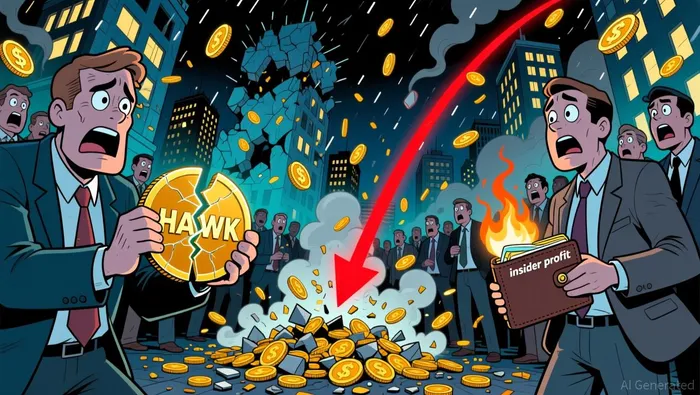 The HAWK token's collapse mirrors other recent meme coin debacles, including the LIBRA token promoted by Argentine President Javier Milei and a Trump-branded SolanaSOL-- token. The lawsuit links these incidents to similar on-chain patterns, suggesting coordinated "rug pulls" orchestrated by pseudonymous wallets. Welch's inclusion in the case marks a significant shift; she had previously cooperated with the law firm Burwick, which initially excluded her to focus on other defendants. The firm now argues her role in marketing the token-described as a "coordinated marketing funnel"-constitutes active participation in misleading retail investors.
Beyond legal woes, meme coins like DogecoinDOGE-- (DOGE) face renewed pressure. Despite stabilization in derivatives markets, DOGEDOGE-- has lost 37% since October's flash crash, trading at $0.1587. Analysts note that while futures open interest has risen, the coin remains vulnerable to further declines unless it holds key support levels above $0.1500. Similarly, the Solana EthereumETH-- Meme (ETHEREUM) token, launched in 2024, trades at $0.00002283 with minimal liquidity, underscoring the speculative nature of the asset class.
Optimism persists, however, among those predicting a Bitcoin-driven rebound. On-chain data suggests whale investors are accumulating while retail traders capitulate-a historical precursor to market reversals. Technical indicators also point to a potential rebound as BitcoinBTC-- tests a critical support level above $90,000. James Thorne of Wellington-Altus draws parallels to Bitcoin's 2019 rally following a government shutdown, suggesting history could repeat.
Regulatory developments add another layer of complexity. The SEC's approval of Dimensional Fund Advisors' dual ETF/mutual fund structure signals growing institutional interest in crypto, though operational challenges remain for automated conversions. Such moves could eventually bolster investor confidence in meme coins by expanding access to diversified strategies.
As the market grapples with volatility, the HAWK lawsuit underscores the risks inherent in meme coin projects. With Welch's case pending and broader macroeconomic factors unresolved, investors remain on edge-balancing hopes for a rebound against the specter of further collapses.

Stay ahead of the market.
Get curated U.S. market news, insights and key dates delivered to your inbox.


AInvest
PRO
AInvest
PRO



Comments
No comments yet