
Bitcoin News Today: HODL Wall's Crucible: Bitcoin's $95K Test Could Dictate $85K Fate


 Aime Summary
Bitcoin's recent plunge below $100,000 has intensified scrutiny of the $95,000 on-chain HODL wall, a critical level where long-term holders (LTHs) have amassed significant supply. The sharp sell-off, which saw $655 million in long liquidations over 24 hours, has exposed fragility in the market's structure, with spot ETFs recording a $961 million net outflow since the start of November according to data. The price drop has shifted a prolonged decline into a more acute sell-off, forcing the market to confront on-chain support levels beneath $100,000.
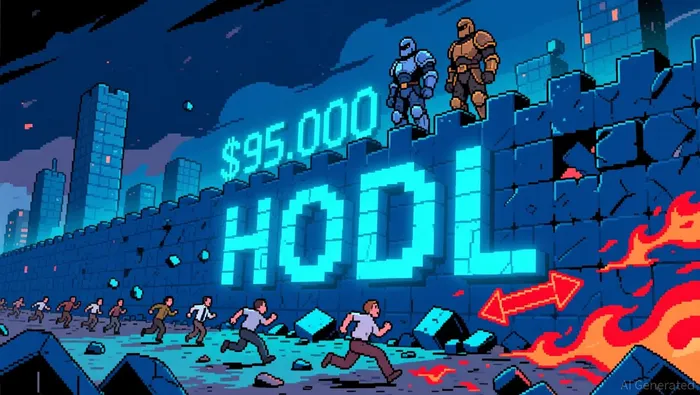
Coinbase data highlights the severity of the move: BitcoinBTC-- fell from a peak of $103,988 to $95,900, leaving it just 2% above the $95,000 HODL wall. On-chain analysis reveals that approximately 65% of invested USD in Bitcoin remains above this level, with short-term holders (STHs) holding coins priced at $95,000 or higher, alongside 30% of LTH supply in the same range. This concentration of value mirrors the dense accumulation seen in late 2021, where overlapping cohorts of seasoned and new buyers created a protracted resolution period. Unlike the speculative peaks of 2017 and 2021, the current structure suggests a more gradual unwinding.
The collapse of the $112,000 STH cost basis has left recent buyers underwater, while LTHs maintain a layered cost-basis ladder just below the highs. Futures unwind and ETF outflows have further thinned support between $106,000 and $118,000, a resistance zone flagged by Glassnode. The key distinction from past cycles lies in the nature of selling: in 2025, unrealized losses account for only half the market cap compared to January 2022, despite Bitcoin nearing the HODL wall. Glassnode data shows STHs have been underwater since October, with their profit-loss ratio dropping below 0.21 near $98,000, indicating over 80% of recent sales occurred at a loss.
The $95,000 level remains pivotal. If long-term holders remain firm, the HODL wall could absorb forced selling from STHs and derivatives markets. However, a clean break below $95,000 would open a clear path to $85,000-the "tariff tantrum" low-before hitting the True Market Mean at $82,000. Unlike the 2022 crash, where the fall from $45,000 to $36,000 was swift and unrelenting, a 2025 decline from $95,000 to the $80,000 range would be shorter and less severe, with demand from the 2024 range still in proximity.
Short-term fundamentals remain fragile. ETF redemptions have replaced year-long inflows, perpetual funding rates and open interest have declined post-October's leverage flush, and options markets now pay an 11% implied volatility premium for puts over calls. The immediate trajectory hinges on LTHs, who control most supply above $95,000. Their resolve could stabilize the wall, allowing time to rebuild demand, while capitulation would accelerate the slide toward $82,000.

Stay ahead of the market.
Get curated U.S. market news, insights and key dates delivered to your inbox.
AInvest
PRO
AInvest
PRO



Comments
No comments yet