
Bitcoin News Today: ETF Dynamics and Macro Risks Test Bitcoin's Stability


 Aime Summary
Bitcoin faces renewed pressure as the asset struggles to hold above critical support levels, with analysts warning of potential further declines. Recent data shows the price dipped below $86,000 on December 1, 2025, marking one of its steepest single-day declines amid a broader global crypto sell-off that [erased $140 billion in market capitalization](https://www.globenewswire.com/news-release/2025/12/01/3196925/0/en/GeekStake-Releases-Market-Brief-as-Bitcoin-Dips-Below-86-000-Amid-Global-Crypto-Sell-Off-on-1st-Dec-2025.html). The downturn was exacerbated by leveraged positions and macroeconomic uncertainties, with altcoins like EthereumETH--, CardanoADA--, and SolanaSOL-- suffering losses exceeding 10% [according to market analysis](https://www.globenewswire.com/news-release/2025/12/01/3196925/0/en/GeekStake-Releases-Market-Brief-as-Bitcoin-Dips-Below-86-000-Amid-Global-Crypto-Sell-Off-on-1st-Dec-2025.html).
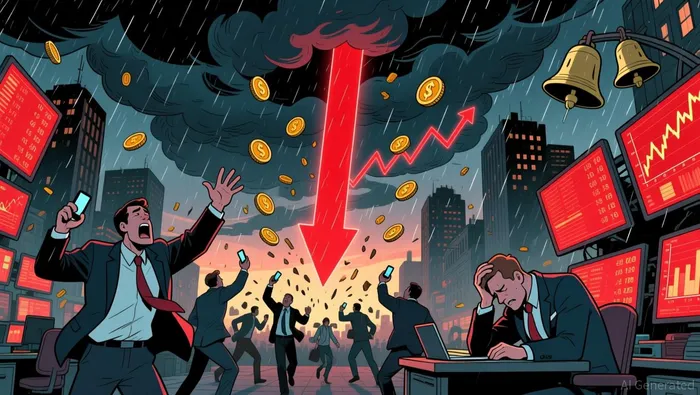
The market's fragility is underscored by BitcoinBTC-- ETF dynamics, which [ended a brutal November](https://cointelegraph.com/news/spot-bitcoin-etfs-end-four-week-outflows-70m-weekly-inflows) with a late $70 million inflow, though this followed four weeks of $4.35 billion in outflows. While the inflow suggests waning seller momentum, the structural role of ETFs as price-setters remains critical. These funds, holding $120 billion in assets, have become pivotal in balancing supply and demand, particularly as miners' daily issuance of 450 BTC creates a constrained supply environment [according to crypto analysts](https://cryptoslate.com/bitcoin-etfs-end-brutal-november-with-a-late-70m-inflow/). Analysts note that even modest ETF inflows can absorb daily issuance multiples, creating upward pressure, while outflows risk reigniting volatility [as market data shows](https://cryptoslate.com/bitcoin-etfs-end-brutal-november-with-a-late-70m-inflow/).
Institutional players are recalibrating expectations. Strategy, a major Bitcoin holder, [reduced its year-end price target](https://www.barrons.com/articles/mstr-stock-price-strategy-bitcoin-buy-4a0daec6) to $85,000–$110,000 from $150,000, reflecting broader caution. The company also [increased its Bitcoin stash](https://www.tradingview.com/news/cointelegraph:d9d9122a7094b:0-strategy-sets-up-1-4b-cash-reserve-lifts-bitcoin-stash-to-650-000-btc/) to 650,000 BTC but cut projected gains to $8.4 billion–$12.8 billion, signaling a shift from aggressive growth to defensive positioning. Meanwhile, [Massimo Group announced](https://seekingalpha.com/news/4526930-massimo-announces-bitcoin-treasury-strategy) a strategic Bitcoin treasury reserve, aligning with a trend of corporations treating the asset as a long-term reserve rather than a core operating holding.
Regional developments highlight crypto's evolving landscape. Brazil's market, driven by stablecoins, now processes $6–$8 billion monthly, with regulators preparing a new DeCripto framework to track transactions under OECD standards [according to market data](https://www.coindesk.com/policy/2025/11/30/stablecoins-drive-90-of-brazil-s-crypto-volume-tax-authority-data-shows). In El Salvador, crypto payments firm Truther is launching a non-custodial USDT Visa card, leveraging the country's bitcoin-legal tender status to expand across Latin America [as reported](https://www.coindesk.com/business/2025/11/29/crypto-payments-firm-truther-to-launch-non-custodial-usdt-visa-card-in-el-salvador). These moves underscore stablecoins' growing role in cross-border commerce, a trend mirrored by Brazil's 90% stablecoin dominance in crypto volume [according to regulatory analysis](https://www.coindesk.com/policy/2025/11/30/stablecoins-drive-90-of-brazil-s-crypto-volume-tax-authority-data-shows).
Despite short-term turbulence, some optimism persists. Cardano's $30 million initiative to onboard tier-one stablecoins and institutional infrastructure aims to address liquidity gaps, though founder Charles Hoskinson cautions against overestimating stablecoin integration's impact [according to the project's roadmap](https://cryptoslate.com/how-cardano-plans-to-use-30m-to-bring-real-liquidity-to-the-network/). Similarly, Bitcoin's ETF inflows, while modest, indicate lingering institutional demand, with [cumulative inflows reaching $57.7 billion](https://cointelegraph.com/news/spot-bitcoin-etfs-end-four-week-outflows-70m-weekly-inflows) since 2024.
The path forward remains fraught with macroeconomic uncertainty. The Federal Reserve's December policy meeting occurs without key inflation data, [creating a "blind flight" scenario](https://cryptoslate.com/bitcoin-etfs-end-brutal-november-with-a-late-70m-inflow/) that could trigger volatility. December's typically thin liquidity further amplifies risks, as institutional participants reduce exposure ahead of year-end. For Bitcoin, the $83,300 support level will be a critical test, with its ability to hold firm likely determining whether the asset enters 2026 with renewed momentum or faces extended consolidation.

Stay ahead of the market.
Get curated U.S. market news, insights and key dates delivered to your inbox.






Comments
No comments yet