
Bitcoin News Today: DOJ's Message: Crypto Anonymity for Crime Faces Prison


 Aime Summary
The U.S. Department of Justice has delivered another blow to the crypto privacy sector, sentencing Samourai Wallet co-founder William Lonergan Hill to four years in prison for his role in operating an unlicensed BitcoinBTC-- mixing service that prosecutors say processed over $237 million in criminal proceeds. The sentence, handed down on Nov. 19, follows a guilty plea from Hill and his co-founder Keonne Rodriguez, who was sentenced to five years in July. The case has become a pivotal moment in the DOJ's broader crackdown on crypto platforms facilitating illicit finance.
Samourai's non-custodial mixing tools, Whirlpool and Ricochet, allowed users to obscure the origins of Bitcoin transactions by pooling and redistributing funds. Despite never holding users' private keys, prosecutors argued that the company exerted "functional control" over transactions through its server-coordinated CoinJoin implementation, violating money transmission laws according to court documents. U.S. Attorney Nicolas Roos emphasized that the sentences "send a clear message that laundering known criminal proceeds-regardless of the technology used-will face serious consequences" according to the DOJ.
The DOJ's legal theory hinges on a broad interpretation of FinCEN regulations, which require money service businesses to obtain licenses. Court documents noted that Samourai's servers "coordinated all Whirlpool transactions" and broadcast anonymized transactions to the Bitcoin network, effectively positioning the service as a middleman in financial transfers. This approach contrasts with traditional custodial models but aligns with the government's increasing scrutiny of decentralized tools that enable anonymity.
Hill and Rodriguez's convictions underscore the risks of operating in regulatory gray areas. Internal communications revealed that Rodriguez actively promoted Samourai's tools to darknet users, touting their utility for "cleaning dirty BTC." In 2020, he publicly encouraged hackers on Twitter to route stolen funds through Samourai's system. The company's legal troubles began in April 2024, when federal agents seized its domain and assets. By September 2024, an open-source alternative emerged to fill the void left by Samourai's shutdown.
The sentencing comes as the DOJ intensifies its focus on crypto crime. Recent high-profile cases include Binance's $4.3 billion settlement, FTX founder Sam Bankman-Fried's 25-year prison term, and BitMEX executives' convictions for AML failures. In April 2025, the Justice Department updated its guidance, raising the bar for prosecuting service providers for users' crimes-but the Samourai case demonstrates that intent to facilitate illicit activity remains a critical factor.
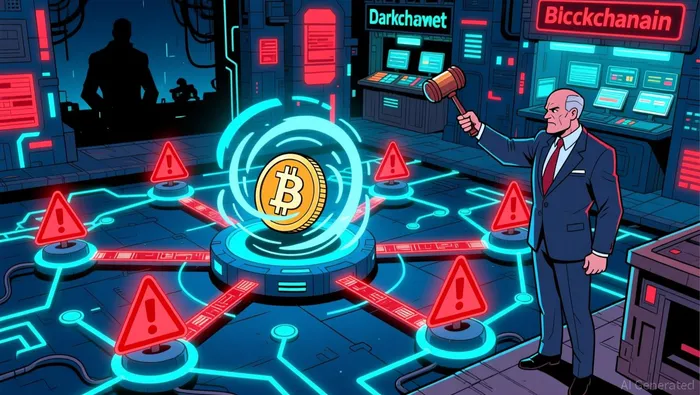
Industry analysts say the ruling could have lasting implications for privacy-focused projects. "The government's message is clear: If your tool is primarily used for criminal purposes, you can't hide behind decentralization," said Jonathan Entin, a constitutional law professor at Case Western Reserve University. Meanwhile, advocates for financial privacy argue that the prosecution sets a dangerous precedent, potentially chilling innovation in decentralized finance.
As the crypto sector grapples with these challenges, the DOJ's enforcement agenda shows no signs of slowing. With $3 billion in digital assets stolen in the first half of 2025 alone, according to Global Ledger, regulators are under pressure to close loopholes that enable rapid laundering. For now, Samourai's founders face prison terms-and a stark reminder that in the eyes of U.S. authorities, enabling financial anonymity for criminals is no longer a theoretical risk but a punishable offense.

Stay ahead of the market.
Get curated U.S. market news, insights and key dates delivered to your inbox.


AInvest
PRO
AInvest
PRO



Comments
No comments yet