
Bitcoin News Today: "Death Cross Signal Stirs Fear of Prolonged Bitcoin Downtrend"
 Aime Summary
Bitcoin’s price action has drawn attention as key moving averages converge, signaling potential for further downward pressure. While the cryptocurrency is currently trading at $114,271.35 per BTC based on the latest exchange data, technical indicators suggest that a bearish trend may persist in the near term. Analysts and market observers have noted the alignment of multiple moving averages, a pattern historically associated with sustained price declines in crypto markets [2].
The recent movement of BitcoinBTC-- USD (BTCFi), a variant of Bitcoin traded as a stablecoin pegged to the U.S. dollar, has mirrored broader BTC price trends. However, unlike traditional Bitcoin, BTCFi is listed on a limited number of exchanges, with Everdex being one of the platforms offering the pair. These exchanges do not consistently demonstrate high trading volumes or strong trust metrics, which could limit market depth and liquidity during periods of volatility [1].
Traders and investors are increasingly turning to both centralized and decentralized exchanges to manage their BTCUSDBTC-- positions. On centralized exchanges (CEX), the process typically involves KYC verification and EUR deposits before executing BTCUSD trades. Decentralized exchanges (DEX) require users to first acquire EthereumETH-- or stablecoins on a CEX, then transfer them to a compatible wallet to facilitate BTCUSD transactions. While DEX platforms offer greater autonomy, they often lack the liquidity and ease of use found on centralized platforms [1].
Despite the availability of multiple trading avenues, Bitcoin’s price remains highly sensitive to macroeconomic factors and broader market sentiment. The Xe Currency Converter reported that as of August 20, 2025, one BTC was equivalent to $114,271.35, with the U.S. dollar buying approximately 0.00000875110 BTC. However, the Xe platform also noted that the mid-market rate is for informational purposes only, and actual transaction rates on exchanges may differ due to fees and market depth [2].
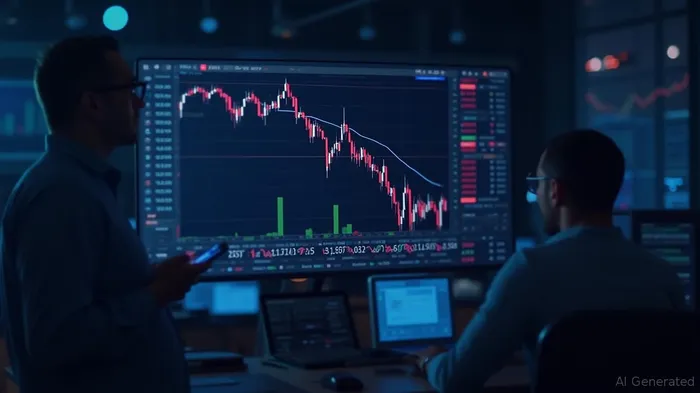
Analysts have noted that Bitcoin’s 200-day moving average, a widely monitored indicator for long-term trends, has crossed below the 50-day and 20-day averages. This convergence, known as a death cross in technical analysis, has historically preceded extended bear markets in equities and has now been observed in Bitcoin. Given the alignment of these key indicators, many traders are preparing for further downside, though it is important to note that such patterns are not deterministic and should be considered in conjunction with broader market conditions [2].
The broader market context also suggests continued caution for BTC holders. The Xe data reveals a lack of volatility in BTC to USD conversions over the last 7, 30, and 90 days, which could indicate a lack of directional momentum. However, the absence of volatility does not necessarily imply stability, as it could also reflect a market in consolidation ahead of a larger move [2].
As the crypto market continues to evolve, investors are advised to closely monitor both technical indicators and macroeconomic developments. The convergence of moving averages, while a notable technical event, should be interpreted within the context of the broader economic environment and regulatory landscape.
Source:
[1] BTCUSD to EUR: Bitcoin USD (BTCFi) Price in Euro (https://www.coingecko.com/en/coins/bitcoin-usd-btcfi/eur)
[2] 1 BTC to USD - Bitcoins to US Dollars Exchange Rate (https://www.xe.com/currencyconverter/convert/?Amount=1&From=BTC&To=USD)

Stay ahead of the market.
Get curated U.S. market news, insights and key dates delivered to your inbox.


AInvest
PRO
AInvest
PRO



Comments
No comments yet