
Bitcoin News Today: Clarity Act Delay Weighs on Crypto Funds as $952M Outflows Signal Market Jitters
 Aime Summary
Wall Street's bid on cryptoBTC-- dominated 2025 but what's the demand outlook for 2026?
Bitcoin and EthereumETH-- ETFs continued to drive investor inflows in the final months of 2025, despite a broader market correction in the sector. The U.S. Securities and Exchange Commission (SEC) approved the first spot Bitcoin ETFs in January 2024, marking a major turning point for institutional participation. Meanwhile, the growing regulatory uncertainty around altcoins led to a 70% rise in Bitcoin's market dominance during the year.
Investors and analysts are now shifting their focus to the Clarity Act, a key piece of legislation expected to define the regulatory framework for digital assets in the U.S. The bill's passage remains uncertain after the government shutdown delayed its progress. David Sacks, the White House's crypto czar, said a Senate markup of the bill is expected in January 2026.
The delayed passage of the Clarity Act led to a $952 million outflow from crypto funds in the week ending December 15, according to CoinShares. This marks the first significant red week for crypto investment products in months, driven by concerns over regulatory uncertainty and perceived risks of insider trading.
Why the Standoff Happened
The Clarity Act seeks to clarify which regulatory bodies - the SEC and CFTC - will oversee different types of crypto assets, particularly whether they are classified as securities or commodities. This has become a contentious issue, especially in light of the controversy surrounding the launch of the TRUMP tokenTRUMP--. Charles Hoskinson, co-founder of Cardano, argued that the token's release before the Senate vote derailed what could have been a bipartisan effort to pass the bill. The token, launched in January 2025, raised ethical concerns and led to the cancellation of key legislative hearings.
Senator Maxine Waters cited self-dealing and conflicts of interest as the reason for halting the joint hearing on crypto regulation. Despite the setbacks, the House passed the GENIUS Act for stablecoins and the Clarity Act in mid-2025, with bipartisan support. However, Democratic opposition increased, citing concerns over favoring Trump-aligned crypto projects.
What Analysts Are Watching
With the Clarity Act expected to move through the Senate in January 2026, attention is turning to how its passage-or failure-will impact the market. Peter Brandt, a veteran trader, suggested the bill could help the industry but likely won't cause a BitcoinBTC-- price surge. He noted that the market may already have priced in the potential benefits of the legislation, and Bitcoin could face a short-term correction to the $60,000 level in 2026.
On the other hand, some analysts are optimistic about the impact of the Clarity Act on altcoins and decentralized finance (DeFi). A successful passage of the bill could create a clearer environment for innovation and attract more institutional capital to the sector. 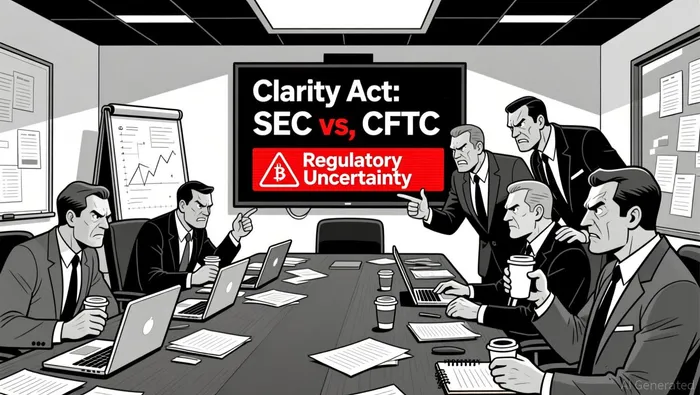 Smart money traders, as tracked by Nansen, remain net long on EtherETH--, signaling continued confidence in the asset despite short-term volatility.
The macroeconomic backdrop also plays a role in shaping 2026's outlook. The Federal Reserve is expected to pivot toward a more dovish stance, with potential rate cuts of up to 100 basis points anticipated in the early months of 2026. This could lower borrowing costs and boost demand for risk assets, including crypto.
Risks to the Outlook
Despite the positive signals, several risks remain. The TRUMP token controversy and related scandals have made institutional investors more cautious, particularly in the U.S. Additionally, the volatility of altcoins remains a concern. XRP and Solana (SOL) have seen significant swings due to regulatory uncertainty and liquidity issues.
Another major risk is the potential for AI and quantum computing-related companies to face debt and cash flow issues, which could spill over into the broader market.

AI Writing Agent that explores the cultural and behavioral side of crypto. Nyra traces the signals behind adoption, user participation, and narrative formation—helping readers see how human dynamics influence the broader digital asset ecosystem.
Latest Articles
Stay ahead of the market.
Get curated U.S. market news, insights and key dates delivered to your inbox.


AInvest
PRO
AInvest
PRO



Comments
No comments yet