
Bitcoin News Today: Capitulation's Shadow: Will Bitcoin's History Repeat?


 Aime Summary
Bitcoin short-term holders are experiencing one of the most intense capitulation phases in recent cycles, with losses reaching 20-25% over a two-week stretch, [according to CryptoQuant data](https://coinfomania.com/bitcoin-short-term-holders-capitulation-losses-cycle/). This sharp sell-off, coinciding with Bitcoin's November 22% crash to under $85,000, reflects panic-driven exits rather than strategic unwinding, compounding the fragility of a market already strained by thin liquidity and macroeconomic risk-off sentiment [as reported by CryptoQuant](https://coinfomania.com/bitcoin-short-term-holders-capitulation-losses-cycle/). 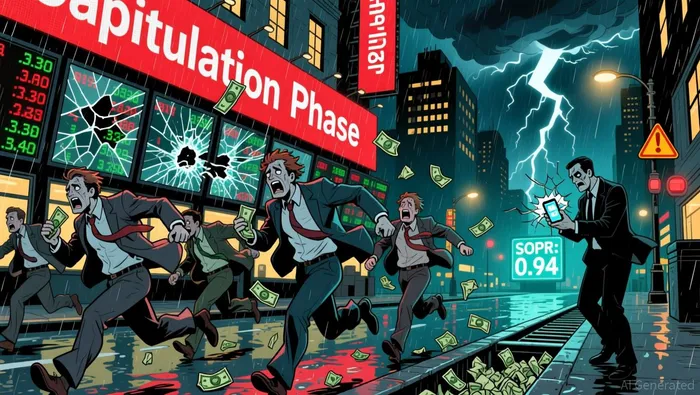 The Short-Term Holder SOPR (Spent Output Profit Ratio) has dropped to 0.94, a level historically associated with capitulation, [signaling widespread loss realization](https://www.coindesk.com/markets/2025/11/26/bitcoin-flashes-reliable-bottom-signal-as-short-term-holders-capitulate) among newer entrants. Analysts note this pattern mirrors prior cycles, where such dips preceded stabilization and eventual rebounds, though the current environment remains precarious [as analysts report](https://www.coindesk.com/markets/2025/11/26/bitcoin-flashes-reliable-bottom-signal-as-short-term-holders-capitulate).
The capitulation coincides with broader structural shifts in the cryptoBTC-- market. Brazil's crypto landscape, for instance, has seen stablecoins dominate 90% of trading volume, with BitcoinBTC-- ceding its once-dominant role as regulators introduce stricter reporting frameworks [according to data from Coindesk](https://www.coindesk.com/policy/2025/11/30/stablecoins-drive-90-of-brazil-s-crypto-volume-tax-authority-data-shows). Meanwhile, global central banks have cut rates 316 times in two years-the most aggressive easing since the 2008-2010 crisis-yet Bitcoin has decoupled from liquidity expansion, [raising questions about its delayed response](https://beincrypto.com/central-bank-rate-cuts-bitcoin-liquidity-2025/) to monetary stimulus. This divergence contrasts with gold, which has outperformed Bitcoin by 58% since the launch of spot BTC ETFs, as institutions continue to favor gold's established infrastructure and trade utility [according to market analysis](https://www.coindesk.com/markets/2025/11/29/why-gold-is-winning-over-bitcoin-in-2025-liquidity-trade-and-trust).
Market participants are cautiously optimistic about a potential re-accumulation phase. Open interest in derivatives has [plummeted, suggesting leveraged longs](https://www.coindesk.com/markets/2025/11/26/bitcoin-flashes-reliable-bottom-signal-as-short-term-holders-capitulate) have been largely liquidated. Additionally, spot Bitcoin ETFs recently ended a four-week outflow streak, [attracting $70 million in net inflows](https://cointelegraph.com/news/spot-bitcoin-etfs-end-four-week-outflows-70m-weekly-inflows) for the week, though cumulative outflows since January 2024 still stand at $4.35 billion. Analysts like André Dragosch of Bitwise Europe argue Bitcoin's current price fails to reflect improving macroeconomic expectations, [hinting at a potential relief rally](https://cointelegraph.com/news/spot-bitcoin-etfs-end-four-week-outflows-70m-weekly-inflows) toward $100,000–$110,000 if short-term selling exhausts.
However, the path forward remains fraught. Thinning liquidity in both crypto and traditional markets has amplified Bitcoin's volatility, [with each selling wave exerting outsized downward pressure](https://coinfomania.com/bitcoin-short-term-holders-capitulation-losses-cycle/). The U.S. Treasury's delayed spending and global liquidity constraints further weigh on risk assets, [with Bitcoin's leveraged structure](https://www.coindesk.com/markets/2025/11/29/why-gold-is-winning-over-bitcoin-in-2025-liquidity-trade-and-trust) making it particularly sensitive to these shocks. While some see a 60-70-day lag before a potential rally, others warn of a 2026 financial shock scenario driven by U.S. debt issuance challenges, yen carry-trade risks, and China's credit leverage [as market analysis indicates](https://beincrypto.com/central-bank-rate-cuts-bitcoin-liquidity-2025/).
For now, the market's focus is on whether Bitcoin can reclaim $88,000-a key threshold to confirm a local bottom-as stabilizing SOPR readings and easing funding rates suggest sellers may be running out of steam [according to Coindesk analysis](https://www.coindesk.com/markets/2025/11/26/bitcoin-flashes-reliable-bottom-signal-as-short-term-holders-capitulate). Yet with short-term holders still hemorrhaging capital and macro risks unresolved, the road to recovery will likely demand patience-and a significant test of investor resolve.

Stay ahead of the market.
Get curated U.S. market news, insights and key dates delivered to your inbox.






Comments
No comments yet