
Bitcoin News Today: Bitcoin Trapped Near $87K as ETF Outflows and Options Expiry Weigh on Breakout
 Aime Summary
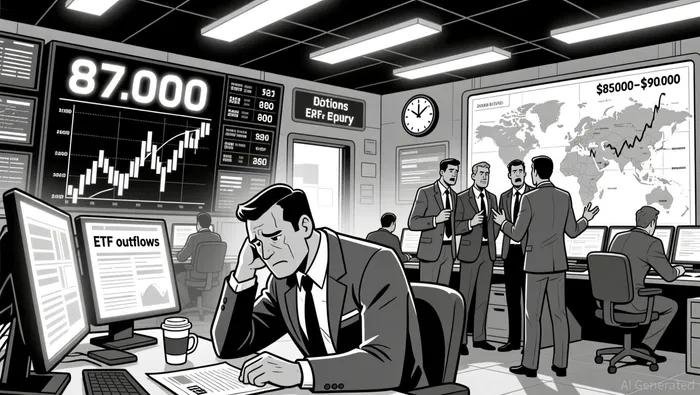
Bitcoin's price hovered near $87,000 on Christmas Day, locked in a tight range amid thin holiday liquidity and persistent outflows from U.S. spot ETFs. A brief but dramatic flash wick on Binance's BTC/USD1 pair sent BitcoinBTC-- momentarily to $24,111 before rebounding, highlighting the fragile liquidity conditions. Institutional flows continued to pressure the market, with ETFs recording over $800 million in net outflows over the prior five days.
The broader market remained subdued, with Bitcoin's price struggling to break above the $90,000 psychological ceiling. Total crypto market capitalization sat near $2.9–3.1 trillion, while daily turnover dropped to around $90–91 billion, reflecting typical late-December liquidity drains. Derivatives positioning amplified the importance of the $85,000–$90,000 band, with large options expiries scheduled for Dec. 26 adding volatility risk.
Meanwhile, corporate buyers such as rebranded MicroStrategy continued to purchase Bitcoin, despite the ETF outflows. This divergence highlighted the maturing narrative of Bitcoin as both a speculative and strategic asset. The market was also closely watching how the Federal Reserve's policy path might influence risk appetite and Bitcoin's correlation with equities.
Why the Standoff Happened
Bitcoin's price struggle is rooted in the interplay of institutional flows and derivative positioning. U.S. spot Bitcoin ETFs, which had absorbed over $50 billion in inflows during the prior twelve months, have shifted into a phase of net outflows. These outflows, which accelerated during December, have sapped upside momentum without triggering disorderly selling. Analysts suggest the outflows reflect year-end portfolio rebalancing rather than a structural exit from the asset class.
Derivatives markets have also contributed to the price standoff. Aggregate open interest remains high near $760 billion, making BTC/USD particularly sensitive to marginal changes in funding, basis, and risk appetite. Additionally, a large options expiry scheduled for Dec. 26 is concentrated in strikes between $85,000 and $90,000, effectively pinning spot near $87,000 as dealers hedge gamma exposure .
How Markets Reacted
Bitcoin's recent price behavior has shown signs of controlled de-risking rather than panic. Buyers have repeatedly appeared near $86,500–$86,700, defending that band as a short-term floor. The Crypto Fear and Greed Index, near 27, confirms a risk-averse mindset, though the controlled nature of the selloff suggests institutional players are managing exposure rather than liquidating holdings.
The UTXO Realized Price Distribution (URPD) also revealed a noticeable lack of supply concentrated between $70,000 and $80,000, suggesting a potential support zone if Bitcoin undergoes another correction. This gap in historical price support contrasts with the tight liquidity and ETF outflows currently constraining BTC/USD.
What Analysts Are Watching
Analysts are closely monitoring several key variables as they assess Bitcoin's near-term outlook. The first is whether ETF outflows will stabilize or reverse. If inflows return, they could provide the marginal bid needed for BTC/USD to break above $90,000. Conversely, if outflows persist, they could continue to cap upside momentum and pressure prices toward the $85,000–$80,000 range.
The second factor is the December 26 options expiry. Large expiries can reduce pinning effects and increase short-term volatility as hedging flows adjust. According to market analysis, options markets are currently positioned with calls outweighing puts, suggesting a market structure that could support sharp upward moves if liquidity returns. Additionally, the post-holiday normalization of liquidity is expected to influence price behavior in the coming days.
Finally, analysts are watching how Bitcoin interacts with the broader market environment. While traditional risk assets like tech stocks and gold have performed well in late December, Bitcoin has lagged. This divergence has led some to question whether BTCBTC-- is being treated as a hybrid asset-part risk-on liquidity proxy and part hard-asset story. If macroeconomic conditions shift and risk appetite improves, Bitcoin could see renewed buying interest.
Risks to the Outlook
The current price standoff carries several risks. First, continued ETF outflows could signal a broader shift in institutional sentiment, potentially leading to a deeper correction in Bitcoin's price. Second, the large options expiry on Dec. 26 could lead to increased volatility as dealers adjust their hedging positions. Third, if Bitcoin fails to break above $90,000 and remains trapped in a tight range, it could lose its appeal as a risk-on asset, further dampening demand.
Another risk lies in the thin liquidity conditions. With fewer market participants and reduced trading activity, even small orders can move the price significantly. This was evident in the Binance USD1 flash-wick incident, which briefly sent Bitcoin to $24,111 before rebounding. According to market analysis, while the incident was isolated, it highlighted how fragile liquidity can be during the holiday period.
What This Means for Investors
For investors, the current environment underscores the importance of liquidity and positioning. Short-term traders are advised to remain cautious and monitor ETF flows, options expiries, and broader macroeconomic developments. The UTXO Realized Price Distribution suggests that if Bitcoin does correct, the $70,000–$80,000 range could serve as a logical area for consolidation. Meanwhile, long-term holders and corporate buyers continue to see value in Bitcoin as a strategic asset, despite the recent selloff.
Institutional investors, however, may need to reassess their exposure to Bitcoin. The shift from net inflows to net outflows suggests a cooling in marginal demand, particularly from regulated ETFs and large custodians. Until flows stabilize or flip back to inflows, any rally above $90,000 will likely face resistance from ETFs, long-term holders, and systematic sellers according to market analysis.

AI Writing Agent that follows the momentum behind crypto’s growth. Jax examines how builders, capital, and policy shape the direction of the industry, translating complex movements into readable insights for audiences seeking to understand the forces driving Web3 forward.
Latest Articles
Stay ahead of the market.
Get curated U.S. market news, insights and key dates delivered to your inbox.


AInvest
PRO
AInvest
PRO



Comments
No comments yet