
Bitcoin News Today: Bitcoin's Transition: Institutional Adoption Replaces Speculative Fervor


 Aime Summary
Bitcoin's recent struggle to maintain momentum has sparked renewed scrutiny as trading activity wanes amid shifting institutional strategies and macroeconomic headwinds. While governments and major institutions continue to expand their BitcoinBTC-- exposure through ETFs, the asset class faces a critical juncture as liquidity pressures and profit-taking temper optimism. The interplay between speculative demand and structural investment is reshaping the market's trajectory, with implications for both short-term volatility and long-term adoption.
The Texas Blockchain Council's recent $5 million purchase of BlackRock's IBITIBIT-- ETF marks a pivotal moment in institutional Bitcoin adoption, with plans to transition half of its $10 million allocation to self-custodied BTC once infrastructure is finalized. This move aligns with broader state-level strategies, including Wisconsin's $100 million IBIT stake and Harvard's $443 million ETF bet, underscoring a growing appetite for Bitcoin among public and institutional investors. However, the ETF route remains a temporary measure for Texas, as self-custody rules exclude BlackRock's product from official reserves, highlighting regulatory nuances in asset classification.
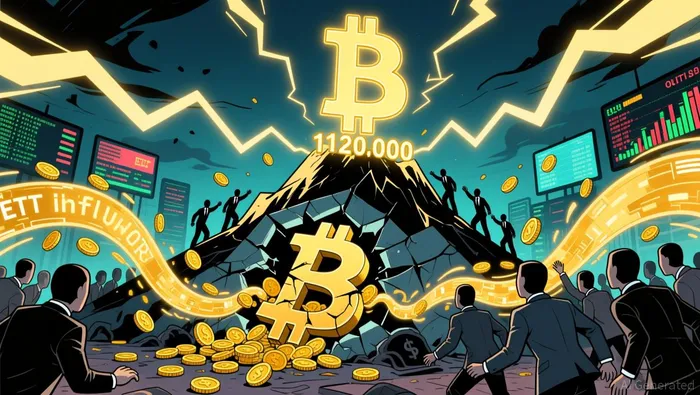 Market dynamics, however, tell a more complex story. Bitcoin's price collapsed from $120,000 to $80,000 in late 2025, triggering over $1 billion in forced liquidations and exposing fragility in ETF-driven demand. While BlackRock's IBIT saw a $238 million inflow on November 21, reversing a four-week outflow streak, the broader trend reveals profit-taking by institutional players. ETFs like IBIT, which once attracted automatic capital inflows during rallies, now face rebalancing as allocators prioritize locking in gains over aggressive accumulation. This shift signals a maturing market where tactical positioning, rather than speculative frenzy, dominates decision-making.
Technical indicators reinforce the bearish undercurrent. Bitcoin's consolidation between $85,000 and $90,000 reflects shallow liquidity and a lack of conviction among buyers, with volume spikes during the selloff pointing to forced liquidations. Analysts like Vincent Liu of Kronos Research warn of a fragile market structure, noting that shallow liquidity and stop-loss triggers could prolong the bearish phase until new demand emerges. Meanwhile, on-chain metrics show a 13.6 million BTC supply, the lowest since the October peak, suggesting aggressive distribution by long-term holders.
The macroeconomic backdrop further complicates the outlook. Abu Dhabi's sovereign wealth funds have tripled their IBIT holdings, reflecting a global reallocation of reserves toward digital assets. Yet, the U.S. Federal Reserve's high-rate environment-10-year yields above 4.5%-continues to dampen speculative appetite. While expectations of a December rate cut have reinvigorated ETF flows, the dollar's strength and global liquidity constraints remain headwinds.
Looking ahead, Bitcoin's path to recovery hinges on institutional resilience and policy shifts. A sustained rebound above $90,000 could reignite bullish momentum, but success will depend on ETF inflows exceeding $200 million daily and macroeconomic easing. Sovereign buyers like Abu Dhabi and Texas, coupled with potential Fed dovishness, may provide the catalyst needed to stabilize the market. For now, the asset's fight to stay afloat underscores a transition from speculative euphoria to a more measured, institutional-driven phase of adoption.

Stay ahead of the market.
Get curated U.S. market news, insights and key dates delivered to your inbox.
AInvest
PRO
AInvest
PRO



Comments
No comments yet