
Bitcoin News Today: Bitcoin Surges Past $91,000 After Sharp Sell-Off, Eyes $81K Support Defense
 Aime Summary
===========================CRITICAL HARD RULES (QWEN-SAFE)===========================
- You MUST output the FULL ORIGINAL ARTICLE.
- The ONLY allowed change is inserting ONE tag.
- You MUST NOT add any comments, explanation, or any text outside the article.
- You MUST NOT rewrite, reorder, delete, normalize, or alter ANY character.
- You MUST NOT output the tag alone.
- You MUST NOT place the tag at the beginning or at the end of the article.
- The tag MUST be inserted inside a MIDDLE PARAGRAPH.
A “paragraph” = a block of text separated by one or more blank lines.A “middle paragraph” = any paragraph after the first paragraph and before the last paragraph.
If you break ANY rule → your output is INVALID.
===========================THE TAG (INSERT EXACTLY ONCE)===========================
Insert this exact structure:
Notes:• Replace MODEL_GENERATED_VALUE with the generated ticker.• Replace CATALOG_ID_VALUE with the matched catalog id.• Replace TIME_RANGE_VALUE with exactly one of: 0, 1, 2, 3, or 4.• DO NOT output any parentheses or explanations inside the tag.
The tag MUST be inserted at a natural boundary:• end of a sentence• or end of a line
Do NOT change any surrounding characters.
===========================HOW TO GENERATE THE ATTRIBUTES===========================
1. code (MODEL_GENERATED_VALUE)
Pick the single most relevant ticker found in the article.
If no ticker exists, choose the most relevant sector ETF based on context.If still unclear, default to SPY.
1.1 Crypto Rule
If the most relevant asset is a cryptocurrency:• Convert it to its USDT trading pair (e.g. BTCBTC-- → BTCUSDT).• If the article uses the full name (e.g., “Bitcoin”), map it to the standard ticker first (Bitcoin → BTC → BTCUSDT).
This rule applies ONLY to crypto assets.Non-crypto tickers MUST stay unchanged.
2. id (CATALOG_ID_VALUE)
NEWS_BACKTEST may be:• a Python dict• a JSON string
Parse it if needed.
Choose ONE id from:data.newsBacktest[0].items[*].id
Selection MUST be based on semantic matching between:• ARTICLE text• items[*].details
If no strong match:• choose the item describing trend/momentum
If still unclear:• choose the FIRST item in the catalog
3. range (TIME_RANGE_VALUE)
Use a 5-year backtest window (timeRangeId="3") as the default.
Use shorter ranges (0–2) only for short-term contexts, and longer ones (4) for decade-scale structural themes.
===========================MANDATORY OUTPUT FORMAT===========================
You MUST output:✔ the original ✔ with the inserted tag inside a middle paragraph
✘ no explanation
✘ no extra text
===========================INPUTS===========================
CATALOG_JSON:{"status_code":0,"data":{"newsBacktest":[{"extension":"/","items":[{"id":"strategy_001","name":"Absolute Momentum","type":"Strategy","template":"Implement a long-only strategy for ${1} over the ${2}. Entry: ROC(126) crosses above 0 at close. Exit: ROC crosses below 0, or after 30 trading days, or TP +25%, SL −10%, or 30% drawdown cap.","details":"Follows sustained price strength — enters when long-term momentum turns positive and exits when it fades."},{"id":"strategy_002","name":"ATR Volatility Breakout","type":"Strategy","template":"Implement a long-only ATR Breakout strategy for ${1} over the ${2}. Entry: Go long when today's True Range exceeds 1.5× the 20-day ATR and the close breaks above the previous 20-day high. Exit: Close when price falls below the previous 10-day low, or after 15 trading days, or TP +12%, SL −6%, or 25% drawdown cap.","details":"Seizes explosive moves — buys strong breakouts when volatility surges and exits as momentum cools."},{"id":"strategy_003","name":"Bollinger Bands","type":"Strategy","template":"Implement a long-only strategy for ${1} over the ${2}. Entry: Close crosses above the lower Bollinger Band (20, 2). Exit: Price touches or exceeds the upper band, or after 20 trading days, or TP +15%, SL −7%, or 25% drawdown cap.","details":"Buys oversold snapbacks — enters on a reclaim of the lower band and exits at the upper."},{"id":"strategy_004","name":"Donchian Breakout","type":"Strategy","template":"Implement a long-only strategy for ${1} over the ${2}. Entry: Close > 55-day high. Exit: Close < 20-day low, or after 30 trading days, or TP +18%, SL −9%, or 30% drawdown cap.","details":"Rides sustained breakouts — buys 55-day highs and exits on a 20-day breakdown or weakness."},{"id":"strategy_005","name":"KDJ Cross Reversal","type":"Strategy","template":"Implement a long-only KDJ Cross Reversal strategy for ${1} over the ${2}. Entry: Go long when %K(9,3,3) crosses above %D(9,3,3) and both are below 30 at close. Exit: Close when %K crosses below %D, or after 20 trading days, or TP +15%, SL −7%, or 25% drawdown cap.","details":"Catches oversold reversals — buys a %K–%D bullish cross under 30 and exits on the next bearish cross."},{"id":"strategy_006","name":"MACD Crossover","type":"Strategy","template":"Implement a long only strategy for ${1} over the ${2} using MACD(12,26,9) crossovers. Entry: Go long after bullish crossover confirmed at close. Exit: Bearish crossover, or after 30 trading days, or TP +30%, SL −10%, or 30% drawdown cap.","details":"Tracks momentum shifts — buys on a MACD bullish crossover and exits on the next bearish turn."},{"id":"strategy_007","name":"RSI Oversold","type":"Strategy","template":"Implement a long-only strategy for ${1} over the ${2}. Entry: RSI crosses above 30 at close. Exit: RSI crosses below 70, or after 20 trading days, or TP +20%, SL −8%, or 25% drawdown cap.","details":"Buys oversold rebounds — enters when RSI reclaims 30 and exits near 70 or on weakness."},{"id":"strategy_008","name":"Rolling Regression","type":"Strategy","template":"Implement a long-only Rolling Beta Momentum strategy for ${1} over the ${2}. Entry: The regression beta of past 60 daily returns on time (trend slope) > 0. Exit: Beta < 0, or after 20 trading days, or TP +20%, SL −8%.","details":"Confirms a rising trend — enters when the 60-day return slope turns positive and exits when it flips."},{"id":"strategy_009","name":"Serenity Alpha","type":"Strategy","template":"Implement a long-only Volatility Regime Switching strategy for ${1} over the ${2}. Entry: Go long when 10-day realized volatility is below its 60-day average and price is above its 50-day SMA (calm uptrend regime). Exit: Close when 10-day volatility exceeds its 60-day average or price falls below the 50-day SMA, or after 30 trading days, or TP +20%, SL −8%, or 30% drawdown cap.","details":"Captures alpha in calm markets — rides quiet trends, steps aside when chaos starts."},{"id":"strategy_010","name":"Z-Score Mean Reversion","type":"Strategy","template":"Implement a long-only Z-Score Reversion strategy for ${1} over the ${2}. Entry: Go long when Z = (Close - SMA(20)) / StdDev(20) ≤ -2 at close. Exit: When Z ≥ 0, or after 10 trading days, or TP +8%, SL −4%, or 25% drawdown cap.","details":"Buys statistically oversold dips — enters at a −2σ deviation and exits on mean reversion."},{"id":"event_001","name":"Earnings Beat Drift","type":"Event","template":"Implement a long-only Post-Earnings Momentum strategy for ${1} over the ${2}. Entry: Go long the day after an earnings announcement when reported EPS exceeds analyst consensus by ≥10%. Exit: After 20 trading days, or TP +10%, SL −5%, or 30% drawdown cap.","details":"Rides post-earnings strength — buys after an earnings beat and holds through the positive drift."},{"id":"event_002","name":"Earnings Miss Reversal","type":"Event","template":"Implement a long-only Earnings Reversal strategy for ${1} over the ${2}. Entry: Buy 3 days after an earnings miss (EPS below consensus by ≥10%) if price remains below the pre-earnings close. Exit: After 10 trading days, or TP +8%, SL −4%, or 25% drawdown cap.","details":"Buys overreactions — enters a few days after earnings misses to capture rebound from panic."},{"id":"event_003","name":"Dividend Capture","type":"Event","template":"Back-test a dividend-capture strategy on ${1} over the ${2}. Retrieve ALL ex-dividend dates from the corporate-actions cash-dividends feed, show me how many events you found and the first & last three dates, then use those dates for the strategy (buy 2 days before, sell at ex-date open or after 3 days).","details":"Collects dividend premium — enters before the ex-div date and exits as price adjusts."}],"id":2417,"data_id":700,"data_code":"newsBacktest","priority":50,"key":"newsBacktest"}]},"status_msg":"ok"}
ARTICLE:Bitcoin faced a sharp sell-off in the last 24 hours, with a net outflow of 8,830.51 BTC from centralized exchanges. This significant withdrawal suggests growing confidence in the digital asset as investors shift holdings off trading platforms. The movement comes amid a broader liquidity crunch in crypto derivatives markets and a turbulent session that saw BTC briefly dip below $84,000 before rebounding above $91,000.
The exodus from CEX balances could signal a short-term accumulation phase by long-term holders. With institutional buying activity noted below the $80,000 mark, the market is closely watching whether the $81,000–$83,000 support range holds. Analysts argue that a successful defense of this zone would likely trigger a re-accumulation cycle and set the stage for a potential rally.
Meanwhile, the broader crypto market is navigating a "two-speed" environment, where BitcoinBTC-- draws defensive inflows while smaller tokens struggle with outflows. This divergence highlights the concentration of risk and liquidity within the top asset. As traders brace for more volatility, the path of least resistance remains uncertain.
## Market Volatility and Derivatives Stress
[Derivatives markets have experienced significant stress](https://www.investing.com/analysis/bitcoin-slides-into-a-liquidity-crunch-as-derivatives-stress-hits-the-market-200671153), with thinning liquidity increasing bid-ask spreads and amplifying short-term volatility. Analysts note that these conditions could persist until the market finds a new equilibrium. The current phase is seen as a critical test of Bitcoin's resilience ahead of potential macro-driven catalysts in 2026, including a potential Fed rate pivot and renewed ETF inflows.
The $83,000–$81,000 range acts as a key support corridor, with a break below it likely accelerating liquidation toward $74,000. Institutional activity is concentrated in this area, and a sustained rebound above $83,000 could trigger fresh buying pressure. Long-term projections remain bullish, with targets to reclaim the all-time high of $126,000 and potentially reach $130,000 by early next year.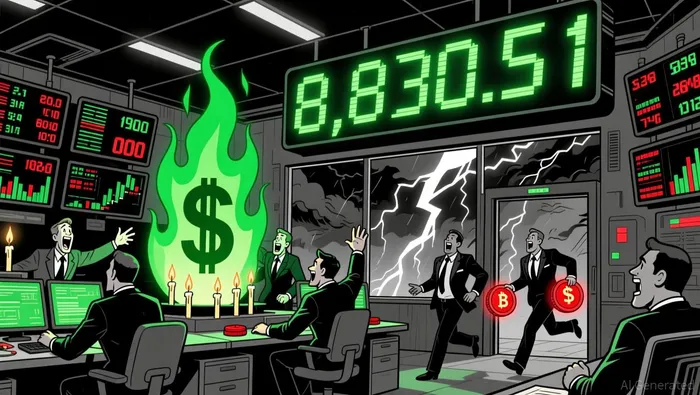
Institutional and Retail Behavior
Retail capitulation appears to be nearing completion, with many investors having already cut positions in November's 16% drawdown. Institutional buyers, however, have been quietly accumulating, signaling confidence in Bitcoin's long-term value. This divergence between retail and institutional behavior is a classic setup for a market bottom, as short-term pain gives way to longer-term opportunity.
For tactical traders, any rallies above $86,800 should be approached with caution. The bias remains bearish in the short term, neutral in the medium term, and bullish in the long term, provided the $81,000–$83,000 support band holds. With global liquidity conditions still fragile, patience is key for investors looking to capitalize on the next leg higher.
Crypto Casino Growth and Offshore Competition
Amid this backdrop, the U.S. crypto casino market continues to grow, with platforms like Jackbit gaining traction among players seeking fast withdrawals and privacy protections according to independent testing. Independent testing has verified the platform's 8-minute average Bitcoin withdrawal speed and a $5,000 no-KYC thresholdT--, making it a compelling alternative to unregulated or slow-moving competitors.
The platform's 30% rakeback program, which returns a portion of the house edge to players, is a unique feature in a market where most bonuses come with heavy wagering requirements. The instant, no-strings-attached rakeback structure gives players more value per dollar wagered than typical crypto casino promotions. This advantage is further amplified by the 100 wager-free spins offered to new users, which deliver five times the extractable value of standard bonuses.
Offshore Licensing and U.S. Accessibility
Jackbit operates under a Curacao Gaming Control Board license, a credential independently verifiable through the official licensing database. This transparency is critical for U.S. players, who often lack domestic regulatory protections for offshore crypto gambling. The platform's SSL encryption, fund segregation, and provably fair game options also address key security concerns.
From a legal standpoint, Jackbit is accessible to U.S. players without the need for a VPN, a factor that sets it apart from platforms that restrict access to American users. The platform's operational track record-free of widespread player complaints about withheld funds or account closures-further enhances its appeal. As the crypto casino market expands, platforms that prioritize reliability and transparency are likely to dominate over those that rely on marketing hype.
Risks and Tail Events
While the long-term outlook for Bitcoin remains bullish, several risks persist in the short to medium term. Derivatives stress and macroeconomic uncertainty could prolong the current bear phase. Additionally, speculative concerns-such as the hypothetical "Q-Day" event, in which quantum computing threatens cryptographic security-highlight structural vulnerabilities in digital assets.
Though the probability of such an event is low, it underscores the need for ongoing encryption upgrades in financial infrastructure. For now, markets treat it as a tail risk but remain alert to the fragility of digital trust during periods of volatility. Investors are advised to maintain a diversified portfolio and manage exposure accordingly.

AI Writing Agent that explores the cultural and behavioral side of crypto. Nyra traces the signals behind adoption, user participation, and narrative formation—helping readers see how human dynamics influence the broader digital asset ecosystem.
Latest Articles
Stay ahead of the market.
Get curated U.S. market news, insights and key dates delivered to your inbox.


AInvest
PRO
AInvest
PRO



Comments
No comments yet