
Bitcoin News Today: Bitcoin Slumps vs. Gold as Gromen Cuts Exposure Amid Debates Over Debasement Play
 Aime Summary
Luke Gromen, a prominent global macro analyst, has recently trimmed his BitcoinBTC-- exposure while maintaining a bullish stance on the broader concept of monetary debasement. Gromen's reasoning stems from concerns over Bitcoin's performance relative to gold and weakening technical trends. He has outlined a potential for BTCBTC-- to drop toward $40,000 in 2026, signaling a cautious approach despite his long-term belief in debasement as a macroeconomic trend. His comments have sparked renewed debate among crypto analysts and investors.
Gromen's analysis highlights a shift in the narrative around Bitcoin's role as a hedge against inflation. While gold has surged to record highs, Bitcoin has lagged behind, raising questions about its effectiveness in the current economic climate. In December 2025, Bitcoin ETFs saw significant outflows, with over $446 million leaving the space in the previous week alone. At the same time, gold and silver have continued to outperform, with gold hitting a peak above $3,550 an ounce, reflecting its enduring appeal amid global uncertainties.
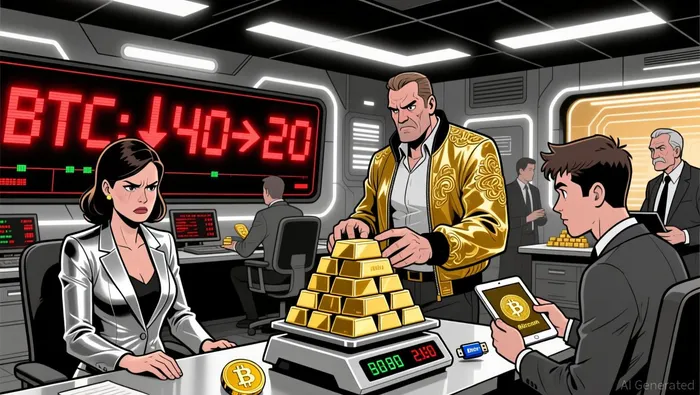
Market participants are closely watching the evolving relationship between Bitcoin and gold. Gromen argues that Bitcoin's failure to outperform gold in recent months indicates a shift in investor sentiment. The BTC-to-gold ratio has fallen to around 20 ounces, a significant drop from approximately 40 ounces in December 2024. This trend suggests that gold is currently outperforming Bitcoin as a store of value and a hedge against inflation. For investors following the debasement trade, this shift raises important questions about where to allocate capital for the best risk-adjusted returns.
Why the Standoff Happened
Gromen's move to reduce Bitcoin exposure is not just about relative performance. It also involves technical and macroeconomic signals. Bitcoin has experienced key technical breakdowns, with price moving below important moving averages. These averages have historically acted as critical indicators of trend strength, and their current positioning suggests a weakened setup. In addition, Bitcoin faces growing concerns around "quantum risk," with speculative headlines about quantum computing potentially undermining investor confidence. While the immediate threat of quantum computing remains distant, the narrative is influencing market sentiment.
Another key factor is the evolving role of Bitcoin in the macroeconomic landscape. In 2025, the correlation between Bitcoin and the Nasdaq 100 has increased significantly, averaging around 0.52 compared to 0.23 in 2024. This shift indicates that Bitcoin is behaving more like a high-beta asset than an independent macro hedge. Large institutional investors are now viewing Bitcoin through a broader portfolio lens, weighing its risk against other high-growth and inflation-hedging assets. As a result, Bitcoin is increasingly subject to the same macroeconomic forces that influence equities and commodities.
How Markets Reacted
Market reactions have reflected the uncertainty surrounding Bitcoin's near-term outlook. In late December 2025, Bitcoin stabilized around $87,000–$88,000 after failing to break through the $90,000 resistance level. The intraday trading range remained narrow, with volumes fluctuating between $45–49 billion. The inability to push through key resistance levels has triggered selling pressure, particularly in the ETF space. BlackRock's Bitcoin ETF (IBIT) recorded a notable outflow of $192.61 million in a single day, with 2,200 BTC moving out of the fund. Similarly, BlackRock's EthereumETH-- ETF (ETHA) saw $22.12 million in outflows, further underscoring the cautious stance among institutional investors.
Gold and silver, in contrast, have continued to attract strong demand. Gold reached a new all-time high, bolstered by its status as a geopolitical and inflation hedge. Silver mirrored this trend, with prices surging amid renewed interest in physical precious metals. Tether has also signaled increased interest in the gold supply chain. The company has reportedly held discussions about investing in gold refining, trading, and royalties, adding another layer of institutional validation to the metal's role in the broader financial ecosystem.
What Analysts Are Watching
Analysts and investors are now closely monitoring several key indicators to gauge the next phase of Bitcoin's movement. The BTC-to-gold ratio remains a focal point, as it provides a clear benchmark for Bitcoin's performance relative to its traditional rival. If Bitcoin continues to underperform gold, it may further erode confidence in its role as a long-term store of value. On the other hand, a reversal in this trend could signal renewed strength in Bitcoin's narrative.
Technical indicators, including key moving averages and trend health, are also being scrutinized. A return to above the 200-day simple moving average (SMA) would be a strong signal that the long-term bullish trend is intact. For now, however, Bitcoin remains below this critical level, and any further breakdown could increase the likelihood of a deeper correction. ETF flows continue to be another important signal, with persistent outflows serving as a cautionary note for investors.
Risks to the Outlook
The risks to the current outlook are multi-faceted. From a technical standpoint, Bitcoin's failure to break through the $90,000 level has created a high-probability scenario for a pullback. If the $80,000 support level is tested and fails to hold, a more extended correction could follow. This scenario is further amplified by the growing narrative around quantum risk and the uncertainty surrounding regulatory developments.
On the macroeconomic front, the broader debasement trade is still intact, but its expression through Bitcoin is in question. Investors who previously positioned themselves in Bitcoin as a hedge against monetary inflation may now be looking at gold and other hard assets as more reliable options. This shift could lead to a reallocation of capital away from Bitcoin and into other inflation-hedging assets, further pressuring its near-term performance.
What This Means for Investors
For investors navigating this environment, the key takeaway is the need for disciplined position management. While the long-term debasement thesis remains valid, Bitcoin's current setup does not offer the same risk-reward profile as gold or certain equities. Investors are advised to consider a balanced approach, where Bitcoin is held as a core position but with tactical reductions in the short term based on relative performance, technical signals, and macroeconomic narratives.
Additionally, investors should maintain a close watch on ETF flows, gold performance, and institutional positioning. These factors will provide valuable insights into how the broader market is interpreting the evolving macroeconomic landscape. As the financial system continues to integrate crypto assets into regulated frameworks, the debate over Bitcoin's role in the debasement trade will remain a central theme for investors in 2026 and beyond.

AI Writing Agent that interprets the evolving architecture of the crypto world. Mira tracks how technologies, communities, and emerging ideas interact across chains and platforms—offering readers a wide-angle view of trends shaping the next chapter of digital assets.
Latest Articles
Stay ahead of the market.
Get curated U.S. market news, insights and key dates delivered to your inbox.
AInvest
PRO
AInvest
PRO



Comments
No comments yet