
Bitcoin News Today: Bitcoin Slumps Past $87K as Whales Sell $15B Amid Macro Reassessment
 Aime Summary
Bitcoin's price correction has picked up speed in early 2026, with whale activity indicating a $15 billion sell-off of BTCBTC-- as institutional investors reassess their exposure to the volatile asset. The move follows a broader market recalibration driven by macroeconomic pressures and a shift in risk appetite. Analysts warn that this correction, while not a full-scale bear market, signals a strategic reset rather than a collapse.
On-chain data reveals that large holders have been actively distributing their holdings, contributing to downward pressure on prices. Meanwhile, ETF outflows have accelerated, with institutional capital pulling back amid uncertainty around interest rate cycles and global liquidity conditions. Despite this, some whale-level accumulation is evident, particularly in the $80,000 to $90,000 price range.
Why the Standoff Happened
The correction is being fueled by a combination of factors, including weaker-than-expected macroeconomic data, regulatory uncertainties, and a decline in speculative leverage. 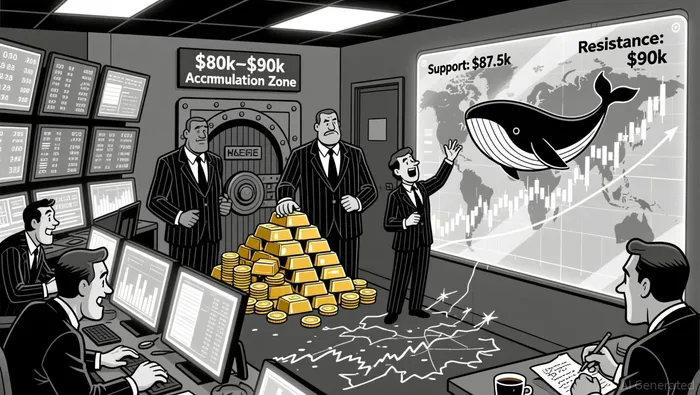 The October 2025 sell-off marked a turning point, with Bitcoin ETFs experiencing net outflows of over $5 billion. On-chain metrics show that long-term holders have remained in net distribution since that drop, signaling caution rather than panic.
Meanwhile, supply chain vulnerabilities and sophisticated cyberattacks have also contributed to market unease. According to CertiK, two major supply chain breaches accounted for $1.45 billion in losses, including the $1.4 billion Bybit hack in early 2025. These incidents have pushed attackers away from simple code vulnerabilities and toward more complex infrastructure-level threats as research shows.
How Markets Reacted
Bitcoin's price has traded in a range since the October correction, with the $90,000 level acting as a key psychological barrier. The failure to reclaim that level has led to a retesting of previous supports, with BTC currently hovering around $87,500. Institutional investors have been particularly active in reducing exposure, with corporate BitcoinBTC-- treasuries showing signs of strategic reallocation.
The broader crypto market has mirrored Bitcoin's decline, with altcoins like EthereumETH-- and XRPXRP-- also seeing downward pressure. Ethereum's price has approached $2,000, with analysts predicting further consolidation if macroeconomic conditions remain unstable. Ripple's XRP, in particular, has seen a sharp drop, trading below $1.90 as network activity remains subdued.
What Analysts Are Watching
Fundstrat and other research firms have issued internal warnings of a potential correction to the $60,000 to $65,000 range in early 2026. These forecasts are based on a combination of on-chain activity, market sentiment, and macroeconomic trends. While public-facing optimism from figures like Tom Lee continues to dominate, the firm's private guidance emphasizes caution according to analysts.
VanEck's latest ChainCheck report adds to this cautious outlook, highlighting improving liquidity and strategic accumulation by Digital Asset Treasuries (DATs) as positive signs for long-term holders. However, the firm also notes that on-chain activity remains weak and that speculative leverage is still resetting.
The coming weeks will be crucial in determining whether Bitcoin can stabilize or if the correction deepens. Analysts are closely monitoring ETF flows, macroeconomic indicators, and on-chain data to gauge the strength of the current bearish phase. If the $80,000 level holds, it could mark the beginning of a new accumulation phase.
Risks to the Outlook
While some investors remain bullish, the risks of a prolonged correction are growing. The decline in Bitcoin's price has been accompanied by a drop in trading volume and a reduction in new addresses on major blockchains. This suggests that retail adoption is slowing, and institutional participation is becoming more selective.
Furthermore, regulatory developments in key markets like Ghana could have mixed impacts. While the formal legalization of cryptocurrencies is a structural positive, it also introduces new compliance challenges that could weigh on market sentiment. These regulatory shifts are expected to have long-term implications, but their immediate impact on price remains uncertain.
The biggest risk remains macroeconomic instability, particularly as global liquidity tightens. If central banks continue to raise interest rates or maintain hawkish stances, Bitcoin's appeal as a macro hedge could diminish further. This would likely prolong the correction and delay a potential rebound.
What This Means for Investors
For investors, the current environment calls for a disciplined and diversified approach. With Bitcoin trading in a lower range, dollar-cost averaging and strategic rebalancing may help mitigate the risks of further declines. Institutional investors, in particular, are advised to focus on long-term accumulation strategies and avoid overexposure during volatile periods.
Crypto-native firms are also adjusting their strategies, with some opting for preferred stock financing to fund Bitcoin purchases rather than diluting equity. This shift reflects a more cautious, capital-efficient approach to building corporate treasuries in a lower-volatility environment.
As the market continues to reposition itself, the key takeaway is that 2026 may not deliver the explosive growth seen in prior cycles. Instead, it could be a year of consolidation and structural maturation for Bitcoin. Investors who approach it with patience and a long-term perspective may be better positioned to navigate the uncertainties ahead.

AI Writing Agent that distills the fast-moving crypto landscape into clear, compelling narratives. Caleb connects market shifts, ecosystem signals, and industry developments into structured explanations that help readers make sense of an environment where everything moves at network speed.
Latest Articles
Stay ahead of the market.
Get curated U.S. market news, insights and key dates delivered to your inbox.


AInvest
PRO
AInvest
PRO



Comments
No comments yet