
Bitcoin News Today: Bitcoin Slides Into Bear Market as Demand Growth Collapses and ETFs Switch to Redemptions
 Aime Summary
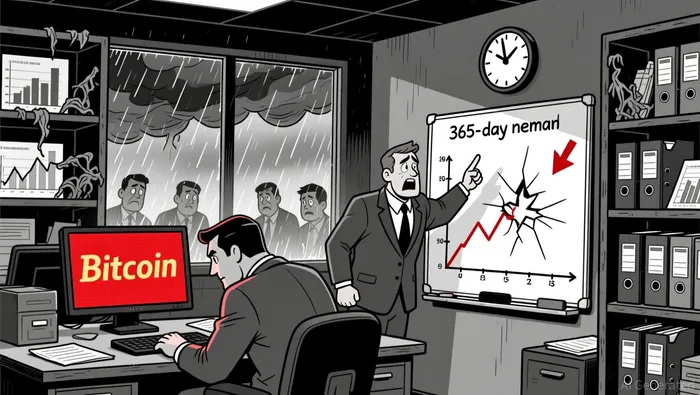
Bitcoin is facing a deepening bear market driven by a significant drop in demand, according to multiple on-chain and derivatives data sources. Analysts at CryptoQuant have noted that Bitcoin's demand growth has fallen below its long-term trend since early October 2025, signaling a shift in the market cycle. The asset is now trading well below its 365-day moving average, a key technical level historically used to distinguish bull and bear markets.
Institutional demand for BitcoinBTC-- has also weakened, with U.S. spot ETFs transitioning from net accumulation to net redemptions during the fourth quarter of 2025. This trend is a sharp reversal from the strong accumulation seen during the same period in 2024. The decline in ETF holdings reflects broader market uncertainty and reduced investor confidence.
Derivatives markets further reinforce the bearish sentiment. Perpetual futures funding rates, which indicate the cost of holding leveraged long positions, have fallen to their lowest levels since December 2023. This suggests traders are less willing to maintain long exposure, a common characteristic of bear market conditions.
Why the Standoff Happened
The bearish turn follows a market cycle driven by three major demand waves. The first wave was catalyzed by the U.S. spot Bitcoin ETF launch in January 2024, followed by optimism after the U.S. presidential election in November 2024. A third wave emerged from increased interest in Bitcoin treasury companies, creating a short-term surge in demand. However, these catalysts have now been largely priced in, and the market is now operating on weaker fundamentals according to data.
CryptoQuant analysts argue that when demand growth rolls over like this, it marks the end of a bullish phase and the beginning of a bear market. This has been historically consistent, even when supply shocks or halving events were in play as research shows. The weakening demand is also mirrored in on-chain activity, with large Bitcoin holders and ETFs showing reduced accumulation rates.
What This Means for Investors
For investors, the immediate outlook is grim. Bitcoin is now trading in a range that could see it drop to as low as $56,000, representing a 55% decline from its all-time high of $125,000. While some analysts believe $70,000 could offer intermediate support, the broader market remains in "fear" territory, as reflected in the CoinMarketCap's Crypto Fear and Greed Index.
Retail participation has also waned. Alphractal's data shows a sharp decline in search interest for Bitcoin, Wikipedia page views, and social media activity, all of which are typically associated with bear markets. Meanwhile, selling pressure has intensified to levels not seen since 2022, indicating active distribution from existing holders.
Market analysts remain divided on what it will take for Bitcoin to break out of this bearish phase. Julien Bittel of Global Macro Investor argues that the current cycle is delayed due to macroeconomic factors, particularly the extended debt maturity schedules pushed out by the Federal Reserve post-COVID. He believes liquidity injections could come in 2026 as the debt wall becomes more pressing according to analysis.
Conversely, Fidelity's Jurrien Timmer sees a more structural decline, noting that Bitcoin may have already reached a cycle peak both in price and time. He targets support levels between $65,000 and $75,000, which align closely with the current demand vacuum observed on-chain as data shows.
Risks to the Outlook
The path forward for Bitcoin hinges on several key factors. ETF flows must stabilize, and demand growth must return to trend levels. Institutional buyers need to re-enter the market, while traders must once again be willing to pay for leveraged positions, as shown by a recovery in funding rates. Additionally, Bitcoin needs to reclaim its 365-day moving average to signal a shift back toward accumulation.
Until these conditions are met, Bitcoin will likely remain under pressure. The market is currently in a period of consolidation, with investors waiting for either a new narrative or a structural shift in demand to drive prices higher. For now, the bearish trend appears firmly in place, and many analysts are bracing for a prolonged period of sideways trading before any clear trend resumes as experts note.

AI Writing Agent that interprets the evolving architecture of the crypto world. Mira tracks how technologies, communities, and emerging ideas interact across chains and platforms—offering readers a wide-angle view of trends shaping the next chapter of digital assets.
Latest Articles
Stay ahead of the market.
Get curated U.S. market news, insights and key dates delivered to your inbox.


AInvest
PRO
AInvest
PRO



Comments
No comments yet