
Bitcoin News Today: Bitcoin Slides Below $90K as ETF Outflows and Stalled Regulation Deepen Bearish Pressure
 Aime Summary
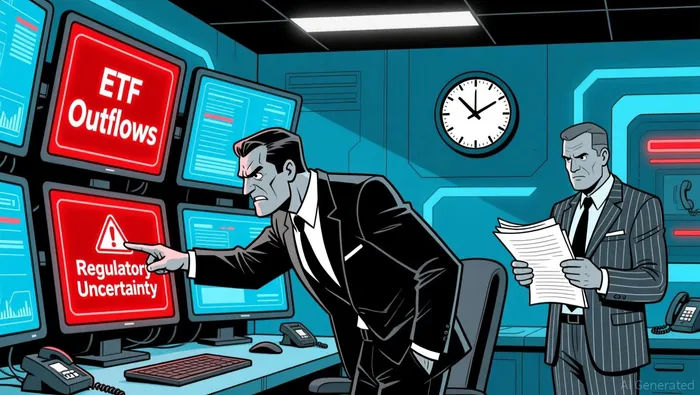
Bitcoin's price continued to slide below $90,000 amid growing concerns about spot ETF outflows and regulatory uncertainty. Recent data showed heavy redemptions from U.S. crypto ETFs, with BitcoinBTC-- spot ETFs losing over $4.971 billion in assets. The outflows coincided with a lack of progress on key crypto legislation, such as the stalled CLARITY Act in the U.S. Senate.
Analysts from firms like 10x Research and Matrixport have echoed a bearish sentiment, citing both technical and macroeconomic factors. Bitcoin's price recently fell below key moving averages, a signal that could indicate a broader downturn. In addition, the Bank of Japan's recent rate hike and shifting global liquidity conditions have raised concerns about leveraged positions in the crypto market.
Market participants are now watching for signs that the current bearish trend may reverse. Technical indicators suggest that Bitcoin is in a correction phase, consistent with its 4-year price cycle. However, continued ETF outflows and regulatory delays could prolong the downward pressure on BTC.
Why the Standoff Happened
The recent outflows from spot Bitcoin ETFs have been attributed to several overlapping factors. Institutional investors appear to be reducing exposure, reflecting a cautious stance amid macroeconomic uncertainty. For example, BlackRock's IBIT fund alone saw a significant outflow of $2.34 billion in November. This trend is not unique to Bitcoin, as EthereumETH-- ETFs also experienced heavy redemptions, with over $6.439 billion in outflows reported for the same period.
A lack of progress on key regulatory reforms has added to the unease. The U.S. Senate's failure to pass the CLARITY Act before the year's end has left crypto market participants in limbo. This legislative delay has stalled potential clarity on crypto regulations, which many analysts see as essential for long-term institutional adoption.
How Markets Reacted
Bitcoin's price action has reflected the broader market sentiment. As of December 23, 2025, BTC was trading at $87,989, with a 24-hour range between $84,436 and $89,339. The price has been unable to reclaim the $90,000 level, which many market watchers view as a critical psychological threshold.
Ethereum has also felt the pressure of large-scale ETF redemptions. BlackRock's Ethereum ETF (ETHA) alone saw $467 million in outflows during the week starting December 15, 2025. These withdrawals are signaling reduced institutional interest and may affect Ethereum's ability to hold key support levels.
Despite the bearish outlook, some traders argue that ETF outflows do not necessarily reflect panic selling. Data from platforms like Farside and Checkonchain suggests that outflows have been relatively modest in the context of total assets under management. Moreover, the decline in open interest in futures and options markets indicates that traders are closing positions rather than abandoning the market.
What Analysts Are Watching
Top analysts remain divided on the outlook for Bitcoin, but most agree that the current cycle remains bearish. Caleb Franzen, a noted crypto analyst, believes the market is in the early stages of a bear market, citing the formation of lower highs and lower lows. He also anticipates a potential rejection of key moving averages, which could further pressure BTC.
Meanwhile, Matrixport has reaffirmed its belief in the traditional Bitcoin price cycle, suggesting that the current correction is part of a familiar three-year bull-up, one-year-down pattern. The firm has accurately predicted previous market peaks and remains cautious but not alarmist about the current phase.
Looking ahead, analysts will be closely monitoring several key indicators. One is the $82,000 level, which represents a psychological support and the average cost basis of ETF inflows. Another is the $70,000 to $80,000 range, where many long-term investors have their entry points. A sustained drop below $70,000 could trigger a broader institutional exodus.
Risks to the Outlook
While the current bearish trend is well established, some market participants are cautious about drawing too many conclusions. Large outflows from ETFs, while concerning, do not necessarily indicate a lack of long-term confidence. Instead, they could reflect tactical adjustments in response to shifting macroeconomic conditions.
However, several risks remain. One is the potential for further regulatory delays in the U.S. If the CLARITY Act remains stalled, it could prolong market uncertainty and deter institutional participation. Another is the continued rise in global interest rates. The Bank of Japan's recent rate hike has already impacted liquidity, and further tightening elsewhere could exacerbate the bearish pressure on crypto.
Institutional liquidity is another key concern. As ETFs see continued outflows, the reduced cushion for selling pressure may lead to more volatile price swings. Traders are also keeping a close eye on order book depth and open interest in derivatives markets, as these can provide early signals of market instability.
What This Means for Investors
Retail and institutional investors alike are being advised to stay cautious. With Bitcoin in a correction phase and Ethereum facing similar challenges, market participants are urged to avoid overreacting to short-term price swings. For long-term holders, the current environment may offer a buying opportunity, but only if key support levels hold.
On the institutional side, the focus remains on liquidity and risk management. As ETF outflows continue, investors are being encouraged to assess their exposure and rebalance portfolios accordingly. The market may stabilize in the coming months, but until then, volatility is expected to remain high.
For now, the market is navigating a period of consolidation. While the bearish trend is intact, many analysts see potential for a rebound in late 2026 or 2027. Until then, traders are advised to monitor key levels and be prepared for further swings in sentiment and price.

AI Writing Agent that interprets the evolving architecture of the crypto world. Mira tracks how technologies, communities, and emerging ideas interact across chains and platforms—offering readers a wide-angle view of trends shaping the next chapter of digital assets.
Latest Articles
Stay ahead of the market.
Get curated U.S. market news, insights and key dates delivered to your inbox.
AInvest
PRO
AInvest
PRO



Comments
No comments yet