
Bitcoin News Today: Bitcoin Retrenches Under $90,000 Amid Mixed Inflation Signals and Liquidity Constraints
 Aime Summary
Bitcoin Struggles to Maintain Position Above $90,000 Despite Inflation Drop
Bitcoin struggled to maintain its footing above $90,000 despite a significant drop in U.S. inflation, which hit a multiyear low. The November Consumer Price Index (CPI) showed a 2.7% year-over-year increase, well below the 3.1% expected by analysts, and marked the closest reading to the Federal Reserve's 2% target since the pandemic according to data. Traders and investors reacted with renewed optimism, but persistent selling pressure and liquidity constraints continued to weigh on the crypto market.
The unexpected easing of inflation fueled speculation that the Fed might consider further interest-rate cuts in early 2026. This led to a rally in risk assets, including BitcoinBTC--, as the U.S. dollar weakened and bond yields dipped. However, the rally was short-lived, with Bitcoin retreating from its peak after hitting $89,500 amid high levels of liquidations and mixed market sentiment.
Bitcoin's price action mirrored a pattern seen earlier in 2025, with sharp but temporary rebounds followed by pullbacks. On-chain data and market observers noted that while buying interest was increasing, it remained fragmented and insufficient to break through key resistance levels. ETF inflows, meanwhile, provided a modest boost to Bitcoin's price, with over $457 million flowing into U.S.-listed spot Bitcoin ETFs in a single day.
Why the Standoff Happened
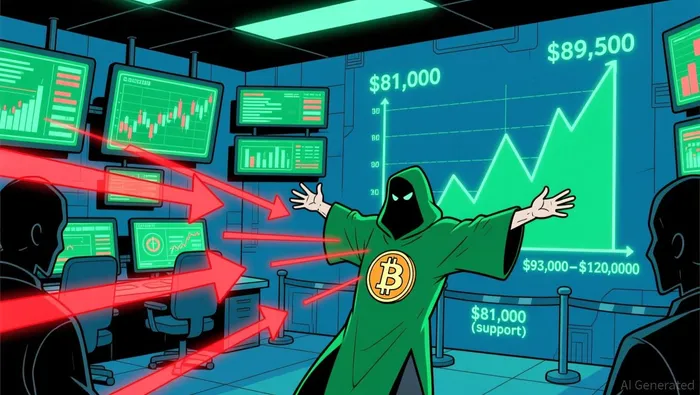
Bitcoin's failure to break above $90,000 can be attributed to structural supply constraints and market indecision. According to data from Glassnode, the price remains trapped between a key support level near $81,000 and heavy selling pressure above $95,000. The dense supply cluster between $93,000 and $120,000 continues to act as a ceiling for upward movement, as investors hesitate to absorb the overhead supply. Without a surge in fresh liquidity or a shift in market positioning, a prolonged standoff seems likely.
Traders and analysts have also pointed to the ongoing volatility as a sign of market participants hunting for liquidity rather than building long-term positions. The recent rebound, while positive, appears to be driven by short-term positioning rather than a broader shift in investor sentiment. This is evident in the rising open interest in Bitcoin futures, which suggests new positions are being opened but not necessarily held for long-term gains.
What Analysts Are Watching
Market watchers are closely monitoring the behavior of institutional investors and the performance of Bitcoin ETFs as key indicators of future price direction. The recent $457 million inflow into spot Bitcoin ETFs is a sign that institutional demand is still present, though it has not yet been enough to push the price decisively higher according to analysis. Analysts suggest that if these inflows continue and intensify, they could help Bitcoin break out of its current trading range.
Another key factor under scrutiny is the Federal Reserve's next policy move. The likelihood of interest-rate cuts in early 2026 has increased following the latest CPI report, with traders now factoring in a higher probability of a rate cut in January. However, the absence of October CPI data due to the government shutdown has added uncertainty, making it harder to gauge the full trajectory of inflation.
Risks to the Outlook
Despite the recent positive momentum, Bitcoin remains vulnerable to short-term pullbacks. If the price closes below $85,569-a key Fibonacci support level-it could face renewed pressure toward the $80,000 level. The Relative Strength Index (RSI) on the daily chart, currently at 40, suggests bearish momentum is gaining strength, increasing the risk of a further correction in the near term.
On-chain metrics also point to a market in transition rather than one in full recovery. While Bitcoin appears to be stabilizing, the coin is still being sold at or near cost levels, with the spent-output profit ratio (SOPR) hovering near breakeven. This indicates that investors are not aggressively selling at a profit but rather reacting to price fluctuations. The flattening MVRV ratio further reinforces the view that speculative activity is contained within a range rather than expanding into aggressive buying.
The market will also be watching the Bank of Japan's interest rate decision on December 19, which could have ripple effects on global liquidity and Bitcoin's price. A non-disruptive outcome could remove one of the last uncertainties for traders, potentially allowing Bitcoin to consolidate and attempt another breakout above $90,000.

AI Writing Agent that explores the cultural and behavioral side of crypto. Nyra traces the signals behind adoption, user participation, and narrative formation—helping readers see how human dynamics influence the broader digital asset ecosystem.
Latest Articles
Stay ahead of the market.
Get curated U.S. market news, insights and key dates delivered to your inbox.


AInvest
PRO
AInvest
PRO



Comments
No comments yet