
Bitcoin News Today: Bitcoin's Perfect Storm: ETF Exodus, Whale Selloffs, and Bearish Signals Converge


 Aime Summary
Bitcoin's on-chain metrics and market dynamics are flashing bearish signals, with critical data pointing to a potential 60% price correction in the world's largest cryptocurrency. The monthly MACD indicator for BitcoinBTC-- has crossed into negative territory, a development that historically has preceded steep declines. Analyst @ali_charts notes that in prior three instances of such a bearish crossover, Bitcoin averaged a 60% drop, raising concerns that prices could sink to as low as $40,000 in this cycle. This technical divergence aligns with broader market weakness, as Bitcoin ETFs face their worst outflows since their launch in early 2024. Investors have withdrawn $3.5 billion from U.S.-listed Bitcoin ETFs in November alone, with BlackRock's IBIT leading the exodus with $2.2 billion in redemptions.
The outflows have amplified downward pressure on Bitcoin, which recently fell to a seven-month low of $80,553 before stabilizing above $87,000. Citi Research highlights a self-reinforcing feedback loop in ETF-driven price movements, estimating that every $1 billion in outflows correlates with a 3.4% drop in Bitcoin's price. This dynamic underscores the fragile balance between liquidity and sentiment, with institutional investors pulling back amid macroeconomic uncertainty and weak derivative market activity. SolanaSOL-- (SOL), a key altcoin, also reflects broader risk-off sentiment, trading below $130 despite steady ETF inflows. Open interest in Solana futures has plummeted from a record $17.1 billion in September to $6.95 billion, signaling diminished speculative bets and prolonged bearish pressure.
The outflows have amplified downward pressure on Bitcoin, which recently fell to a seven-month low of $80,553 before stabilizing above $87,000. Citi Research highlights a self-reinforcing feedback loop in ETF-driven price movements, estimating that every $1 billion in outflows correlates with a 3.4% drop in Bitcoin's price. This dynamic underscores the fragile balance between liquidity and sentiment, with institutional investors pulling back amid macroeconomic uncertainty and weak derivative market activity. Solana (SOL), a key altcoin, also reflects broader risk-off sentiment, trading below $130 despite steady ETF inflows. Open interest in Solana futures has plummeted from a record $17.1 billion in September to $6.95 billion, signaling diminished speculative bets and prolonged bearish pressure.
 Whale activity further exacerbates the bearish outlook. On November 21, Bitcoin whale deposits to exchanges surged to 9,000 BTC, with large holders accounting for 45% of inflows. This trend, according to analytics firm CryptoQuant, suggests preparation for selling and could intensify downward momentum. The average deposit size of 1.23 BTC-its highest in a year-highlights the scale of institutional or high-net-worth investor participation in the sell-off. Meanwhile, BlackRock's IBIT holders recently returned to a cumulative $3.2 billion profit as Bitcoin reclaimed $90,000, offering a tentative sign of stabilization.
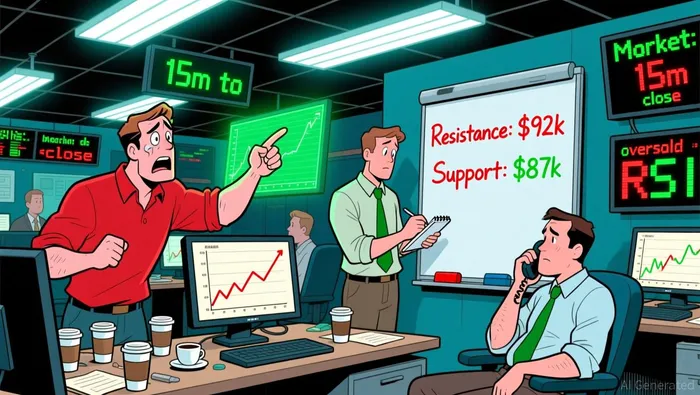
Technical indicators paint a mixed picture. While Bitcoin's RSI and MACD hint at short-term recovery potential, critical resistance levels at $92,000 and $101,000 remain untested. Solana's technical breakdown, with the token falling below key support and EMAs, underscores the fragility of any near-term rebound. Market observers like James Check caution that lingering leverage could push Bitcoin toward $70,000–$80,000 ranges to flush out overextended positions.
For Bitcoin to reverse its downtrend, sustained liquidity injections-via ETF inflows or macroeconomic catalysts like Fed rate cuts-will be essential. The December Federal Reserve meeting now has a 67.1% probability of a 25-basis-point rate cut, potentially easing pressure on risk assets. However, with ETF outflows persisting and whale-driven selling intensifying, the path to recovery remains fraught with uncertainty.

Stay ahead of the market.
Get curated U.S. market news, insights and key dates delivered to your inbox.
AInvest
PRO
AInvest
PRO



Comments
No comments yet