
Bitcoin News Today: Bitcoin's Paradox: Idle Capital, Thin Liquidity Stifle Breakout Ahead of Fed Decision
 Aime Summary
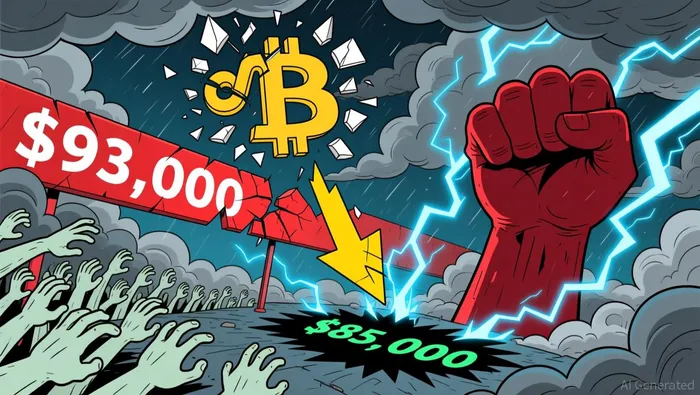
Bitcoin's recent price action has highlighted a critical imbalance in market dynamics, with weak spot buyer participation and thin liquidity preventing a sustained breakout above the $93,000 resistance level. Despite a brief spike to $93,300 last week, the cryptocurrency has since retreated below $85,000, underscoring the fragility of bullish momentum according to analysis. Analysts attribute this stagnation to a combination of onchain cost-basis clusters, underperforming short-term holders, and a lack of fresh buying pressure in the $84,000–$90,000 range as research shows. The failure to close above $93,000 has invalidated a potential trend reversal, leaving BitcoinBTC-- trapped in a volatile range between $80,600 and $96,000 according to market analysis.
A key indicator of pent-up demand is the Binance "Bitcoin to Stablecoin Reserve Ratio," which has plummeted to its lowest level since 2018. This metric suggests that stablecoin reserves on the exchange have surged to unprecedented levels relative to Bitcoin, signaling idle capital ready to deploy into BTC according to reports. Historically, such extreme ratios have preceded major rallies, as seen in 2020 and 2023 as data shows. However, current spot demand remains weak, with the market caught in a paradox: while the stablecoin overhang implies significant buying power, liquidity constraints have prevented its activation according to analysis. This imbalance has led to sharp corrections, such as the 5% drop to $85,970 in early December, driven by algorithmic resets and liquidation waves according to price analysis.
The broader macroeconomic landscape adds complexity. U.S. spot Bitcoin ETFs, which have dominated price discovery since their launch, ended November with $3.5 billion in net outflows-the largest monthly redemptions since February. BlackRock's IBIT, the sector leader, accounted for $2.3 billion of these outflows, reflecting a tactical retreat by institutional investors according to reports. Yet, cumulative inflows since January 2024 remain robust at $57.7 billion, suggesting underlying demand is intact. The ETF structure itself acts as a multiplier, as even modest inflows can absorb the daily issuance of miners, creating a leveraged effect on price according to market analysis.
Looking ahead, the market faces a critical juncture ahead of the Federal Reserve's December 9–10 FOMC meeting. With Bitcoin's price rangebound and liquidity thin, traders are likely to remain cautious as they await signals on interest-rate policy according to analysis. A retest of the $80,600–$84,000 support zone could provide a constructive base for a rebound, but an immediate attempt to reclaim $93,000 risks triggering further selling according to market data. Meanwhile, on-chain data from Hyblock Capital and Captain Faibik highlights the importance of volume confirmation during breakouts, as a successful rally above $93,000 could target $100,000 according to on-chain analysis.
The interplay between technical indicators and macroeconomic uncertainty underscores Bitcoin's current vulnerability. While the Binance reserve ratio and stablecoin liquidity hint at eventual upside, the lack of coordinated spot buying and the fragility of ETF flows mean the path forward remains fraught with volatility. Investors will need to monitor both on-chain metrics and central bank policy to navigate the precarious balance between consolidation and breakout potential.

Stay ahead of the market.
Get curated U.S. market news, insights and key dates delivered to your inbox.


AInvest
PRO
AInvest
PRO



Comments
No comments yet