
Bitcoin News Today: Bitcoin Mining Taps Surplus Renewables to Optimize Grids in Uganda, Ethiopia
 Aime Summary
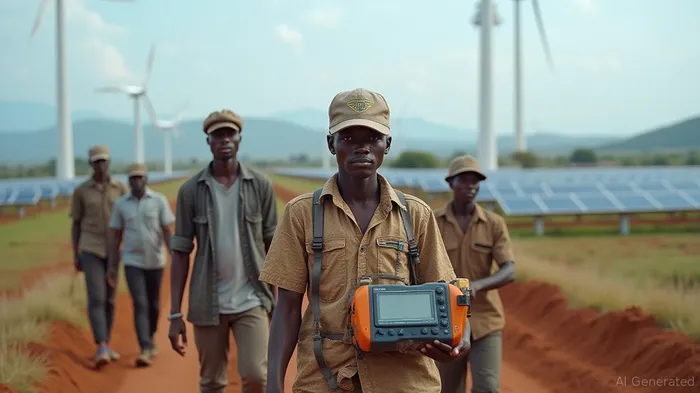
Bitcoin mining, long criticized for its energy consumption, is emerging as a tool to optimize electricity grids by leveraging surplus renewable energy. The concept, rooted in historical experiments with energy-backed currencies, has evolved with Bitcoin’s ability to address prior failures of centralization and property rights. Today, countries like Uganda and Ethiopia are exploring BitcoinBTC-- mining as a strategy to monetize unused energy capacity, enhance grid efficiency, and attract foreign investment.
The idea of energy-backed money dates to 1921, when Henry Ford and Thomas Edison proposed replacing gold with a currency tied to electrical energy. However, their plan failed due to centralization and lack of self-sovereign property rights—issues Bitcoin resolved through decentralized consensus and cryptographic security. Unlike earlier attempts, Bitcoin’s Proof-of-Work mechanism ensures that energy consumption is both a security feature and a tool for decentralization. This innovation has positioned Bitcoin as the first successful energy-backed digital currency, recognized as an asset in multiple jurisdictions, including the U.S. [1].
Current applications of Bitcoin mining in energy grids focus on two paths: institutional adoption as a store of value and utility-driven integration as a medium of exchange. While the former capitalizes on Bitcoin’s scarcity, the latter seeks to anchor its value to real-world economic activity. A notable example is Uganda, which has a 1.060 gigawatt (GW) surplus in electricity generation. By directing this surplus toward Bitcoin mining, Uganda could transform its underutilized hydroelectric capacity into a revenue stream. The country’s 84% reliance on hydropower, combined with increasing grid availability in rural areas, makes it an ideal candidate for Bitcoin-powered energy utilization [1].
Ethiopia provides a relevant model. With 90% of its electricity from hydropower and a generation capacity of 5,200 MW, Ethiopia has already allocated 2.5% of the global Bitcoin hash rate. Despite low energy costs ($0.01 per kWh), miners are charged higher rates ($0.032/kWh), generating foreign currency for the government. This approach not only monetizes surplus energy but also stabilizes the grid by creating a consistent demand anchor during off-peak hours. Uganda could replicate this by designating zones near hydropower stations like Karuma and Isimba, dedicating 300–500 MW to mining operations [1].
Regulatory frameworks are critical for success. Ethiopia’s model includes a multi-agency task force to ensure grid stability, internet infrastructure, and security. Similarly, Uganda could establish a task force involving regulators, energy agencies, and financial authorities to create designated mining zones. Tax incentives, such as 5–7-year holidays for green-powered miners, and funding for micro-mining cooperatives would further incentivize adoption. Crucially, Bitcoin mining’s energy intensity can improve load factors, reduce average electricity costs, and accelerate grid modernization [1].
Challenges remain, particularly in regulation. A phased approach is recommended: first legalizing mining as a digital commodity operation under strict renewable energy mandates, followed by enabling foreign remittances via cryptocurrencies. This framework balances innovation with oversight, ensuring compliance with environmental, social, and governance (ESG) standards.
The potential for Bitcoin to enhance energy grids is not limited to Africa. Nations with surplus renewable energy—such as those with underutilized wind, solar, or hydro resources—can adopt similar strategies to stabilize grids, reduce waste, and attract investment. By transforming energy surpluses into productive assets, Bitcoin mining could redefine the relationship between digital currencies and infrastructure development.
Source: [1] [Bitcoin Mining Could Make Our Electricity Grids Smarter] [https://hackernoon.com/bitcoin-mining-could-make-our-electricity-grids-smarter]

Stay ahead of the market.
Get curated U.S. market news, insights and key dates delivered to your inbox.


AInvest
PRO
AInvest
PRO



Comments
No comments yet