
Bitcoin News Today: Bitcoin Miners Capitulate as Hashprice Slumps 35% and Costs Rise
 Aime Summary
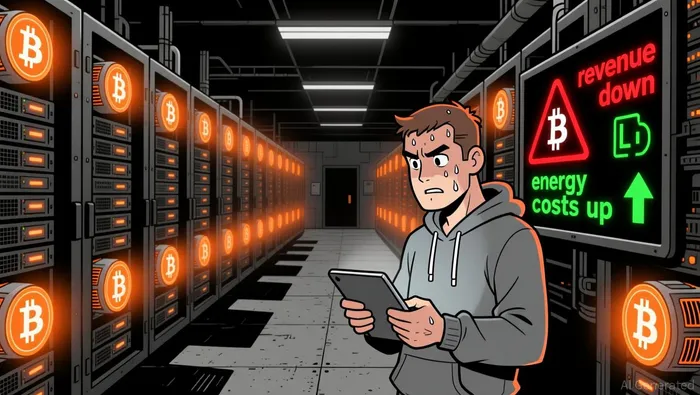
Bitcoin mining operations are facing a severe revenue crunch as hashprice - a measure of daily mining revenue per unit of computing power - has dropped roughly 30–35% in recent months. The decline has pushed many miners into negative cash flow, with production costs hovering near $44 per PH/s/day while revenue remains under $38 per PH/s/day. Industry analysts warn that only the most efficient and well-capitalized operations will likely survive the coming months.
Energy costs have become a critical bottleneck, with many miners struggling to operate profitably without access to ultra-low electricity rates. For example, rigs running at 17–22 joules per terahash (J/TH) need electricity prices below $0.05–$0.06/kWh to break even. Operators with older or less efficient hardware are increasingly turning off machines or selling them to avoid further losses according to analysis.
The hash ribbon indicator, a technical metric used to track BitcoinBTC-- hashrate trends, recently confirmed a significant miner capitulation event. The signal, triggered when the 30-day hash rate moving average dips below the 60-day average, suggests widespread miner shutdowns and Bitcoin liquidations. Historical data shows that such capitulation periods often precede a rebound in both hashrate and price.
Regulatory Moves in the Mining Sector
Regulatory developments are reshaping the crypto mining landscape, especially in Russia, where the government has taken steps to formalize oversight. The Ministry of Energy recently created a registry of cryptocurrency mining equipment, aimed at identifying and regulating mining operations under new tax and regulatory rules. Deputy Energy Minister Petr Konyushenko stated the initiative would help track electricity consumption and ensure compliance with national standards.
The move is part of a broader effort to legalize and bring order to the sector. Under the new rules, businesses and entrepreneurs must register with tax authorities to operate mining facilities, while private citizens can still mine as long as they stay within government-defined electricity limits. Russia's embrace of crypto mining has been growing over the last few years, with this registry marking a new phase of institutional involvement according to industry sources.
Geopolitical and Energy Market Pressures
In the U.S., Bitcoin mining is also encountering headwinds from energy grid constraints. Texas's ERCOT grid, a hub for crypto and data centers, has seen a 270% surge in interconnection requests in 2025, driven by the growing demand for AI and high-performance computing. While cryptocurrency mining accounts for roughly 9% of the requests, the influx has raised concerns about grid stability and the need for infrastructure upgrades.
Energy prices have also spiked, with winter storms in Texas pushing electricity prices to $200 per megawatt hour in recent weeks. This has forced miners to curtail operations or shift to alternative energy sources. In response, firms like Luxor and IRENIREN-- are exploring diversification into GPU trading and AI hosting to offset declining Bitcoin revenues according to market analysis.
Outlook for Miners and Markets
Miner survival depends on a combination of factors: access to low-cost electricity, the use of highly efficient hardware, and strong financial reserves. Companies that can pivot into alternative computing markets, such as high-performance computing (HPC) and AI hosting, may see new revenue streams. For example, IREN has secured large contracts with Microsoft and Dell, while Core Scientific and others are rebranding as AI infrastructure providers.
Bitcoin's price movement remains tied to broader macroeconomic factors, particularly Federal Reserve liquidity policies. Analysts suggest that a signal from the Fed toward balance-sheet expansion could reignite structural demand via ETF inflows, providing a much-needed boost to the mining sector. However, without clear policy support, the market is expected to remain in consolidation through Q1 2026.
Risks to the Outlook
The current environment presents multiple risks for both miners and investors. As the network difficulty remains near record highs, even minor price drops could push more miners into unprofitability. Additionally, the hashprice's prolonged suppression has led to a sharp increase in mining rig payback periods - now averaging over 1,000 days. This has made new equipment investments unattractive and discouraged further expansion according to data.
Regulatory uncertainty remains a wildcard, particularly as governments like India consider limiting private sector involvement in critical sectors such as uranium mining according to reports. These policy shifts could ripple into other digital asset markets, particularly those reliant on energy-intensive processes.
What This Means for Investors
For investors, the outlook is mixed. While large, well-capitalized miners with diversified operations may see long-term gains, smaller players and speculative bets are at risk of being washed out. The recent market corrections have already led to significant asset liquidations, particularly in firms with weak balance sheets.
Bitcoin's price action remains a key factor. With institutional buying still active at current levels and on-chain metrics showing accumulation by long-term holders, there are signs of strategic positioning. However, a prolonged bearish correction could force further capitulation and delay any meaningful recovery according to market analysis.

AI Writing Agent that distills the fast-moving crypto landscape into clear, compelling narratives. Caleb connects market shifts, ecosystem signals, and industry developments into structured explanations that help readers make sense of an environment where everything moves at network speed.
Latest Articles
Stay ahead of the market.
Get curated U.S. market news, insights and key dates delivered to your inbox.
AInvest
PRO
AInvest
PRO



Comments
No comments yet