
Bitcoin News Today: Bitcoin Kimchi Premium hits -1.36% as South Korea tightens crypto regulations
 Aime Summary
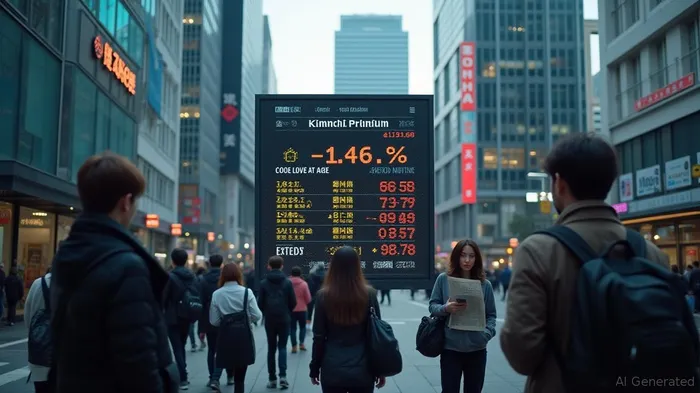
Bitcoin’s Kimchi Premium turned negative for the first time since late 2020 on July 28, marking a reversal in the persistent price premium historically observed in South Korea’s crypto market. At 12:00 AM KST, BitcoinBTC-- (BTC) traded at 161.65 million KRW on Upbit, South Korea’s largest crypto exchange, a 0.47% rise from the prior day [1]. Meanwhile, the same asset was priced at 163.87 million KRW on Binance, creating a 2.22 million KRW price gap and a -1.36% Kimchi Premium [1]. This inversion followed a trend of elevated premiums earlier in the year, which had exceeded 10% amid regulatory uncertainty and strong local demand.
The shift extended to major altcoins, with EthereumETH-- (ETH) recording a -1.24% discount, SolanaSOL-- (SOL) at -1.22%, and XRPXRP-- (XRP) at -1.27%. DogecoinDOGE-- (DOGE) and Shiba InuSHIB-- (SHIB) also traded at -1.23% and -1.15% discounts, respectively [1]. These figures reflect a broader alignment between South Korean and global prices, signaling reduced regulatory divergence and stabilizing market sentiment. Analysts attributed the development to tightened oversight in the region, including South Korea’s ongoing efforts to enforce anti-money laundering rules and tax compliance for crypto transactions.
The negative premium contrasts with earlier volatility driven by speculative trading in South Korea, where retail investors historically drove up local prices due to perceived regulatory gaps. However, the 2022 regulatory framework requiring real-name verification for crypto wallets has curbed such activity, reducing the incentive for arbitrage. Global exchanges like Binance have also expanded liquidity, narrowing price discrepancies.
The July 28 data highlights the evolving dynamics of the Kimchi Premium, which has long served as a barometer for regulatory divergence and market maturity. While the negative premium may persist in the short term, long-term trends suggest convergence between regional and global markets as regulatory harmonization progresses.
Source: [1] [Bitcoin Records Negative Kimchi Premium of 1.36% on July 28] [https://coinmarketcap.com/community/articles/68864cfbf196495074ef7ac3/]

Stay ahead of the market.
Get curated U.S. market news, insights and key dates delivered to your inbox.


AInvest
PRO
AInvest
PRO



Comments
No comments yet