
Bitcoin News Today: Bitcoin's Fear Index at 22 as Market Awaits Recovery Catalyst


 Aime Summary
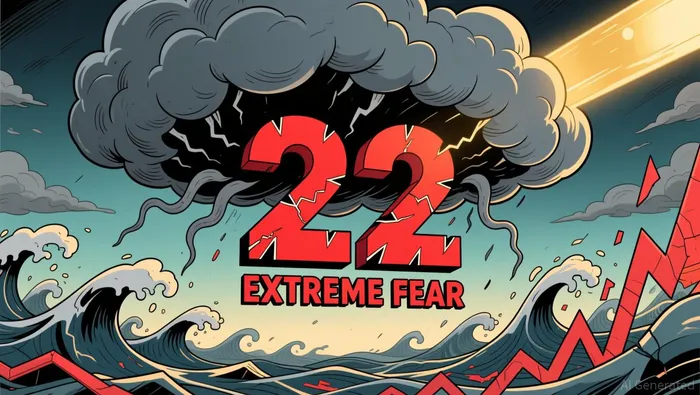
The BitcoinBTC-- Fear & Greed Index has rebounded to 22, marking a modest easing from previous extremes of fear but still reflecting a deeply bearish sentiment in the cryptocurrency market. This increase, up from 20 the prior day, aligns with broader signs of cautious stabilization as traders grapple with a prolonged period of volatility. The index, which aggregates metrics like volatility, social media sentiment, and market volume, now sits just above the "extreme fear" threshold of 20, signaling that while panic has abated slightly, risk appetite remains subdued according to analysis.
The uptick in sentiment contrasts sharply with the broader market's struggles. Bitcoin, which had plummeted to a seven-month low of $80,553 earlier this week, has since stabilized near $87,000 according to Bloomberg. However, the asset remains in a bearish technical pattern, with key resistance levels at $90,500 and $100,000 acting as critical benchmarks for a potential reversal as analysts note. Analysts note that prolonged periods of fear-such as the current seven-day stretch in the "extreme fear" zone-historically precede market bottoms as capitulation wanes and contrarian buyers emerge according to CoinDesk.
 Structural factors, including leverage and liquidations, have amplified the recent selloff. A recent X thread highlighted that the correction in both crypto and traditional markets has been driven by "structural" forces rather than specific news triggers, with leveraged positions exacerbating downward momentum according to Cointelegraph. This dynamic is evident in Bitcoin ETFs, which are on track for their worst monthly outflows since inception, with $3.5 billion withdrawn in November alone. BlackRock's IBIT, the largest Bitcoin ETF, has accounted for $2.2 billion of these redemptions, according to Bloomberg. Citi Research estimates that every $1 billion in ETF outflows corresponds to a 3.4% drop in Bitcoin's price, underscoring the feedback loop between institutional flows and market sentiment according to Bloomberg.
Despite the gloom, some analysts see potential for a near-term rebound. The Fear & Greed Index's rise to 22 coincides with Bitcoin reclaiming $90,000, a level that has historically acted as a psychological floor. Santiment's data reveals that social media sentiment has hit its lowest point since late 2023, according to Cointelegraph, suggesting a possible inflection point as retail capitulation wanes. Meanwhile, technical indicators like the RSI and MACD hint at overbought conditions, with the RSI nearing the oversold threshold of 30 and the MACD histogram flattening, signaling potential indecision among traders according to Forex.com.
The broader market remains fragile. Altcoins, already reeling from thin liquidity, have underperformed Bitcoin, according to CoinDesk. Tether's CEO has also added to the uncertainty, clashing with S&P Global Ratings, which now includes 5.6% Bitcoin. This regulatory scrutiny, coupled with the Federal Reserve's delayed rate-cut expectations, has kept risk assets under pressure.
Looking ahead, the path to recovery hinges on whether institutional flows stabilize and macroeconomic catalysts emerge. While the Fear & Greed Index suggests a bottom could be near, history shows that such extremes often require a catalyst-be it regulatory clarity, macroeconomic shifts, or a surge in retail buying-to trigger a sustained rebound according to CoinDesk. For now, traders remain on edge, with the index's trajectory and Bitcoin's ability to hold key support levels at $80,300 will be critical in determining the next phase of this volatile market.

Stay ahead of the market.
Get curated U.S. market news, insights and key dates delivered to your inbox.


AInvest
PRO
AInvest
PRO



Comments
No comments yet