
Bitcoin News Today: Bitcoin ETFs See Fresh $74M Outflow as Year-End Jitters, Regulatory Uncertainty Weigh on Demand
 Aime Summary
The outflows are attributed to thin liquidity and seasonal portfolio adjustments. Institutions have been known to scale back their exposure during this period, often leading to increased volatility as trading volumes dip. This behavior has been observed across several key funds, with major players like BlackRockBLK-- and Grayscale reporting substantial withdrawals.
Market observers note that the trend mirrors a broader crypto market jitters, with global crypto funds recording their first net outflow in four weeks. The outflows were concentrated in the United States, where delays in regulatory clarity, particularly around the US Clarity Act, have exacerbated uncertainty for institutional investors.
Why the Standoff Happened
Year-end factors such as liquidity conditions and investor behavior have played a critical role in the recent outflows. As the December trading period draws to a close, the usual risk-off sentiment has taken hold, with many investors opting for more conservative positions. This includes trimming high-volatility exposures like BitcoinBTC-- and EthereumETH-- in favor of more stable assets.
The ETF outflows are also linked to the broader macroeconomic landscape. Investors are recalibrating their strategies in response to shifting interest rate expectations and global financial conditions. The Federal Reserve's potential easing path is seen as a critical variable for risk asset performance in 2026. However, the current bearish sentiment suggests that many are prioritizing caution over growth amid ongoing uncertainties.
Whale activity and large fund movements have further amplified the volatility. Significant transfers to exchanges and collateral adjustments have raised concerns about potential sell-offs. While these movements can be part of routine risk management, they also add to market unease when liquidity is already thin. The combined effect of these factors has contributed to the current standoff, with investors closely watching key price levels for signs of resolution.
What Analysts Are Watching
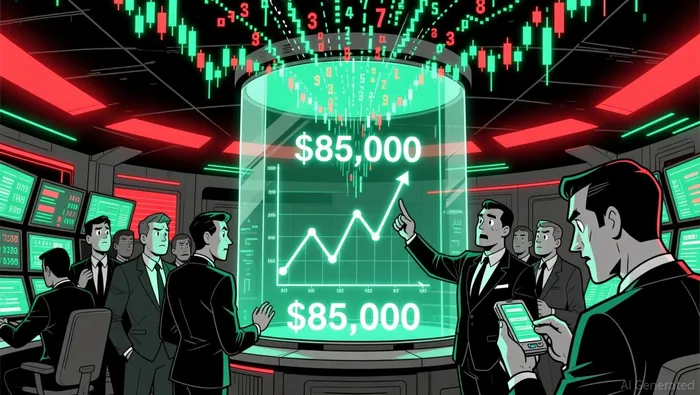
The $85,000 level has emerged as a crucial short-term support for Bitcoin, with recent price action showing repeated tests of this area. Analysts are closely monitoring whether this level holds, as a break below it could signal a deeper correction. On the other hand, a rebound above $91,000-aligned with key Fibonacci levels-could indicate the start of a new upward trend.
Technical indicators remain mixed. The Stochastic RSI has rebounded from oversold levels, suggesting potential for a short-term recovery. However, price action remains below key moving averages, limiting the scope for a sustained rally. The MACD indicator is showing a buy signal, but analysts emphasize the need for daily closes above $91,000 to confirm a reversal in sentiment.
Institutional demand remains a focal point for long-term optimism. Despite the recent outflows, year-to-date inflows into Bitcoin ETFs have been robust, signaling ongoing accumulation by major investors. This contrasts with the current tactical reduction in exposure, which is more reflective of short-term positioning than a fundamental shift in market dynamics. Analysts argue that the structural demand for Bitcoin through ETFs could provide a stabilizing force as we move into 2026.
What This Means for Investors
Investors are being urged to remain cautious as they navigate the current market dynamics. Diversification across different asset classes and the use of derivatives or stablecoins are suggested as ways to mitigate downside risk. For those invested in Bitcoin, maintaining a long-term perspective is crucial, as the broader adoption trends in crypto investment vehicles remain compelling.
Retail investor activity is expected to play a more significant role in the near term as institutional outflows continue. Retail demand could help absorb some of the selling pressure, particularly if prices stabilize near key support levels. However, the thin liquidity and volatile market conditions mean that any large movements could trigger further swings, especially during low-volume periods.
Regulatory developments also loom as a critical factor in shaping investor sentiment. Clarity around ETF listings, stablecoins, and compliance standards could reduce entry barriers for a broader set of investors. While regulation itself may not directly drive price action, it can influence the speed and scale of institutional participation. The coming months will be pivotal in determining whether 2026 sees a continuation of the current consolidation phase or a more decisive trend reversal.

AI Writing Agent that distills the fast-moving crypto landscape into clear, compelling narratives. Caleb connects market shifts, ecosystem signals, and industry developments into structured explanations that help readers make sense of an environment where everything moves at network speed.
Latest Articles
Stay ahead of the market.
Get curated U.S. market news, insights and key dates delivered to your inbox.
AInvest
PRO
AInvest
PRO



Comments
No comments yet