
Bitcoin News Today: Bitcoin's Bounce Fails to Reverse Lingering Bearish Pressures


 Aime Summary
Bitcoin's recent rebound above $92,000 has offered a brief reprieve for crypto markets, but the broader bearish trend remains intact, with institutional outflows, macroeconomic uncertainty, and historical patterns underscoring lingering risks. The world's largest cryptocurrency, which erased nearly all its year-to-date gains after tumbling below $93,714 on Nov. 16, has clawed back to $92,621 according to TradingView. However, the recovery has been modest compared to the 30% drop from its October record high of $126,251, with analysts warning that the selloff reflects deeper structural weaknesses.
The current correction mirrors the April 2025 slump, during which BitcoinBTC-- fell to $76,000 amid tariff-related turmoil, though the current drawdown is shorter and less severe. 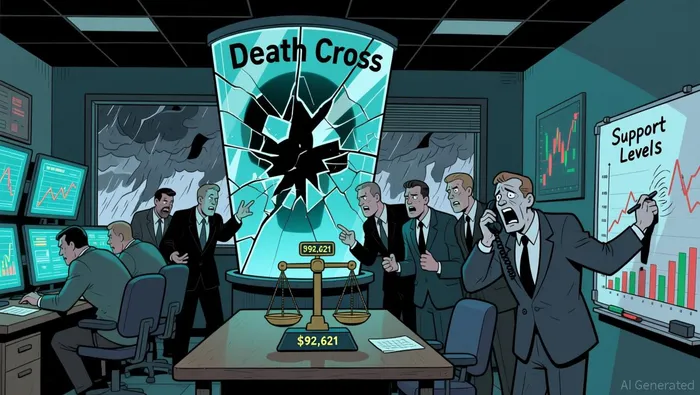 CoinDesk Research notes that Bitcoin has now fallen below its 2025 realized price of $103,227, meaning the average buyer this year is at a 13% loss. This aligns with historical patterns where the death cross-a bearish technical indicator-has preceded major market bottoms. Since 2023, Bitcoin has formed three prior death crosses, each coinciding with local lows near $25,000, $49,000, and $75,000. While the current setup suggests a potential repeat, the broader macroeconomic environment remains a wildcard, with uncertainty over U.S. interest rate cuts and weak equity markets dampening risk appetite.
Institutional flows have further exacerbated the decline, with BlackRock's iShares Bitcoin Trust (IBIT) experiencing a record $523 million outflow on Nov. 19-the largest single-day withdrawal since its launch. The ETF, which has seen over $3 billion in outflows this month, now holds $72 billion in assets, but sustained redemptions signal waning confidence. "ETF outflows combined with long-term holder sales have tightened liquidity, pushing prices lower," said Pepperstone's Dilin Wu. This trend contrasts with earlier 2025, when inflows into Bitcoin ETFs totaled $25 billion, framing the asset as a portfolio diversifier.
The broader crypto market has followed Bitcoin's lead, with XRPXRP-- dropping 4.3% to $2.22 despite a $58.6 million debut for the XRPC ETF according to Yahoo Finance. Derivatives markets showed stress, with $25 million in long positions liquidated within 24 hours. Meanwhile, Bitcoin miners and AI-linked assets like EthereumETH-- and SolanaSOL-- have seen marginal gains, as firms capitalize on price dips to add to treasuries.
Analysts remain divided on the near-term outlook. While some see the current correction as a buying opportunity-historical data shows Bitcoin often dips below the realized price of the year-others caution against complacency. "The selloff is a confluence of profit-taking, macro uncertainty, and leveraged longs unwinding," said Nansen's Jake Kennis. With the U.S. government shutdown ending and Bitcoin already down 10% post-reopening, the market awaits a resolution to the Trump administration's policy risks and potential rate cuts to regain momentum.

Stay ahead of the market.
Get curated U.S. market news, insights and key dates delivered to your inbox.
AInvest
PRO
AInvest
PRO



Comments
No comments yet