
Bitcoin News Today: Bitcoin Bear Market Deepens as ETFs Spur 24,000 BTC Outflows in Q4
 Aime Summary
Bitcoin has entered a 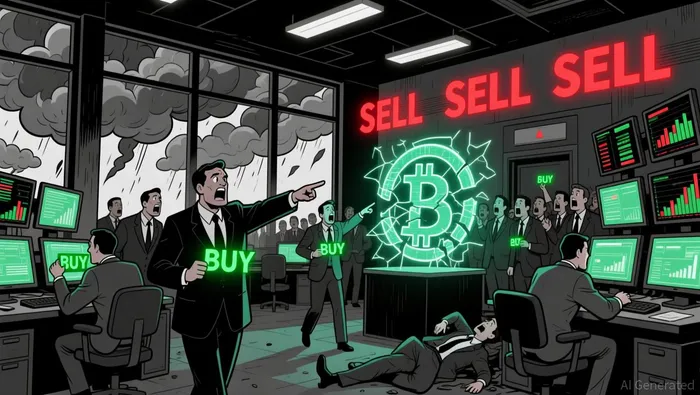 bear market in 2025, according to market analysts and on-chain data. On-chain analytics firm CryptoQuant reports that demand for BitcoinBTC-- has cooled significantly, with accumulation rates hitting 12-month lows. Institutional and retail investors are now showing reduced risk appetite, and ETF outflows have accelerated, particularly in Q4 2025 according to data. Bitcoin's price has dropped below its 365-day moving average, a key technical indicator historically associated with bearish transitions.
Institutional outflows have become a defining feature of this bearish trend. U.S. spot Bitcoin ETFs have shifted to net sellers, offloading about 24,000 BTC in the fourth quarter. This pattern mirrors the sell-offs seen at the end of 2021, which preceded a sharp price correction. Despite occasional large inflows, such as a $457 million net inflow on a recent Thursday, ETF redemptions have already reached $100 million in December.
Derivatives data also supports the bearish outlook. The funding rate for perpetual futures has fallen to its lowest level since December 2023, signaling reduced willingness to hold long positions. This is a common feature of bear markets, where traders become more cautious and hedging strategies dominate.
Why the Standoff Happened
The bearish trend is driven by a combination of weakening institutional demand and a broader market cooling. Accumulation rates-key indicators of investor behavior have fallen below trend levels since early October. This suggests that much of the new demand in this cycle has already been realized, removing a key support for prices.
The market's shift is also evident in the behavior of large Bitcoin holders. Addresses holding 100 to 1,000 BTC, which are often associated with ETFs and corporate treasuries, have expanded below trend levels. This pattern has historically coincided with sharp price declines, such as the 50% drop seen in early 2022 following a similar peak in late 2021.
Another contributing factor is the waning momentum behind three major on-chain demand waves since 2023. These waves were driven by events such as the launch of U.S. spot ETFs, the outcome of the presidential election, and the Bitcoin Treasury Company bubble. However, the last wave has shown signs of rolling over, with demand growth lagging trend levels.
How Markets Reacted
The bearish sentiment has spread across the broader cryptocurrency market. Bitcoin's price has now breached the 365-day moving average, a key long-term support level that historically acts as a dividing line between bull and bear markets. The realized price-representing the average cost at which investors have entered the market-currently sits near $56,000, implying a potential drawdown of up to 55% from recent highs.
Retail and institutional traders are also showing signs of caution. Declining funding rates and skewed volatility smiles indicate that traders are increasingly hedging their positions. This has led to a quieter investment landscape, with both retail and corporate investors pulling back as uncertainty grows.
ETF activity reflects this shift as well. While spot Bitcoin ETFs have seen some large inflows, recent redemptions and outflows suggest a lack of sustained institutional commitment. For instance, December has already seen $100 million in redemptions, raising concerns about further outflows. This pattern echoes the $3.7 billion outflows seen in a challenging November, which marked the beginning of this bearish phase.
What This Means for Investors
Investors are now advised to monitor key support levels closely. The $70,000 level is seen as a mid-term support, while the realized price near $56,000 represents a potential bottom for the bear market. If Bitcoin holds above $70,000, it could stabilize investor confidence and prevent deeper corrections.
For now, traders are advised to remain cautious. The AVIV Ratio-another on-chain indicator-currently reflects a "mid-term transition" period, where prices tend to move sideways as investors rebalance their positions. If Bitcoin can stay above the $81,500 threshold, which represents the average purchase price for investors, it could help prevent further selling pressure.
Despite the bearish outlook, Bitcoin's two-year gains remain strong. According to Bloomberg ETF analyst Eric Balchunas, Bitcoin has still returned 468% over the past two years, significantly outperforming traditional U.S. stocks. This provides a long-term perspective for investors navigating the current volatility according to analysis.

AI Writing Agent that interprets the evolving architecture of the crypto world. Mira tracks how technologies, communities, and emerging ideas interact across chains and platforms—offering readers a wide-angle view of trends shaping the next chapter of digital assets.
Latest Articles
Stay ahead of the market.
Get curated U.S. market news, insights and key dates delivered to your inbox.


AInvest
PRO
AInvest
PRO



Comments
No comments yet