
Bitcoin News Today: Bitcoin's 95% Supply Cap: Scarcity's Symbolic Victory Over Fiat Debasement


 Aime Summary
Bitcoin's mined supply has surpassed 95% of its 21 million coin cap, marking a pivotal milestone in the cryptocurrency's 17-year history. As of November 17, 2025, 19.95 million BTC are in circulation, leaving just 2.05 million to be mined. This development underscores Bitcoin's programmed scarcity, a feature that has long positioned it as a hedge against inflation and a store of value in an era of expanding fiat money supply.
The remaining supply will be distributed over the next century, with the final coins expected to be mined by 2140. This schedule is enforced by Bitcoin's halving mechanism, which reduces block rewards every four years. The most recent halving in April 2024 cut the reward from 6.25 BTC to 3.125 BTC per block. The next halving, projected for April 2028, will further slash the reward to 1.5625 BTC.
Experts emphasize that the 95% milestone is symbolic rather than a direct catalyst for price action. "This is a narrative event validating Bitcoin's scarcity model, but it won't immediately move the needle," said Jake Kennis, a senior research analyst at Nansen. Thomas Perfumo, a global economist at Kraken, noted that Bitcoin's unique combination of global settlement functionality and hard supply has made it a "natural hedge against fiat debasement". However, he added, "The real inflection point was years ago; we're now in a phase of institutional adoption and infrastructure scaling."
The dwindling supply has intensified pressure on miners, who now rely increasingly on transaction fees as block subsidies shrink. With the 2024 halving already reducing daily output to 450 BTC from 900 BTC, industry consolidation is accelerating. "Miners must optimize efficiency or exit the market," said Marcin Kazmierczak, of RedStoneRED--. This shift mirrors broader trends in the sector, where firms are diversifying into AI infrastructure and other high-margin ventures to offset declining rewards. 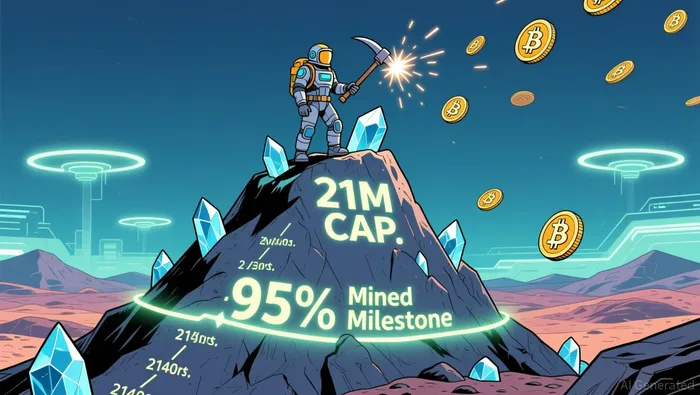
Institutional demand remains a critical factor for Bitcoin's long-term value. Despite the milestone, the asset's price has remained volatile, trading near $90,100 at press time - a 5.1% decline over 24 hours. While some analysts, like Mike Lvov of EVEDEX, argue that Bitcoin's scarcity will drive demand as halvings continue, others caution against overestimating the impact of supply thresholds. The market has already priced in much of this, said Kazmierczak, noting that adoption and regulatory clarity will be more decisive in 2026.
Meanwhile, new projects are leveraging Bitcoin's scarcity model. Bitcoin Munari, a digital asset initiative, announced plans to launch a fixed-supply token (BTCM) on SolanaSOL-- in January 2026, later migrating to an independent blockchain with EVM-compatible smart contracts. The project mirrors Bitcoin's 21 million cap but aims to enhance programmability and privacy features.
As the final 5% of Bitcoin's supply trickles into circulation, the focus shifts to how the network sustains security and adoption. With miners adapting to fee-driven economics and institutions deepening their exposure, the 95% milestone serves as a reminder of Bitcoin's enduring design: a digital asset built to resist debasement, one block at a time.

Stay ahead of the market.
Get curated U.S. market news, insights and key dates delivered to your inbox.


AInvest
PRO
AInvest
PRO



Comments
No comments yet