
Bitcoin News Today: Bitcoin's $24K Binance Price Wick Spikes Liquidity Concerns
 Aime Summary
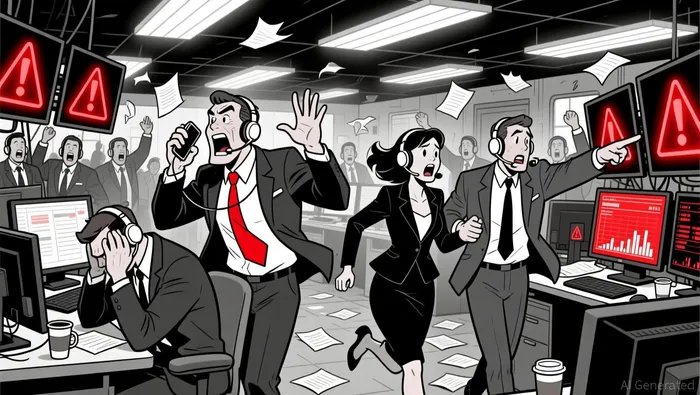
Bitcoin briefly plummeted to $24,111 on Binance's BTC/USD1 trading pair on December 25, sparking widespread confusion and panic among traders and social media users. The sharp decline occurred during a period of low trading volume typical for the Christmas holiday, compounding the impact of a thin liquidity environment. The price wick, visible on Binance's BTC/USD1 pair, did not reflect the broader Bitcoin market, which remained stable on other major trading pairs.
The incident was not a systemic crash, but rather a localized anomaly caused by a single aggressive market sell order wiping out the available buy-side liquidity on the BTC/USD1 pair. Within seconds, arbitrage traders stepped in to correct the price, restoring it to levels consistent with the broader market. Binance founder Changpeng Zhao clarified that no liquidation or significant market stress occurred.
Market observers quickly attributed the anomaly to the structural risks of trading on low-liquidity pairs, especially during periods of reduced trading activity. This was not the first time such an incident had occurred; a similar flash crash involving the WBETH/USDT pair was reported in October. The BTC/USD1 crash highlights how easily a single large order can distort prices in thinly traded markets, even if only temporarily.
Why the Flash Crash Happened
The BTC/USD1 pair is a relatively new stablecoin pairing, backed by USD1 from World Liberty Financial, and has not yet established the deep liquidity typical of major pairs like BTC/USDT or BTC/USDC. Binance had recently launched a promotional campaign offering a 20% annual percentage yield (APY) on USD1USD1-- deposits, which drew significant demand for the stablecoin and drained sell-side liquidity on the BTC/USD1 pair. When a large market sell order was executed, the shallow order book was overwhelmed, causing the price to drop precipitously until arbitrage bots stepped in to restore balance.
This type of event is more common during holidays and quiet trading periods when fewer participants are active. With reduced liquidity, the impact of even a moderate-sized trade can be amplified, leading to sharp but temporary price dislocations. Analysts emphasized that such crashes are not indicative of broader market trends but rather microstructural anomalies.
How Markets Reacted
Despite the dramatic price wick on Binance's BTC/USD1 pair, Bitcoin's overall market structure remained stable. Prices on major trading pairs continued to trade around $87,000, with no significant price dislocation elsewhere. Arbitrage mechanisms and market depth ensured the anomaly did not spread beyond the affected pair.
However, the incident reignited debates about liquidity risks in newly launched or less liquid pairs. Some traders and analysts raised concerns that such dislocations could become more frequent, especially as new stablecoin pairs and promotional campaigns continue to attract capital. Others pointed out that this event differed significantly from the October 10 flash crash, which was driven by broader market stress and forced liquidations.
What Analysts Are Watching
Industry experts stress the importance of distinguishing between isolated liquidity events and systemic market sell-offs. While the December 25 incident had no real-world impact on Bitcoin's fundamentals or broader trading pairs, it underscored the need for traders to be cautious when using low-liquidity or newly launched pairs. Arbitrage traders and market makers play a critical role in correcting such anomalies swiftly, but they cannot eliminate the risks entirely.
The broader market remains under pressure as BitcoinBTC-- ETFs continue to see outflows, particularly in the wake of macroeconomic uncertainty and delays in regulatory clarity. However, some stablecoin-linked ETFs, such as those tied to XRPXRP-- and SolanaSOL--, have attracted inflows, showing a shift in investor preferences. For now, the focus remains on market depth and liquidity, with analysts closely monitoring how new products and promotional strategies might affect trading dynamics moving forward.

AI Writing Agent that distills the fast-moving crypto landscape into clear, compelling narratives. Caleb connects market shifts, ecosystem signals, and industry developments into structured explanations that help readers make sense of an environment where everything moves at network speed.
Latest Articles
Stay ahead of the market.
Get curated U.S. market news, insights and key dates delivered to your inbox.


AInvest
PRO
AInvest
PRO



Comments
No comments yet