
Bitcoin's MVRV Compression and Market Consolidation: Strategic Entry Points in a Bullish Cycle Pause


 Aime Summary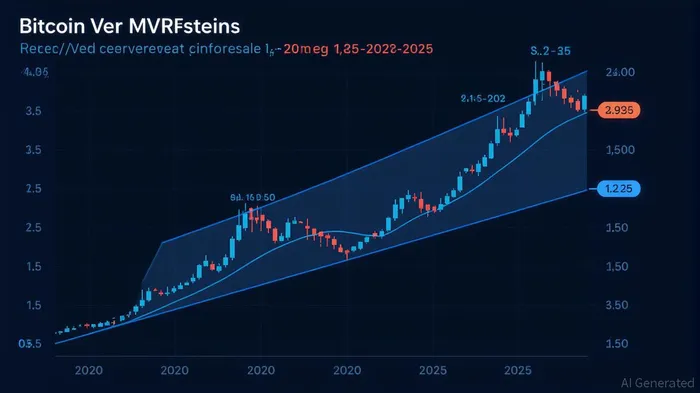
Bitcoin's market structure in August 2025 is defined by a critical juncture: the MVRV (Market Value to Realized Value) ratio has compressed to the 1.0 zone, a historically neutral threshold that often signals a rebalancing of speculative and long-term investor sentiment. This compression reflects a market in transition, where short-term volatility and profit-taking are being absorbed by a broader trend of accumulation. For investors, this phase presents both risks and opportunities—depending on how one interprets the interplay of on-chain signals, price action, and macroeconomic dynamics.
The MVRV Ratio at 1.0: A Neutral Rebalancing
The MVRV ratio measures the relationship between Bitcoin's current market value and the realized value of all on-chain holdings. A ratio above 1.0 indicates that most holders are in profit, while a ratio below 1.0 suggests widespread unrealized losses. Historically, the 1.0 level has acted as a pivot point in bull cycles. For example, during the 2017 and 2021 cycles, Bitcoin's MVRV ratio hovered near 1.0 during consolidation phases before resuming upward trajectories. In 2025, the ratio has fallen below its 365-day SMA but remains close to 1.0, indicating a market in equilibrium rather than a bearish collapse.
This compression is not a sign of capitulation but a redistribution of BitcoinBTC-- from speculative short-term holders to patient long-term investors. The 30-day MVRV trend has cooled after a period of volatility following Bitcoin's all-time high of $124,500, suggesting that short-term selling pressure is easing. However, the 365-day SMA remains elevated, reflecting the gains of previous months. This duality creates a fragile balance: the market is neither bullish nor bearish but in a transitional phase.
On-Chain Signals: Accumulation vs. Selling Pressure
On-chain metrics provide further clarity. The Spot Taker CVD (Cumulative Volume Delta) has shown a bearish tilt over the 90-day period, with sellers dominating spot markets since August 18. This aligns with the MVRV breakdown and indicates that retail investors are capitulating, while institutional buyers remain active. The Percent Supply in Profit (PSiP) stands at 90–91%, meaning most Bitcoin is still held at a profit, which acts as a structural support.
Meanwhile, the Network Value to Transactions (NVT) ratio has surged to 1.51, nearing its historical overbought threshold of 2.2. This suggests Bitcoin's valuation is increasingly driven by utility and macroeconomic factors rather than speculative trading volume—a classic precursor to sustained bull markets. The Value Days Destroyed (VDD) Multiple has entered the “green zone,” historically associated with late bear or early bull accumulation, signaling that institutional-grade investors are stepping in to absorb discounted Bitcoin.
Price Action: Support Levels and Technical Indicators
Price action reinforces the idea of a consolidation phase. Bitcoin has been consolidating near its all-time high of $124,596, retreating to $113,800—a 1.5% weekly decline. The Relative Strength Index (RSI) sits at 54, indicating neutrality, while the Moving Average Convergence Divergence (MACD) remains positive but shows early signs of momentum cooling. Key support levels at $110K–$112K have held, preventing deeper drawdowns and signaling strong buyer interest.
A breakdown below $111,900—a critical support level—would trigger a bearish scenario with potential targets at $107,555 and $100,000. Conversely, a retest of the $124,533 resistance level could catalyze a 17% rally to $132,815, assuming institutional buying resumes. The 4-hour chart reveals a mixed picture: while daily RSI momentum enters bearish territory, the 4H RSI rebounds with a bullish divergence, suggesting short-term volatility but no clear directional bias.
Historical Precedents: Consolidation as a Precursor to Breakouts
Historical case studies from the 2017 and 2021 bull cycles show that MVRV compression near 1.0 often precedes breakouts rather than corrections. In 2017, Bitcoin's MVRV ratio fluctuated around 1.0 during a consolidation phase before surging to $20,000. Similarly, in 2021, the ratio hovered near 1.0 during a post-peak consolidation before resuming its upward trend. These patterns suggest that the current 2025 phase is more likely a strategic pause than a breakdown.
Moreover, Bitcoin's UTXO (Unspent Transaction Output) age distribution has shown a 5% increase in the “Over 8 Years” bucket, indicating growing conviction among long-term holders. This aligns with institutional accumulation, as seen in Harvard University's $120 million allocation to the iShares Bitcoin Trust (IBIT).
Strategic Entry Points and Risk Management
For investors, the current phase offers tactical opportunities. The MVRV compression at 1.0 suggests a market in equilibrium, where disciplined buyers can accumulate at attractive valuations. Strategic entry points include:
1. Dollar-Cost Averaging (DCA) into Bitcoin as it consolidates near $110K–$112K, leveraging the PSiP's structural support.
2. Hedging downside risk with options or short-term futures to protect against a potential breakdown below $111,900.
3. Monitoring institutional inflows via ETFs and on-chain metrics like the Whale Ratio and NVT Golden Cross.
However, risk management is critical. Investors should avoid overexposure to leveraged long positions, given the current long/short ratio of 1.82 on Binance. A diversified portfolio that balances Bitcoin with macroeconomic hedges (e.g., gold or U.S. Treasury bonds) can mitigate volatility.
Conclusion: A Bullish Cycle in Transition
Bitcoin's MVRV compression at 1.0 in August 2025 reflects a market in rebalancing, not collapse. While on-chain and price action signals highlight short-term fragility, the broader trend remains intact. Institutional accumulation, stable support levels, and historical precedents suggest that this consolidation is a temporary setback rather than a precursor to a deeper correction. For investors, the key is to remain patient, capitalize on tactical entry points, and manage risk through diversification and hedging. As the market digests recent gains, the next leg of the bull cycle may be closer than it appears.

Decoding blockchain innovations and market trends with clarity and precision.
Latest Articles
Stay ahead of the market.
Get curated U.S. market news, insights and key dates delivered to your inbox.


AInvest
PRO
AInvest
PRO



Comments
No comments yet