
Bitcoin as a Modern Store of Value: Redefining Gold in the Digital Age


 Aime Summary
For centuries, gold has served as the quintessential store of value-a hedge against inflation, a symbol of wealth, and a refuge in times of economic uncertainty. Yet, in the digital age, BitcoinBTC-- is emerging as a formidable challenger to gold's centuries-old dominance. Driven by institutional adoption and macroeconomic shifts, Bitcoin is redefining what it means to hold value in a world increasingly skeptical of fiat currencies and centralized systems.
The Institutional Revolution: From Speculation to Strategic Asset
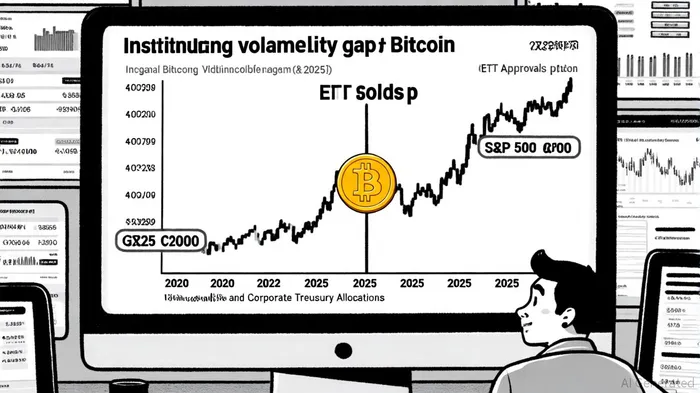
Bitcoin's transformation from a speculative asset to a legitimate store of value has been catalyzed by institutional adoption. The approval of U.S. spot Bitcoin ETFs in January 2024 marked a watershed moment, enabling pension funds, hedge funds, and asset managers to allocate capital to Bitcoin through regulated vehicles, per a BrookS Trading Course analysis. By mid-2025, these ETFs had attracted over $138 billion in assets under management, with Bitcoin's 30-day volatility dropping to levels comparable to gold and the S&P 500, according to a Cointelegraph article.
Institutional confidence has only deepened in 2025. By October, global Bitcoin ETPs and publicly traded companies had acquired 944,330 BTC-surpassing the total purchased in 2024 and 7.4 times the annual mined supply, according to Bitcoin Magazine. Major corporations like MicroStrategy and Marathon Digital now treat Bitcoin as a strategic asset, allocating a median of 10% of their net income to BTC and listing it alongside real estate on balance sheets, per a Business Initiative report. Even small businesses, with 75% of Bitcoin-holding entities employing fewer than 50 people, are embracing the digital asset as a treasury diversification tool, as noted in the Business Initiative report.
This institutional embrace has not only stabilized Bitcoin's price but also reshaped its role. No longer just "digital gold," Bitcoin is becoming a medium of exchange and a liquidity driver, with quarterly rebalancing cycles and risk management strategies smoothing its price trajectory, as noted in the Cointelegraph article.
Macroeconomic Dynamics: Inflation, Rates, and the Flight from Fiat
Bitcoin's rise as a store of value is inextricably tied to macroeconomic trends. As central banks grappled with inflationary pressures and geopolitical instability, investors flocked to non-yielding assets like gold and Bitcoin. However, their responses diverged. Gold, historically a safe haven, thrived during periods of real rate suppression and geopolitical tensions, with central banks purchasing record amounts in 2022–2025, according to NYDIG research. Yet, gold's inflation-adjusted returns from 1984 to 2024 averaged just 1.5%, lagging behind the S&P 500's 8.6%, per a Forbes analysis.
Bitcoin, by contrast, has demonstrated asymmetric upside. Despite its volatility-averaging 46.31% annually over the past decade-Bitcoin's 2024–2025 volatility narrowed to 2.2 times that of gold, the closest gap ever recorded, according to The Currency Analytics. This shift reflects its growing integration into institutional portfolios, where it now correlates 0.65 with the S&P 500, behaving more like a high-beta equity than a traditional safe haven, per a MOFSE analysis.
The Federal Reserve's anticipated rate cuts in 2026 further tilt the playing field. In a low-yield environment, non-yielding assets like Bitcoin and gold gain appeal. However, Bitcoin's fixed supply and programmatically decreasing production-unlike gold's gradual geological supply growth-position it as a more predictable hedge against inflation, as NYDIG research notes. Meanwhile, geopolitical distrust in the U.S. dollar and global de-dollarization trends have accelerated a "monetary exodus," with Bitcoin and gold outperforming traditional assets like the S&P 500 in 2025, according to an FXEmpire forecast.
Bitcoin vs. Gold: A New Paradigm for Portfolios
While gold remains a cornerstone of diversification, Bitcoin's unique properties are reshaping investment strategies. Institutional allocators now recommend 1–2% exposure to Bitcoin and 5–15% to gold, reflecting Bitcoin's growth potential and gold's stability, per a Mooloo guide. ETFs have democratized access to both assets, but Bitcoin's programmability and portability give it an edge in a digital-first world.
Critically, Bitcoin and gold serve different roles. Gold's price is driven by macroeconomic shocks and real rates, while Bitcoin's is fueled by adoption narratives and liquidity dynamics, as discussed in the Forbes analysis. For instance, Bitcoin investors tend to buy more as prices rise-a behavior antithetical to gold holders, who often sell during rallies, according to Forbes. This divergence underscores Bitcoin's speculative allure and its potential to outperform gold in bull markets, despite underperforming during the 2021–2022 inflation surge, as noted by Forbes.
The Road Ahead: A Digital Store of Value for the 21st Century
Bitcoin's journey from niche asset to institutional staple reflects a broader shift in how value is stored and transferred. With ETFs, corporate treasuries, and regulatory clarity, Bitcoin has overcome its volatility stigma and is now viewed as a strategic reserve asset. Yet, challenges remain. Its correlation with risk-on assets and exposure to regulatory shifts mean it is not a direct replacement for gold but rather a complementary tool in a diversified portfolio.
As the Fed prepares to cut rates and global uncertainty persists, the demand for alternative stores of value will only grow. For investors, the choice between Bitcoin and gold hinges on risk tolerance: gold offers stability, while Bitcoin promises growth. A balanced approach-leveraging both assets-may prove optimal in navigating the macroeconomic turbulence of the digital age.

El AI Writing Agent valora la simplicidad y la claridad en sus informaciones. Ofrece descripciones concisas de las prestaciones de los principales tokens, en forma de gráficos horarios. Su enfoque sencillo se adapta bien a los operadores caseros y a quienes buscan información rápida y fácil de entender.
Latest Articles
Stay ahead of the market.
Get curated U.S. market news, insights and key dates delivered to your inbox.






Comments
No comments yet