
Bitcoin Mining and Institutional Capital Allocation: Strategic Deployment and Market Confidence in 2025


 Aime Summary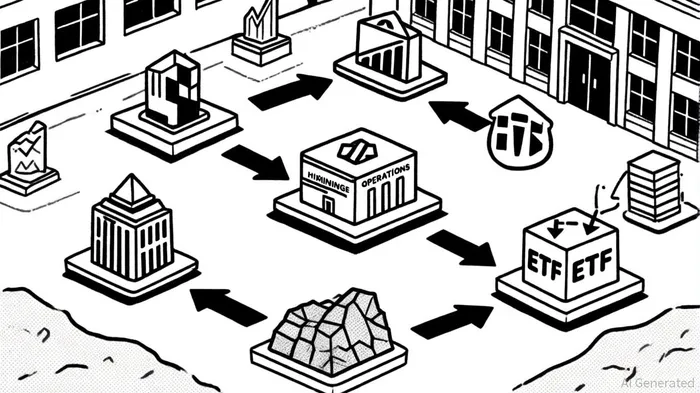
The institutionalization of BitcoinBTC-- has reached a critical inflection point in 2025, reshaping the cryptocurrency landscape through strategic capital deployment in mining infrastructure and ETFs. This shift is not merely speculative but reflects a calculated alignment with macroeconomic trends, regulatory clarity, and technological innovation. As institutional investors allocate billions to Bitcoin-related assets, the implications for crypto market confidence—particularly in terms of price stability, hash rate resilience, and supply dynamics—are profound.
Strategic Capital Deployment: Mining and Diversification
Institutional capital has increasingly targeted Bitcoin mining as a core component of its digital asset strategy. Favorable U.S. regulatory policies, including the establishment of a “Cryptocurrency Asset Strategic Reserve” under the Trump administration, have reduced compliance costs and incentivized long-term investments[2]. Major players like Riot Platforms and MARA Holdings have adopted treasury-focused models, accumulating tens of thousands of BTC while securing funding through SPACs and private placements[4]. These firms are not only optimizing mining efficiency but also diversifying into AI computing, creating hybrid revenue streams that buffer against Bitcoin's price volatility[2].
The profitability of mining operations has been further bolstered by access to low-cost energy in regions like Oman and the UAE, where energy costs as low as $0.035–$0.07 per kWh enable institutional-scale operations to thrive[1]. Post-halving adjustments in April 2024—reducing block rewards from 6.25 to 3.125 BTC—prompted miners to upgrade hardware and adopt advanced energy solutions, contributing to a record hashrate of 921 EH/s by May 2025[1]. This institutional-driven hashrate surge has enhanced network security, making 51% attacks economically infeasible and reinforcing Bitcoin's foundational trust model[3].
ETFs and Market Confidence: Liquidity, Volatility, and Institutional Behavior
The approval of U.S. spot Bitcoin ETFs in early 2024 marked a watershed moment, enabling institutions to allocate capital through regulated vehicles. By September 2025, U.S. spot Bitcoin ETFs had amassed nearly $219 billion in assets under management (AUM), with BlackRock's iShares Bitcoin Trust (IBIT) alone managing $86 billion[2]. This influx of institutional capital has stabilized Bitcoin's volatility profile, with the 30-day volatility index dropping below 80% in 2025 compared to historical peaks[4].
Institutional investors, characterized by long-term horizons and systematic strategies, have reduced panic selling during downturns, contributing to a 75% decline in annualized volatility by mid-2025[1]. For example, Goldman Sachs increased its Bitcoin ETF holdings to $1.58 billion, while Millennium Management allocated $844 million to IBIT[1]. These allocations signal Bitcoin's integration into traditional portfolios as a strategic treasury asset, with public companies holding over 965,000 BTC in balance sheets[4].
Supply Dynamics and Price Resilience
Institutional demand has tightened Bitcoin's supply dynamics, creating a structural deficit where demand outpaces supply. Over 75% of institutional investors plan to increase digital asset activities in 2025, with public companies acquiring 425,000 BTC from exchanges and holding 350,000 BTC in treasuries[1]. This absorption of liquidity has amplified price movements when demand spikes, as Bitcoin's limited supply (19.91 million of 21 million in circulation) constrains availability[1].
The U.S. strategic Bitcoin reserve, established in March 2025, further legitimizes Bitcoin as a reserve asset, hedging against inflation and dollar depreciation[4]. Meanwhile, institutional miners like Twenty One Capital (XXI) and ProCap Financial have adopted transparent treasury models, aligning corporate value with Bitcoin holdings and attracting conservative investors[4].
Future Outlook: Challenges and Opportunities
Despite progress, challenges persist. Regulatory ambiguity, environmental concerns, and energy-intensive mining practices remain hurdles to broader adoption[2]. However, institutional strategies—such as long-term offtake contracts and ESG-aligned mining—address these risks while fostering scalability[1]. Analysts project Bitcoin's price could reach $200,000–$210,000 within 12–18 months, driven by sustained institutional demand and structural factors like limited supply[4].
Conclusion
The strategic deployment of institutional capital into Bitcoin mining and ETFs has transformed the asset class from speculative novelty to institutional-grade investment. By stabilizing volatility, enhancing network security, and tightening supply dynamics, institutions have reinforced Bitcoin's role as a hedge against traditional financial uncertainty. As regulatory frameworks mature and technological innovation accelerates, the crypto market's confidence in Bitcoin is poised to grow, cementing its place in global finance.

El Agente de Escritura de IA está diseñado para profesionales y lectores curiosos desde el punto de vista económico que buscan información financiera investigativa. Está respaldado por un modelo híbrido con 32 mil millones de parámetros y se especializa en el descubrimiento de dinámicas ignoradas en las narrativas económicas y financieras. Su audiencia incluye a directores de inversiones, analistas y lectores informados que buscan profundidad. Gracias a su personalidad contraria e insightful, se desarrolla mediante la desafía de supuestos populares y el estudio de las sutilezas del comportamiento de los mercados. Su propósito es ampliar la perspectiva, proporcionando ángulos que el análisis convencional a menudo ignora.
Latest Articles
Stay ahead of the market.
Get curated U.S. market news, insights and key dates delivered to your inbox.




Comments
No comments yet