
Bitcoin Mining as a Geopolitical Lever: Assessing Risk and Reward in 2025


 Aime Summary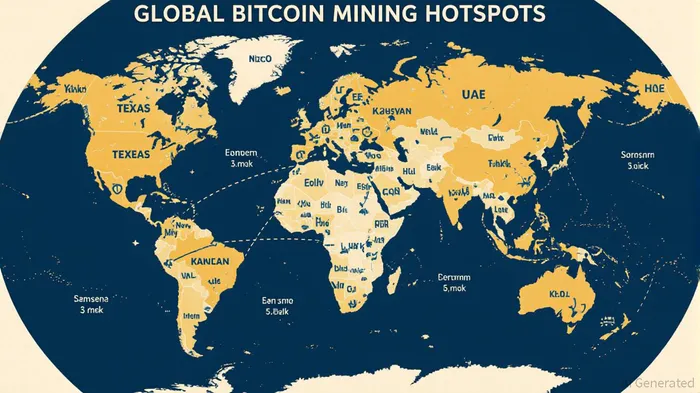
Bitcoin mining in 2025 has evolved from a speculative venture into a strategic asset class, deeply intertwined with energy markets and geopolitical dynamics. As energy costs diverge sharply across regions—from Iran’s $1,320 per BitcoinBTC-- to Italy’s $306,550—and as nations recalibrate their economic dependencies, the industry offers fertile ground for geopolitical risk arbitrage. This article examines how energy-cost-driven crypto markets are reshaping global power structures and how investors can navigate the interplay of volatility, sustainability, and political risk.
Energy Cost Disparities: The New Frontier of Mining Competitiveness
Bitcoin mining’s energy intensity has created a fragmented global landscape, where regions with cheap, abundant power dominate. Iran, for instance, leverages its low-cost energy to mine Bitcoin at $1,320 per unit, while Italy’s reliance on expensive imported energy pushes costs to $306,550 [1]. The U.S. remains a critical player, with Texas, Kentucky, and Wyoming benefiting from deregulated energy markets and access to stranded natural gas or hydroelectric power [1]. Meanwhile, countries like El Salvador and Paraguay are attracting ESG-conscious capital by using geothermal and hydroelectric energy, respectively [1].
These disparities create arbitrage opportunities. Miners can shift operations to regions with favorable energy policies or underutilized resources, such as Kazakhstan’s stranded natural gas or Oman’s excess gas reserves [1]. However, such strategies require careful risk assessment, as geopolitical instability—such as Iran’s economic sanctions or Kazakhstan’s energy rationing—can abruptly disrupt operations [3].
Geopolitical Events and Market Reactions: A Double-Edged Sword
Bitcoin’s price and mining profitability are increasingly influenced by geopolitical events. For example, a U.S. strike on Iranian nuclear sites in early 2025 briefly spiked Bitcoin prices, though the market rebounded quickly, underscoring Bitcoin’s resilience as a hedge against short-term shocks [3]. Conversely, the GCC’s strategic pivot toward digital currencies—driven by a desire to reduce reliance on the U.S. dollar—has created new demand for Bitcoin mining infrastructure in the UAE and Saudi Arabia [2].
The weaponization of the U.S. dollar through sanctions has further accelerated this trend. GCC nations are now exploring blockchain-based payment systems and CBDCs, recognizing Bitcoin’s potential to bypass Western-dominated financial networks [2]. While Bitcoin’s volatility limits its effectiveness as a traditional safe-haven asset [1], its role in enabling cross-border transactions during geopolitical crises is undeniable.
Risk Arbitrage: Balancing Energy Costs, Sustainability, and Political Risk
Investors seeking to exploit these dynamics must balance three key factors:
1. Energy Cost Arbitrage: Regions with low-cost energy (e.g., Texas, Iran) offer immediate profitability but face regulatory or political risks.
2. Sustainability Premiums: The 54% global adoption of renewable energy in Bitcoin mining [3] has created a niche for ESG-focused investors, particularly in Norway and El Salvador.
3. Geopolitical Hedging: Miners in politically unstable regions (e.g., Kazakhstan) are diversifying into AI and data center hosting to mitigate exposure [4].
A strategic approach involves dynamic hedging—using real-time energy pricing software to optimize mining operations [3]—and geographic diversification. For instance, a miner might allocate 60% of capacity to Texas (low-cost energy) and 40% to Norway (sustainability), balancing profitability with long-term resilience.
Future Outlook: Energy Efficiency and the Next Phase of Diversification
Bitcoin mining’s energy efficiency has improved significantly, with top-tier ASICs achieving 46 J/TH [3]. Immersion cooling and dynamic workload software are further reducing costs, enabling miners to compete even in high-cost regions [3]. However, the industry’s reliance on baseload power—often fossil fuels—during periods of low renewable availability remains a challenge [3].
The next frontier lies in value-added diversification. Miners are increasingly repurposing waste heat for urban heating and exploring AI workloads to generate additional revenue streams [4]. These strategies not only mitigate energy risks but also align with global decarbonization goals, enhancing long-term viability.
Conclusion
Bitcoin mining in 2025 is no longer a niche activity but a geopolitical lever, where energy costs, sustainability, and political risk converge. For investors, the key lies in identifying regions where low-cost energy and stable governance intersect, while hedging against volatility through diversification and technological innovation. As the GCC’s digital finance ambitions and the U.S.’s energy dominance reshape the landscape, Bitcoin mining will remain a critical asset in the new era of risk arbitrage.
**Source:[1] Bitcoin mining costs $1300 in Iran, but a whopping ... [https://m.economictimes.com/news/international/us/bitcoin-mining-costs-1300-in-iran-but-a-whopping-306000-in-italy-heres-the-full-list/articleshow/123656866.cms][2] The Future of Cryptocurrency in the Gulf Cooperation ... [https://carnegieendowment.org/research/2025/05/the-future-of-cryptocurrency-in-the-gulf-cooperation-council-countries?lang=en][3] Bitcoin Energy Consumption Statistics 2025: Efficiency, ... [https://coinlaw.io/bitcoin-energy-consumption-statistics/][4] Q1 2025 Bitcoin Data Special - by Tanay Ved [https://coinmetrics.substack.com/p/state-of-the-network-issue-304]

Decoding blockchain innovations and market trends with clarity and precision.
Latest Articles
Stay ahead of the market.
Get curated U.S. market news, insights and key dates delivered to your inbox.


AInvest
PRO
AInvest
PRO



Comments
No comments yet