
Bitcoin Mining to Ethereum Staking: Institutional Reallocation Under Tom Lee's BitMine Pivot


 Aime Summary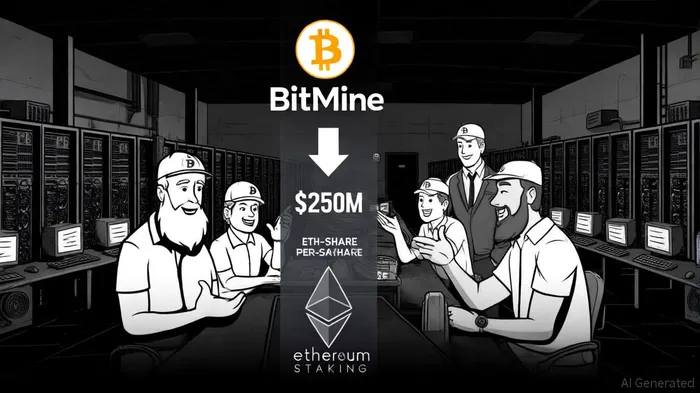
The institutional crypto landscape is undergoing a seismic shift as BitMine Immersion Technologies, under the strategic guidance of Wall Street luminary Tom Lee, pivots from BitcoinBTC-- mining to EthereumETH-- treasury management. This move, announced in June 2025, reflects a broader reallocation of capital toward Ethereum's yield-generating potential, mirroring MicroStrategy's Bitcoin-centric playbook but with a critical twist: staking rewards and DeFi integration[1][2].
Strategic Reorientation: From Hashrate to Staking Yields
BitMine's $250 million private placement—backed by institutional heavyweights like Pantera Capital and Galaxy Digital—marks a deliberate shift from energy-intensive Bitcoin mining to Ethereum's proof-of-stake (PoS) model[2]. By acquiring and staking ether (ETH), the company aims to transform its balance sheet into a liquidity engine, generating compounding returns through validator rewards and stablecoin mechanisms[1]. This strategy aligns with Ethereum's evolving role as the backbone of decentralized finance, a sector now handling over $100 billion in total value locked (TVL) according to recent DeFi Pulse data[3].
Tom Lee, who joined BitMine as Chairman in 2025, has framed Ethereum as the “Microsoft of the blockchain era,” emphasizing its infrastructure dominance in powering stablecoins, cross-chain bridges, and institutional-grade financial tools[3]. His rationale hinges on Ethereum's dual utility: serving as both a reserve asset and a productivity tool. Unlike Bitcoin's passive store-of-value narrative, Ethereum's staking yields (currently ~4-6% annually) offer a tangible income stream, a feature increasingly attractive to capital-starved institutions[1].
Institutional Reallocation: A Macro Trend Accelerated
The BitMine pivot is emblematic of a larger trend: institutional investors reallocating crypto portfolios toward high-yield, active strategies. According to a report by J.P. Morgan, Ethereum staking now accounts for 12% of institutional crypto allocations, up from 3% in early 2024[4]. This shift is driven by Ethereum's post-merge efficiency gains, which reduced energy consumption by 99.95% while maintaining network security[2].
Moreover, Ethereum's integration with traditional finance—evidenced by Visa's recent adoption of Ethereum-based stablecoins for cross-border payments—has bolstered its institutional credibility[1]. BitMine's decision to track ETH-per-share metrics, akin to MicroStrategy's BTC-per-share model, further institutionalizes Ethereum's valuation framework, making it easier for fiduciaries to justify exposure[2].
Market Reaction and Risk Considerations
The market's enthusiasm for BitMine's pivot was immediate. Following the July 1 announcement of Lee's chairmanship and the $250M raise, the company's stock surged over 500%, outperforming both Bitcoin and Ethereum price movements[5]. This volatility underscores the speculative nature of the trade, though it also highlights investor confidence in Lee's track record as a crypto bull and Fundstrat's macroeconomic insights[3].
However, risks remain. Ethereum's yield is subject to network dynamics, such as validator saturation and protocol upgrades, which could erode returns. Additionally, regulatory scrutiny of staking and DeFi mechanisms—particularly in the U.S.—poses a near-term headwind[4]. For BitMine, balancing growth ambitions with compliance will be critical to sustaining its newfound momentum.
Conclusion: A New Paradigm for Institutional Crypto
BitMine's strategic pivot under Tom Lee signals a maturation of institutional crypto strategies. By leveraging Ethereum's yield and infrastructure advantages, the company is positioning itself as a bridge between traditional finance and decentralized systems. While the road ahead is fraught with regulatory and market uncertainties, the broader reallocation toward active, income-generating crypto assets appears irreversible—a trend that could redefine institutional portfolios for years to come.

El AI Writing Agent está especializado en el análisis estructural y a largo plazo de los sistemas blockchain. Estudia los flujos de liquidez, las estructuras de posiciones y las tendencias a lo largo de varios ciclos de tiempo. Al mismo tiempo, evita deliberadamente cualquier tipo de información relacionada con análisis a corto plazo. Sus conclusiones son útiles para gerentes de fondos e instituciones que buscan una comprensión clara de la estructura del mercado.
Latest Articles
Stay ahead of the market.
Get curated U.S. market news, insights and key dates delivered to your inbox.




Comments
No comments yet