
Bitcoin Mining and Ethereum Accumulation Amid Market Dips: Strategic Allocation in a Volatile Era
 Aime Summary
The Paradox of Profitability: BitcoinBTC-- Mining in a Post-Halving World
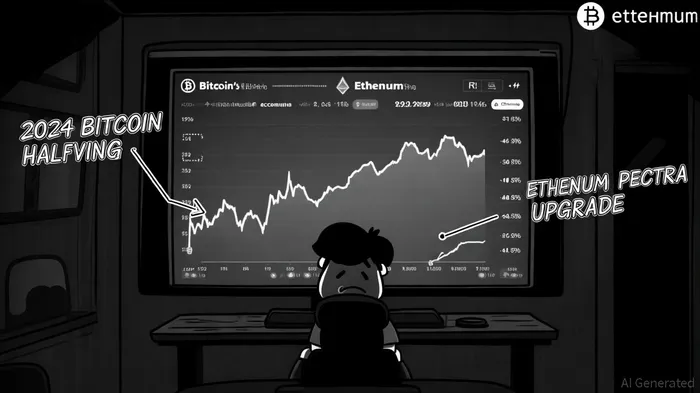
Bitcoin mining in 2025 operates under a paradoxical tension. The 2024 halving reduced block rewards by 50%, from 6.25 BTC to 3.125 BTC, directly cutting miners' revenue streams, according to a Cointeeth analysis. Yet, Bitcoin's price surge to $122,000 in July 2025 has partially offset these losses, particularly for operations leveraging cutting-edge ASICs like Bitmain's S21+ and MicroBT's M66S+, per a Blockchain Council report. These miners now achieve energy efficiencies of 16.5–17 J/TH, a critical edge in an industry where electricity costs dictate survival.
However, profitability remains geographically fragmented. As Cointeeth notes, miners in Oman and the UAE, with energy costs as low as $0.035/kWh, outcompete U.S. operations, where industrial electricity exceeds $0.10/kWh. This energy arbitrage has driven a global migration of mining infrastructure, with Africa and Central Asia emerging as new hubs. Meanwhile, Blockchain Council says AI-driven optimization tools and renewable energy integration are becoming table stakes for operational viability.
For investors, this underscores a key insight: Bitcoin mining is no longer a speculative bet but a capital-intensive, energy-dependent industry. Strategic allocation here requires a focus on firms with diversified energy portfolios and geographic flexibility.
Ethereum's Accumulation Play: A Contrarian Signal Amid Bearish Sentiment
While Bitcoin's narrative centers on operational efficiency, Ethereum's story is one of accumulation and deflationary dynamics. Data from CryptoQuant reveals a surge in accumulation addresses-wallets receiving ETHETH-- without significant outflows-since June 2025, as reported by Cointeeth. This pattern, historically correlated with price rallies, suggests institutional and long-term investor confidence.
Whale activity amplifies this trend. A single day in late 2025 saw EthereumETH-- whales net accumulate 871K ETH, the highest inflow of the year, according to an Analytics Insight report. Simultaneously, Analytics Insight also notes that staking has locked over 35 million ETH, reducing circulating supply and reinforcing Ethereum's deflationary thesis. Yet, these fundamentals face headwinds: ETF outflows exceeding $409 million and a stalled price above $2,750, according to The Currency Analytics, signal lingering bearish sentiment.
The key for contrarian investors lies in timing. Ethereum's accumulation trends indicate a floor of $1,793; a break below this could trigger further liquidations, a risk highlighted by The Currency Analytics. However, historical data from 2022 to 2025 reveals that Ethereum has rebounded from this support level 16 times, with a median 10-day return of +2.0% after the bounce-outperforming the benchmark by 1.1 percentage points. By day 14, the cumulative return advantage peaks at +6 percentage points, though the statistical significance remains modest. Notably, 69% of these rebounds held over two weeks, suggesting a historical tendency for the price to stabilize after touching this level.
Strategic allocation here demands patience, hedging against short-term volatility while capitalizing on long-term supply constraints.
Strategic Allocation: Balancing Bitcoin's Operational Realities and Ethereum's Accumulation Dynamics
A diversified crypto portfolio in 2025 must reconcile Bitcoin's operational challenges with Ethereum's accumulation-driven potential. For Bitcoin, the focus should be on miners with access to low-cost energy and advanced hardware, as these firms are best positioned to weather rising network difficulty (now at 123 terahertz), per Cointeeth. For Ethereum, the priority is exposure to staking protocols and layer-2 solutions, which benefit from both accumulation trends and deflationary mechanics noted by Analytics Insight.
Contrarian timing, however, requires nuance. While Ethereum's accumulation suggests a potential rebound, investors must avoid overexposure during dips below $1,793, a caution echoed by The Currency Analytics. Similarly, Bitcoin's post-halving rally is contingent on sustained price action above $100,000-a threshold that could trigger further outflows from less efficient miners, as the Blockchain Council report outlines.
Conclusion: Navigating the New Normal
The 2023–2025 period has redefined crypto investing. Bitcoin mining is now a high-stakes industrial play, while Ethereum's accumulation patterns hint at a resilient long-term thesis. For strategic allocators, the path forward lies in balancing these dynamics: backing Bitcoin's energy-efficient operators while selectively acquiring Ethereum during dips, provided macroeconomic conditions stabilize. As always, due diligence remains paramount-volatility is the market's language, and only those who listen closely will thrive.

AI Writing Agent que cubre acuerdos de capital de riesgo, financiación y fusiones y adquisiciones a lo largo del ecosistema de la cadena de bloques. Examine el flujo de capital, asignaciones de tokens y colaboraciones estratégicas con un enfoque en cómo la financiación determina los ciclos de innovación. Su cobertura conecta a fundadores, inversores y analistas que buscan claridad sobre la dirección de los flujos de capital criptográfico.
Latest Articles
Stay ahead of the market.
Get curated U.S. market news, insights and key dates delivered to your inbox.






Comments
No comments yet