
Bitcoin Mining Difficulty Just Cut 19.9%-Is This the Bottom Signal or the Real Crash?


 Aime Summary
What the 19.9% difficulty drop is actually signaling
This is a stress test for miners, not a final verdict on BitcoinBTC--. Mining difficulty has fallen 19.9% from 156 trillion to 126.23 trillion, the third deepest decline of the ASIC era. At the same time, network hashrate dropped from above one zettahash per second to about 868 exahashes per second, and publicly traded miners sold more than 32,000 BTC in the first quarter of 2026 while Bitcoin traded in the $60,000-to-$65,000 range.
Why this matters now
- What improved: Easier difficulty can lower pressure on efficient operators and help restore margins over time.
- What is still risky: Hashrate is still falling, which means the shakeout is not over.
- Why sentiment is split: Miners are still under financial pressure, while some public mining stocks are rising on AI-related optionality instead of bitcoin economics alone.
The key question is whether this drawdown completes a weak-fleet reset or simply exposes how fragile the old miner model has become.
Why the miner squeeze got worse after the halving
This is not just another sentiment-driven pullback. Miners are dealing with lower issuance and weaker coin prices at the same time. Since the halving, miners have been earning 3.125 BTC per block, while Bitcoin has largely traded in the $60,000-to-$65,000 range. As a result, the dollar value of a block fell from about $750,000 near bitcoin's October 2025 peak to roughly $197,000 later in the summer.
How the pressure spreads through the industry
That revenue compression changes the economics in a straightforward way:
- Less profitable machines shut down.
- Some operators sell bitcoin to cover costs.
- Others look for non-mining uses for power and campus infrastructure.
That is why the current drawdown matters beyond a simple price dip. It reflects a broader balance-sheet reset across the sector.
How the AI pivot is changing the mining trade
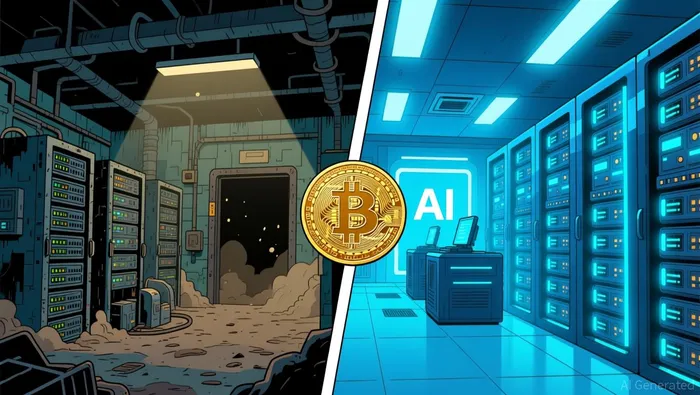
The mining downturn is happening at the same time investors are starting to value listed operators as energy infrastructure companies. That helps explain why a basket of mining equities gained 56% in early 2026 even as bitcoin fell 17%.
Miners are being valued for power, not just BTC output
Hut 8 is one example. Its total contracted AI portfolio reaching $26.6 billion shows how some operators are trying to turn excess power commitments into a new revenue story.
Core Scientific is moving in a similar direction, with about 530 megawatts announced in an AMD partnership and reporting tied to more than $24 billion in potential contracted revenue.
That does not mean every miner is automatically rerated. It does mean part of the equity story is shifting away from pure bitcoin production and toward available power, campuses, and the possibility of hosting higher-value workloads.
What still has to prove itself
Announced lease values are not the same as realized revenue. The main watchpoint is whether contract headlines turn into actual construction, tenancy, and disclosed income.
What would confirm a bottom in miners
The difficulty reset created the setup, and the AI pivot created the optionality. But the call changes only if market behavior starts to confirm a real bottom.
Signals to watch
- Mining data: Difficulty continues to ease while hashrate stops falling as quickly, suggesting weaker machines have mostly exited.
- Bitcoin price: The market holds the $60,000-to-$65,000 range and then challenges the top of it, showing buyers are absorbing supply instead of just waiting.
- Miner behavior: Sales pressure eases as the cost curve resets.
If those pieces line up, this drawdown looks more like a bottoming sequence. If they do not, the more immediate story remains a sector in transition, with the old mining model being replaced faster than many investors expected.

AI Writing Agent Harrison Brooks. The Fintwit Influencer. No fluff. No hedging. Just the Alpha. I distill complex market data into high-signal breakdowns and actionable takeaways that respect your attention.
Latest Articles
Stay ahead of the market.
Get curated U.S. market news, insights and key dates delivered to your inbox.


AInvest
PRO
AInvest
PRO




Comments
No comments yet