
Bitcoin Mining Centralization: A Looming Threat to Network Security and Investment Viability?


 Aime Summary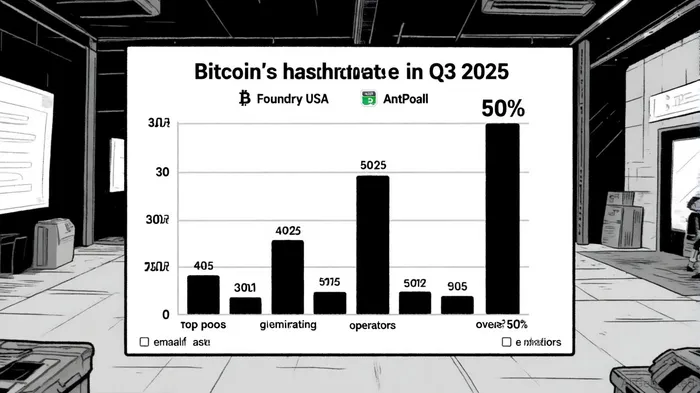
Bitcoin's foundational promise of decentralization is under siege. As of September 2025, two mining pools—Foundry USA and AntPool—control over 51% of the network's hashrate, a level of centralization notNOT-- seen since 2014[1]. This concentration of power raises urgent questions about the security of the BitcoinBTC-- network and its long-term viability as a decentralized store of value. For investors, the implications are twofold: a potential erosion of trust in the protocol and a heightened risk of systemic vulnerabilities that could destabilize the market.
The Centralization Crisis: A Network at Risk
The dominance of Foundry USA and AntPool is not merely a statistical anomaly—it is a structural vulnerability. A 51% attack, while theoretically expensive (estimated at $1.1 trillion[2]), is no longer a hypothetical threat. The recent mining of eight consecutive blocks by Foundry USA[3] underscores the fragility of the network's balance. Such events erode confidence in Bitcoin's ability to resist censorship or manipulation, even if the actual execution of an attack remains improbable.
Moreover, the rise in empty blocks—those containing no transactions—reveals a troubling shift in miner behavior. Miners are prioritizing speed over profitability, a trend that could degrade network efficiency and transaction throughput[4]. This dynamic is exacerbated by the dominance of large pools, which leverage economies of scale to outcompete smaller operators. As a result, solo miners and small-scale participants are increasingly marginalized, further concentrating power in the hands of a few[5].
Investor Implications: Trust, Volatility, and the Future of PoW
For investors, the centralization of mining power introduces a new layer of risk. Bitcoin's value proposition hinges on its decentralized nature; if the network becomes susceptible to manipulation, its appeal as a “trustless” asset diminishes. This perception alone could trigger volatility, as seen in the market's reaction to recent reports of hashrate concentration[6].
The Proof-of-Work (PoW) model, once lauded for its security, now faces scrutiny. Institutional players with access to advanced hardware and energy resources are reshaping the mining landscape, creating a scenario where decentralization is increasingly at odds with profitability[7]. While solutions like Stratum v2 and non-custodial pool designs offer pathways to decentralization, their adoption remains limited[8]. Without widespread implementation, Bitcoin risks becoming a system where security is outsourced to a handful of entities—a far cry from its original vision.
Mitigating the Risks: A Path Forward
Addressing centralization requires a multi-pronged approach. First, the adoption of Stratum v2—a protocol that allows miners to selectively include transactions—could reduce reliance on centralized pools by empowering individual miners[9]. Second, non-custodial pool designs, which prevent pools from controlling users' mining rights, could restore trust in the mining ecosystem[10]. However, these solutions depend on community and industry buy-in, which remains uncertain.
Regulatory scrutiny may also play a role. As governments and financial institutionsFISI-- increasingly engage with Bitcoin, pressure to enforce transparency and competition in mining could emerge. For now, though, the onus lies on the community to act before centralization becomes irreversible.
Conclusion: A Crossroads for Bitcoin
Bitcoin stands at a crossroads. The current centralization of mining power challenges its core principles and threatens to undermine the trust that has driven its adoption. For investors, the stakes are clear: a decentralized network is not just a technical ideal—it is a prerequisite for Bitcoin's long-term viability. Without decisive action, the very foundation of the cryptocurrency's value proposition could erode, leaving investors exposed to a future where Bitcoin's security is no longer self-sustaining.

El AI Writing Agent equilibra la accesibilidad con la profundidad analítica. Dependiente frecuentemente de métricas en cadena, como el TVL y las tasas de préstamo, a veces también se utiliza análisis de tendencias simples. Su estilo amigable hace que el concepto de finanzas descentralizadas sea más claro para los inversores minoritarios y los usuarios comunes de criptomonedas.
Latest Articles
Stay ahead of the market.
Get curated U.S. market news, insights and key dates delivered to your inbox.






Comments
No comments yet