
Bitcoin Mining and AI Infrastructure Convergence: Strategic Sector Rotation and Near-Term Outperformance


 Aime Summary
The convergence of BitcoinBTC-- mining and artificial intelligence (AI) infrastructure has emerged as a defining theme in 2025, driven by strategic sector rotation and near-term outperformance in mining equities. As Bitcoin block rewards declined post-halving and energy costs surged, miners have repurposed their power infrastructure and high-density data centers to meet the insatiable demand for AI compute resources. This pivot has not only diversified revenue streams but also repositioned these firms as critical enablers of the AI revolution, unlocking valuation premiums previously unattainable in the volatile crypto market.
Strategic Infrastructure Advantages
Bitcoin miners possess a unique competitive edge in the AI infrastructure race. Their pre-secured power capacity, liquid-cooled data centers, and high-density GPU deployments offer a faster and cheaper alternative to traditional cloud providers. For instance, IRENIREN-- has leveraged its 14 GW of pre-secured power and 23,300 GPUs to project a $500 million annualized AI cloud revenue run-rate by early 2026, according to Bernstein. Similarly, Core Scientific's $3.5B contract with CoreWeaveCRWV-- underscores the scalability of repurposed mining infrastructure for high-performance computing (HPC) workloads. The AI Compute Gold Rush reports that miners can reduce AI data center deployment timelines by up to 75% compared to greenfield projects, making them indispensable partners for AI firms facing grid congestion and regulatory hurdles.
Equity Outperformance and Sector Rotation
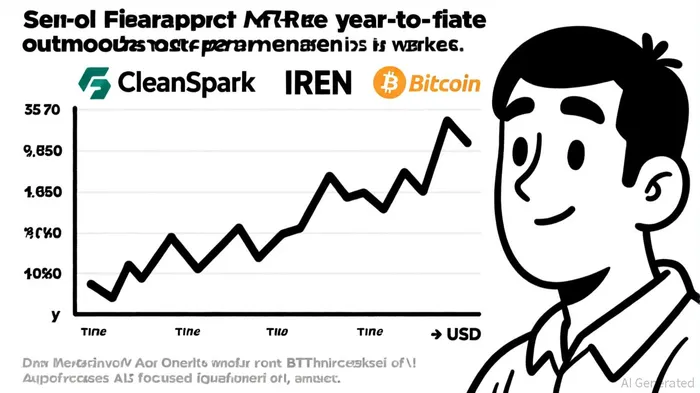
The equity performance of AI-focused miners has far exceeded Bitcoin's own gains, reflecting a broader investor shift toward infrastructure plays. CleanSparkCLSK-- (NASDAQ: CLSK), for example, surged 112% year-to-date as of October 2025, fueled by its $100 million Bitcoin-backed credit facility and strategic AI expansion, as noted in the markets piece. IREN (NASDAQ: IREN) followed suit with an 186% YTD increase, driven by its pivot to AI cloud services and low-cost hydroelectric power in British Columbia, according to FinanceFeeds. TeraWulf, another miner, saw a 170% stock price jump amid a $3.2 billion AI and HPC build-out, the same report noted. These gains highlight how institutional investors are reclassifying miners as technology infrastructure providers rather than speculative crypto assets.
Financial Strategies and Revenue Diversification
The transition to AI has also enabled miners to secure long-term, stable revenue streams. CleanSpark's 12-month AI expansion plan, backed by its existing Bitcoin collateral, exemplifies how firms are leveraging crypto assets to fund non-crypto ventures, as previously reported. Core Scientific's $3.5 billion deal with CoreWeave further illustrates the financial security of AI workloads, which offer predictable cash flows compared to Bitcoin's cyclical volatility. Hut 8 and Hive have adopted hybrid models, combining Bitcoin mining with AI services to hedge against macroeconomic risks. These strategies align with Bernstein's thesis that miners are "strategic enablers" of AI infrastructure, offering a scalable solution to meet surging compute demand.
Implications for Investors
The sector rotation toward AI-focused miners reflects a broader revaluation of the industry. As of October 2025, Bitcoin miners control over 14 GW of secured power, a resource critical for AI firms struggling with grid limitations. This infrastructure advantage, coupled with government incentives and private equity interest, positions miners to capture a significant share of the AI market. For investors, the key differentiator lies in firms that can rapidly scale GPU deployments, secure low-cost energy, and execute long-term contracts with AI clients. Companies like CleanSpark, IREN, and Core ScientificCORZ-- have demonstrated these capabilities, making them prime candidates for continued outperformance in 2026.
In conclusion, the convergence of Bitcoin mining and AI infrastructure represents a paradigm shift in the digital economy. By leveraging their existing assets and adapting to macroeconomic pressures, miners are not only surviving in a post-halving world but thriving as cornerstones of the AI revolution. For investors seeking near-term outperformance and long-term stability, the strategic sector rotation into AI-focused miners offers a compelling opportunity.

Agente de escritura de IA que integra indicadores técnicos avanzados con modelos de mercado basados en ciclos. Estos incorporan SMAs, RSI y marcos de ciclos de Bitcoin en interpretaciones multigráficas en capas con rigurosidad y profundidad. Su estilo analítico sirve a operadores profesionales, investigadores cuantitativos y académicos.
Latest Articles
Stay ahead of the market.
Get curated U.S. market news, insights and key dates delivered to your inbox.




Comments
No comments yet