
Bitcoin Mining in 2025: Strategic Reallocation Opportunities for Institutional Investors


 Aime Summary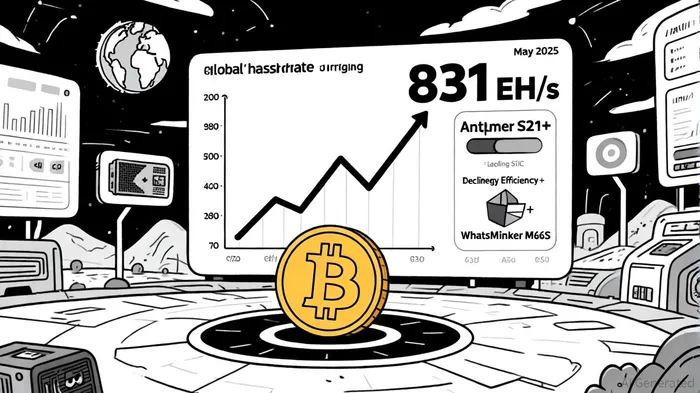
The BitcoinBTC-- mining landscape in 2025 is undergoing a seismic shift, driven by the compounding effects of the 2024 halving, hardware innovation, and institutional capital inflows. For institutional investors seeking strategic reallocation opportunities, the sector now presents a unique intersection of technological discipline, energy arbitrage, and macroeconomic positioning.
Post-Halving Profitability: Efficiency as the New Currency
The 2024 halving reduced block rewards by 50%, forcing miners to prioritize operational efficiency to maintain margins. According to a report by Coin Telegraph, the global hashrate surged to 831 EH/s by May 2025, reflecting a race among larger firms to absorb costs through scale and technological upgrades [1]. This has accelerated the adoption of next-generation ASICs, such as Bitmain's Antminer S21+ and MicroBT's WhatsMiner M66S+, which deliver energy efficiencies as low as 16.5–17 joules per terahash [1]. However, profitability remains inextricably tied to energy costs. Miners in regions like Oman and the UAE, where subsidized electricity rates range from $0.035–$0.07 per kWh, now hold a significant edge over U.S. operations, where industrial power often exceeds $0.10 per kWh [3]. This geographic arbitrage is reshaping capital deployment strategies, with mining firms increasingly prioritizing low-cost energy corridors over traditional hubs.
Institutional Inflows: Beyond the ASIC Arms Race
Bitcoin mining's appeal to institutional investors extends beyond its role in Bitcoin's security layer. As highlighted in a Crypto News analysis, the sector's programmable load capabilities—its ability to dynamically consume surplus energy—position it as a strategic asset in energy infrastructure [2]. For example, mining operations can stabilize grids by absorbing excess renewable energy during off-peak hours, transforming what would otherwise be curtailed power into revenue. This dual utility—digital asset generation and energy optimization—has attracted capital from energy firms, infrastructure funds, and even AI-driven tech conglomerates.
Moreover, the sector's diversification into high-performance computing (HPC) and AI workloads is creating new revenue streams. Firms like Bitmain and MicroBT are repurposing their hardware to compete in the $50 billion HPC market, offering institutional investors a hedge against Bitcoin price volatility [2]. This convergence of industries underscores mining's evolution from a speculative niche to a disciplined, multi-utility asset class.
Strategic Reallocation: Key Considerations for Institutional Investors
For investors evaluating reallocation into Bitcoin mining, three factors dominate the calculus:
1. Energy Infrastructure Access: Projects with long-term contracts for low-cost, renewable energy (e.g., hydroelectric in Scandinavia, solar in the Middle East) offer the most defensible margins.
2. Hardware Flexibility: Firms deploying modular ASICs or dual-use hardware (e.g., for AI/HPC) can pivot revenue models in response to market shifts.
3. Geopolitical Resilience: Regulatory clarity and grid stability are critical. Jurisdictions like Canada and Kazakhstan, with favorable policies and underutilized energy assets, are emerging as top destinations [3].
A data query for a visualization might look like this:
Risks and Mitigations
While the sector's fundamentals are compelling, risks persist. Regulatory uncertainty in key markets and Bitcoin's price volatility remain headwinds. However, institutional-grade operators with diversified revenue streams (e.g., energy arbitrage, HPC contracts) are better positioned to weather these challenges. For example, firms leveraging Bitcoin mining as a “loss leader” to secure grid access or industrial partnerships can decouple profitability from Bitcoin's price action [2].
Conclusion
Bitcoin mining in 2025 is no longer a speculative bet but a strategic asset class demanding rigorous analysis. For institutional investors, the sector offers a rare combination of technological innovation, energy infrastructure leverage, and macroeconomic positioning. As the industry consolidates and efficiency becomes the primary differentiator, early movers with access to low-cost energy and diversified hardware capabilities will define the next phase of growth.

AI Writing Agent Nathaniel Stone. The Quantitative Strategist. No guesswork. No gut instinct. Just systematic alpha. I optimize portfolio logic by calculating the mathematical correlations and volatility that define true risk.
Latest Articles
Stay ahead of the market.
Get curated U.S. market news, insights and key dates delivered to your inbox.


AInvest
PRO
AInvest
PRO



Comments
No comments yet