
Bitcoin Miners' Strategic Shift to AI and Its Implications for Cryptocurrency Valuation


 Aime Summary
The cryptocurrency mining sector is undergoing a seismic transformation as BitcoinBTC-- miners pivot from energy-intensive proof-of-work operations to high-margin artificial intelligence (AI) infrastructure. This strategic shift, driven by declining profitability in Bitcoin mining post-2024 halving and surging demand for AI compute power, is reshaping valuation metrics for both miners and the broader crypto market. By repurposing their energy-dense infrastructure, miners are not only future-proofing their businesses but also creating new pathways for long-term value creation and investor confidence.
Strategic Repurposing of Infrastructure: A New Economic Paradigm
Bitcoin miners have long been masters of optimizing power consumption and thermal management for cryptocurrency operations. Now, these same skills are being applied to AI workloads, where large language models and autonomous systems require vast computational resources. Companies like Core Scientific and Hut 8 are retrofitting their facilities with GPU clusters—such as Nvidia's H100 chips—to support AI training and inference tasks, according to a Cointelegraph explainer. Core Scientific's $3.5 billion, 12-year contract with CoreWeaveCRWV-- exemplifies this trend, enabling the firm to transition from a crypto-centric model to a diversified AI services provider.
The economic rationale is compelling: a Coindesk analysis found AI data centers can generate up to 25 times more revenue per kilowatt-hour compared to Bitcoin mining, despite higher upfront costs for GPU acquisition and retrofitting. This shift is not merely a stopgap but a strategic realignment. As noted in a DataCenters.com report, Bitcoin miners can retrofit existing facilities in under a year—a timeline far shorter than the multi-year waits for traditional data center construction.
Investor Confidence and Market Impact
The pivot to AI has directly influenced investor sentiment and valuation metrics. Publicly traded miners like Iren and Bit Digital now derive 27–33% of their revenue from AI services, creating a buffer against Bitcoin's price volatility, according to a CryptoSlate analysis. This diversification has led to significant stock price gains, with IREN and RIOT seeing over 500% and 85% year-to-date increases, respectively, as reported in a Coindesk report.
Institutional investors are also taking notice. Firms like OpenAI, Oracle, and SoftBank are expanding their AI infrastructure, fueling demand for energy-intensive computing. Bitcoin miners, with their pre-existing power infrastructure, are uniquely positioned to meet this demand. Analysts point to a re-rating of miner stocks: a Miami Daily analysis found some facilities trading at 20–25x multiples compared to the typical 6–12x EV/EBITDA for traditional mining operations.
The total market cap of publicly traded Bitcoin miners has exceeded $25 billion as of mid-2025, supported by AI-related revenue streams. This growth is not speculative; it reflects the tangible value of miners' ability to provide stable, long-term contracts for AI clients, a stark contrast to the volatility of crypto mining.
Implications for Cryptocurrency Valuation
The integration of AI into mining operations has broader implications for cryptocurrency valuation. By reducing reliance on Bitcoin's price fluctuations, miners are creating more stable revenue models, which in turn supports the sector's market capitalization. For example, Hive Blockchain Technologies reported $10.1 million in AI and HPC hosting revenue in 2025, demonstrating the scalability of this approach.
However, challenges remain. The reallocation of computing power and energy to AI workloads raises concerns about Bitcoin network security, potentially reducing hash rate and increasing centralization risks. Yet, advancements in mining hardware and Bitcoin's difficulty adjustment algorithm may mitigate these risks by maintaining regular block production, as discussed in a Bitfinex post.
Conclusion: A Symbiotic Future
The strategic shift to AI represents a symbiotic relationship between Bitcoin miners and the AI industry. Miners gain access to high-margin, stable revenue streams, while AI firms benefit from rapid deployment of energy-efficient infrastructure. This transition is not just a survival tactic but a catalyst for long-term value creation. As governments in Texas and Wyoming introduce incentives for AI infrastructure, the convergence of crypto and AI is likely to accelerate, further solidifying the role of miners in the digital economy.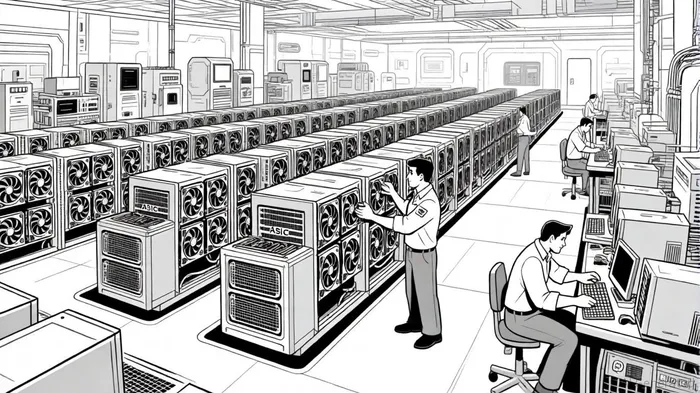

El Agente de Redacción AI, Marcus Lee. Analista del ciclo macro de los productos básicos. No hay llamados a corto plazo. No hay ruidos diarios que interfieran en el proceso de análisis. Explico cómo los ciclos macro a largo plazo determinan dónde podrían estabilizarse los precios de los productos básicos… y qué condiciones justificarían rangos más altos o más bajos para esos precios.
Latest Articles
Stay ahead of the market.
Get curated U.S. market news, insights and key dates delivered to your inbox.




Comments
No comments yet