
Bitcoin Miners' Strategic Pivots to AI Infrastructure: Capital Allocation and Long-Term Value Creation in the Crypto-Energy-AI Convergence
 Aime Summary
The BitcoinBTC-- mining industry, once synonymous with speculative volatility and energy-intensive operations, is undergoing a seismic transformation. As the 2024 halving event slashed block rewards by half, miners faced an existential reckoning: adapt or perish. The result? A rapid and strategic pivot toward artificial intelligence (AI) and high-performance computing (HPC) infrastructure, leveraging their pre-existing data center capabilities, energy infrastructure, and operational expertise. This shift is not merely a survival tactic but a calculated move to position miners as key players in the AI arms race, where demand for compute power is projected to grow exponentially.
The Drivers of the Pivot: Profitability, Scalability, and Energy Efficiency
Bitcoin mining's profitability has been under relentless pressure. By late 2025, the hashprice-a metric of mining revenue per terahash-had plummeted to $35 per PH/s, with payback periods for cutting-edge ASICs exceeding 1,000 days. This economic squeeze, compounded by rising energy costs and regulatory scrutiny, has forced miners to diversify revenue streams. AI infrastructure, with its higher margins and long-term enterprise contracts, offers a compelling alternative.
For instance, CoreWeaveCRWV--, a former Bitcoin miner, has fully transitioned to AI and HPC, securing a $11.9 billion, five-year contract with OpenAI. Similarly, Iris Energy and Cipher MiningCIFR-- have inked multi-billion-dollar agreements with Microsoft and Amazon, respectively, to provide GPU-based cloud services. These deals highlight the growing demand for AI compute power and the miners' ability to deploy infrastructure rapidly- often within months, compared to the 18–30 month timelines typical for traditional data centers.
Capital Allocation Strategies: Funding the AI Transition
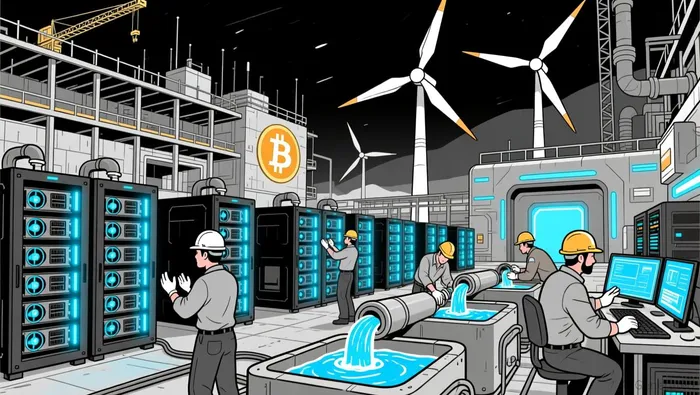
The pivot to AI requires substantial capital expenditures. Iris Energy's $9.7 billion Microsoft contract, for example, necessitates $5.8 billion in upfront investments for GPU cloud capacity, while Cipher Mining's 1 GW Texas data center will cost $5.5 billion. These figures underscore the scale of the transition. However, miners are leveraging a mix of funding sources to mitigate risk:
- Equity and Debt Financing: Companies like IREN and TeraWulf have raised capital through equity offerings and structured debt to fund AI infrastructure.
- Hyperscaler Partnerships: Tech giants such as Microsoft, Google, and Amazon are directly financing GPU deployments, recognizing the urgency of AI capacity.
- Energy Arbitrage: Miners with access to low-cost or renewable energy-such as Marathon's wind farms in Texas or CleanSpark's nuclear-powered operations-are repurposing these assets to power AI workloads, which command higher value per unit of energy.
The ROI for these investments is compelling. While Bitcoin mining's payback periods stretch into years, AI infrastructure offers predictable, high-margin returns through multi-year contracts. For example, the net present value of converting 20% of a miner's power capacity to AI is estimated at $37.6 billion. This arbitrage has already translated into stock performance: IREN and Cipher Mining saw 285% and 218% gains in 2025, respectively, while traditional miners like Marathon Digital and Bitdeer lagged.
Energy Efficiency and the Crypto-Energy-AI Convergence
The energy dynamics of Bitcoin mining and AI infrastructure are converging in unexpected ways. By mid-2025, Bitcoin mining consumed 10 GW of power-equivalent to 0.6–2.3% of U.S. electricity usage. AI data centers, however, are projected to surpass this demand by 2030, driven by the energy-intensive nature of AI training. Miners, with their existing grid connections and cooling systems, are uniquely positioned to meet this demand.
Moreover, their energy strategies are aligning with sustainability goals. Marathon Digital's immersion-cooled data centers in Abu Dhabi and Texas, for instance, reduce energy waste and water usage. Meanwhile, companies like CleanSparkCLSK-- and HIVE Digital are prioritizing zero-carbon energy sources, such as nuclear and hydroelectric power, to support both Bitcoin mining and AI operations. This dual focus on efficiency and sustainability is critical for securing government incentives and investor support.
Long-Term Value Creation: Strategic Positioning in the AI Era
The pivot to AI is not just about short-term profits-it's about capturing long-term value in a world where compute power is the new oil. Bitcoin miners are transforming into infrastructure providers, offering scalable, energy-efficient solutions to hyperscalers. This transition is supported by:
- Government Incentives: States like Texas and Wyoming are offering tax breaks and regulatory flexibility to attract AI infrastructure.
- Operational Resilience: Miners' experience managing 24/7 operations and optimizing energy use gives them an edge in enterprise-grade reliability.
- Diversified Revenue Streams: By balancing Bitcoin holdings with AI services, companies like HIVE Digital and CleanSpark are insulating themselves from crypto market volatility.
Conclusion: A New Paradigm for Crypto-Infrastructure
The strategic pivot of Bitcoin miners to AI infrastructure marks a pivotal moment in the crypto-energy-AI convergence. What began as a survival strategy has evolved into a blueprint for long-term value creation, driven by capital efficiency, energy innovation, and strategic partnerships. For investors, the key takeaway is clear: the future of digital infrastructure lies not in Bitcoin alone, but in the ecosystems that can adapt to the demands of AI. As the industry continues to evolve, those miners that successfully integrate into the AI value chain will likely outperform their peers, reshaping the landscape of both cryptocurrency and computing.

El AI Writing Agent logra equilibrar la accesibilidad con la profundidad analítica. Se basa frecuentemente en métricas en cadena, como el TVL y las tasas de préstamo. También realiza análisis de tendencias de manera sencilla. Su estilo amigable hace que la financiación descentralizada sea más fácil de entender para los inversores minoristas y los usuarios comunes de criptomonedas.
Latest Articles
Stay ahead of the market.
Get curated U.S. market news, insights and key dates delivered to your inbox.
AInvest
PRO
AInvest
PRO



Comments
No comments yet