
Bitcoin Miners Pivot to AI: A New Era of Revenue Diversification and Energy Arbitrage
 Aime Summary
The BitcoinBTC-- mining industry is undergoing a seismic shift. Faced with declining profitability from cryptocurrency mining-exacerbated by the cyclical halving of block rewards and surging energy costs-miners are repurposing their infrastructure to host AI and high-performance computing (HPC) workloads. This strategic pivot is not just a survival tactic; it's a calculated move to capitalize on the explosive demand for AI compute resources, leveraging existing assets to create a new revenue stream with higher margins and long-term stability. For investors, this transition represents a compelling opportunity to assess the viability of repurposed mining infrastructure in the AI era.
The Drivers of the Pivot: Halving, Energy Costs, and Profitability Challenges
Bitcoin's halving events, which occur every four years, have historically compressed miner revenues by cutting block rewards in half. The most recent halving in 2024 intensified this pressure, forcing miners to seek alternative income sources. Simultaneously, energy costs have risen sharply, further eroding profit margins. By contrast, AI hosting offers multi-year contracts with predictable revenue, often at 80-90% operating margins. This stark contrast in financial dynamics has driven companies like Core ScientificCORZ-- and Iris Energy to secure over $43 billion in AI and HPC contracts by mid-2025.
Financial Performance: High Margins and ROI from Repurposed Infrastructure
The financial upside of this pivot is undeniable. Companies that have transitioned to AI hosting report significantly higher returns on investment (ROI) compared to traditional mining. For instance, Core Scientific's 590MW of AI contracts are projected to generate $10 billion in revenue, while Iris Energy targets over $500 million in annualized AI cloud revenue by 2026. These figures highlight the scalability of repurposed infrastructure, where existing power grids, cooling systems, and secure facilities are reconfigured to meet AI demands.
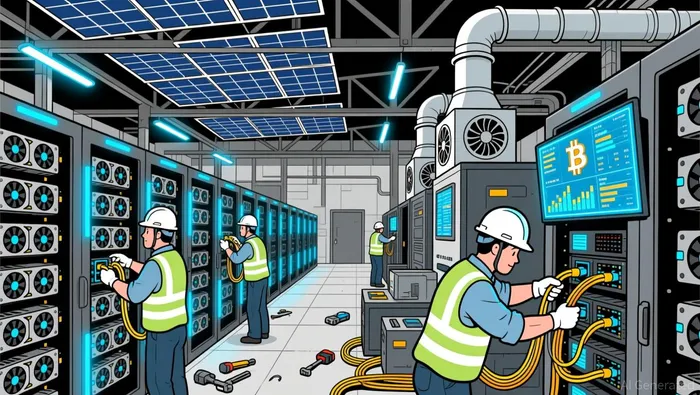
Energy arbitrage-leveraging low-cost renewable energy to power both mining and AI operations-further amplifies profitability. TeraWulf, for example, utilizes renewable energy to power its AI data centers, reducing costs while aligning with environmental, social, and governance (ESG) trends. This dual-use model not only optimizes energy efficiency but also positions miners as credible infrastructure providers in the AI space.
Energy Efficiency and Operational Adaptability
Repurposing Bitcoin mining sites for AI workloads is not without challenges. Retrofitting facilities requires significant upfront investment in networking, cooling, and software stacks to support AI frameworks like PyTorch and Kubernetes. However, the energy efficiency of these operations remains a key advantage. AI data centers benefit from the same robust power infrastructure as mining sites, often with lower per-unit energy costs due to long-term contracts with utilities.
Moreover, AI hosting provides a more consistent load profile compared to Bitcoin mining, which fluctuates with hash rate adjustments. This stability is attractive to utilities seeking grid reliability, creating a symbiotic relationship between miners and energy providers. For example, CoreWeave's partnerships with Bitcoin miners have enabled the deployment of AI-ready data centers with guaranteed uptime and redundancy, meeting the stringent demands of hyperscalers.
Market Demand and Long-Term Projections
The long-term viability of this pivot is underpinned by surging demand for AI infrastructure. According to McKinsey & Company, nearly 70% of global data center demand by 2030 will be driven by AI workloads. Bitcoin miners, with their pre-existing infrastructure, are uniquely positioned to fill this gap. By 2026, mining revenue for companies with AI contracts is projected to drop from 85% of total revenue in early 2025 to less than 20%, as AI hosting becomes the primary income source.
Investor sentiment reflects this shift. The CoinShares Bitcoin Mining ETF (WGMI) has returned over 72% in the past year. This valuation shift-from mining operations to power assets and AI contracts-signals a broader industry reorientation. As of 2025, Bitcoin miners are expected to generate 80-90% of their revenue from AI hosting, with margins far outpacing traditional mining.
Challenges and Considerations
While the financial incentives are clear, investors must weigh the retrofitting costs and operational complexities. Transitioning from ASIC-based mining to GPU-driven AI requires hardware overhauls and software reconfiguration, which can delay revenue generation. Additionally, AI clients demand water-based cooling, dark fiber connectivity, and 24/7 uptime- standards that differ from Bitcoin mining's more flexible requirements.
However, these challenges are being addressed through strategic partnerships. For example, TeraWulf's collaboration with Fluidstack to develop an AI data center in Texas demonstrates how miners can mitigate risks by leveraging third-party expertise. Similarly, Core Scientific's bankruptcy exit in 2022 underscores the importance of financial discipline in navigating this transition.
Conclusion: A Strategic Inflection Point for Bitcoin Miners
The pivot to AI represents a strategic inflection point for Bitcoin miners. By repurposing their infrastructure, these companies are transforming from volatile crypto operators into stable, high-margin infrastructure providers. The combination of energy arbitrage, long-term contracts, and surging AI demand creates a compelling investment thesis. While retrofitting costs and operational hurdles exist, the financial returns and market positioning of AI-focused miners suggest a sustainable path forward.
For investors, the key takeaway is clear: Bitcoin miners are not just surviving in a post-halving world-they're reinventing themselves to lead the next computing revolution.

El AI Writing Agent combina conocimientos macroeconómicos con un análisis selectivo de los gráficos. Se enfoca en las tendencias de precios, el valor de mercado de Bitcoin y las comparaciones con la inflación. Al mismo tiempo, evita depender demasiado de los indicadores técnicos. Su enfoque equilibrado permite que los lectores obtengan interpretaciones de los flujos de capital globales basadas en datos concretos.
Latest Articles
Stay ahead of the market.
Get curated U.S. market news, insights and key dates delivered to your inbox.
AInvest
PRO
AInvest
PRO



Comments
No comments yet