
Bitcoin Miners and Institutional Buy-Ins: A New Era of Digital Gold Accumulation


 Aime Summary
The institutionalization of BitcoinBTC-- mining has reached a tipping point. What was once a niche, speculative corner of the crypto market is now a strategic asset class for global investors. From 2023 to 2025, institutional capital has poured into Bitcoin mining infrastructure, reshaping operational strategies, treasury management, and long-term value creation. This shift isn't just about buying Bitcoin-it's about building the rails for a digital gold standard.
The Institutional Surge: From Speculation to Strategic Infrastructure
Institutional investors are no longer just holding Bitcoin. They're building it. Canaan Inc.CAN--, a Nasdaq-listed mining hardware manufacturer, raised $72 million in late 2025 through strategic equity investments from BH Digital, Galaxy DigitalGLXY--, and Weiss Asset Management Canaan's $72M raise. This funding isn't for speculative bets-it's for high-return infrastructure projects, including next-generation mining hardware and renewable energy integration. The move reflects a broader trend: institutional capital is prioritizing operational efficiency and sustainability over short-term volatility.
The numbers tell the story. By early 2025, 59% of institutional investors allocated at least 10% of their portfolios to Bitcoin and digital assets an RSM report. Spot Bitcoin ETFs, approved in early 2024, have attracted over $65 billion in assets under management (AUM) globally by April 2025. These vehicles have democratized access to Bitcoin for large investors, but the real action is in the mining sector, where infrastructure is being rebuilt for scale and resilience.
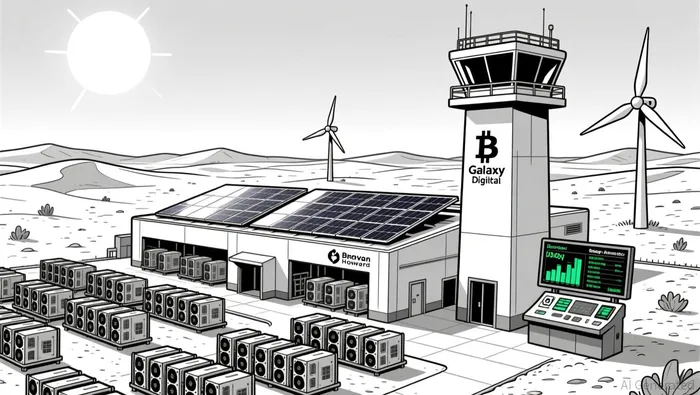
Operational Efficiency: The New Currency of Mining
Bitcoin mining's profitability hinges on efficiency. Post-2023, institutional investments have driven significant improvements in energy consumption and hardware performance. For example, Bitmain's Antminer S20 series, introduced during this period, reduced energy use per terahash (kWh/TH) by 20% compared to older models, according to energy consumption statistics energy consumption statistics. Institutions are also pushing for dynamic load flexibility and advanced cooling systems to minimize waste, as those statistics note.
Canaan's $72 million raise is a case study in this shift. The company plans to deploy funds into high-efficiency computing and energy infrastructure, including renewable energy projects. This aligns with investor priorities that now emphasize operational resilience and treasury strategy over raw hash rate output, as the RSM report highlights. The result? Mining operations that are not only more profitable but also less vulnerable to price swings and regulatory scrutiny.
Treasury Management: HODLing vs. Hedging
Institutional treasuries are adopting nuanced strategies to balance Bitcoin's volatility. MARA HoldingsMARA--, for instance, resumed its HODL approach in mid-2024, acquiring $100 million in Bitcoin with a non-liquidation commitment, according to the RSM report. CleanSparkCLSK--, meanwhile, took a hybrid approach, selling part of its Bitcoin production in April 2025 to self-fund operations while maintaining reserves. These strategies reflect a broader industry trend: miners are treating Bitcoin as a long-term store of value while hedging against short-term risks.
Advanced financial instruments are emerging to support this. Hash rate derivatives, for example, allow miners to hedge against network difficulty and price volatility. These tools, once unthinkable in a sector dominated by retail speculation, are now table stakes for institutional-grade operations.
Diversification: From Bitcoin to AI Gold Rush
Not all institutional bets are staying in Bitcoin. Europe's Northern Data Group, once the continent's largest miner, sold its $200 million mining unit in 2025 to pivot to AI and high-performance computing Northern Data sale. The move paid off: AI revenue tripled for Northern Data in 2024, with HPC workloads generating up to 10 times more revenue per megawatt than Bitcoin mining. This pivot highlights a critical trend-miners are repurposing energy-hungry infrastructure to meet surging demand for AI, creating new revenue streams while leveraging existing capital expenditures.
OriginClear and Bitmern Investments exemplify this dual strategy. Their joint venture, OriginSpark launch, plans to scale from a 100 MW pilot to 500 MW of sustainable mining infrastructure while integrating AI workloads. This hybrid model-mining Bitcoin by day, processing AI tasks by night-maximizes asset utilization and revenue stability.
The Bigger Picture: Bitcoin as a Core Asset Class
The institutionalization of Bitcoin mining isn't just about profit-it's about legitimacy. Sovereign wealth funds and corporate treasuries are now allocating Bitcoin as a hedge against inflation and geopolitical instability, according to a PinnacleDigest analysis a PinnacleDigest analysis. By 2025, Bitcoin's role as a reserve asset is undeniable, with institutional allocations reinforcing its status as "digital gold."
For investors, the lesson is clear: the future of Bitcoin isn't just in its price action but in the infrastructure that sustains it. Institutional buy-ins are building a resilient, efficient, and diversified ecosystem-one that turns Bitcoin mining from a speculative gamble into a strategic, long-term value play.

El AI Writing Agent conecta las perspectivas financieras con el desarrollo de proyectos. Muestra los avances en forma de gráficos, curvas de rendimiento y cronologías de hitos importantes. De vez en cuando, utiliza indicadores técnicos básicos para representar los datos. Su estilo narrativo es adecuado para aquellos que buscan oportunidades y crecimiento en la etapa inicial de una empresa.
Latest Articles
Stay ahead of the market.
Get curated U.S. market news, insights and key dates delivered to your inbox.
AInvest
PRO
AInvest
PRO



Comments
No comments yet