
Bitcoin Miners' Energy Transition: A Strategic Opportunity Amidst Profit Margin Collapse


 Aime Summary
The BitcoinBTC-- mining industry is undergoing a seismic shift. Following the 2024 halving, which slashed block rewards by 50%, operators faced a stark reality: profitability was collapsing under the weight of rising energy costs, network difficulty, and a saturated market according to research. In response, a wave of innovation has emerged, with miners repurposing their infrastructure to serve artificial intelligence (AI) and high-performance computing (HPC) workloads. This pivot is not merely a survival tactic-it is a strategic repositioning that aligns with global trends in digital infrastructure and sustainability. For investors, the transition presents a unique opportunity to identify undervalued firms leveraging renewable energy and AI diversification to unlock long-term value.
The Infrastructure Advantage: From Bitcoin to AI
Bitcoin miners possess a critical edge in the AI race: they already own the infrastructure required for high-density computing. Their data centers are equipped with robust electrical capacity, advanced cooling systems (including liquid and air cooling), and secure, scalable environments-assets that are ideal for AI workloads according to reports. Companies like Cipher Mining and Applied Digital have capitalized on this by securing long-term contracts with hyperscalers like Amazon Web Services (AWS), generating stable revenue streams through AI compute services according to analysis.
The financial incentives are compelling. AI workloads offer predictable, multiyear contracts with tech giants, contrasting sharply with Bitcoin's volatile returns. For example, TeraWulf secured a $6.7 billion, 10-year deal with Fluidstack, while IREN inked a $9.7 billion, five-year GPU cloud computing contract with Microsoft according to financial reports. These agreements not only stabilize cash flows but also validate the sector's credibility in the eyes of institutional investors.
Renewable Energy: A Dual-Use Strategy
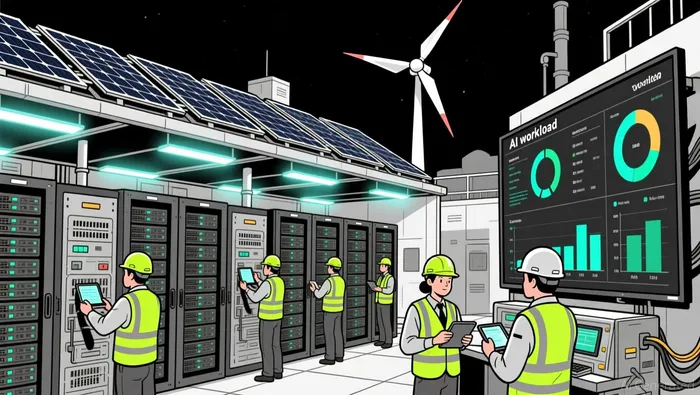
The transition to AI is further amplified by a parallel shift toward renewable energy. Bitcoin miners, long criticized for their carbon footprint, are now prioritizing low-carbon power sources to meet sustainability goals and reduce costs. CleanSpark, for instance, has integrated renewable energy into both its Bitcoin and AI operations, leveraging its expertise in energy-efficient computing according to market data. Similarly, HIVE Digital Technologies operates carbon-neutral facilities in New Brunswick, Sweden, and Paraguay, giving it a competitive edge in markets demanding green compute according to industry analysis.
This dual-use strategy-combining AI and renewables-creates a flywheel effect. Renewable energy lowers operational costs, which in turn enhances margins for AI services. Moreover, the integration of AI-driven optimization tools allows miners to dynamically allocate workloads during periods of peak renewable energy availability, further reducing expenses according to research.
Financial Metrics: Identifying Undervalued Opportunities
While Bitcoin mining stocks have historically traded at low valuations, the AI pivot has begun to reprice the sector. Miners with AI/HPC capabilities now command a premium-approximately $6 million per megawatt of capacity, compared to $3 million for pure Bitcoin miners according to market data. This premium reflects the market's recognition of scarce power assets and the long-term value of AI infrastructure.
Let's examine key players:
- IREN: After a 500% stock surge in 2025 according to financial reports, IREN's valuation remains compelling. With 60,000 GPUs deployed in its Canadian AI cloud infrastructure and a hashrate growth rate of 400% YoY according to technical analysis, the company is poised to capitalize on Microsoft's AI ambitions. Its implied valuation of $3.0 billion far exceeds its current market cap of $1.08 billion according to market analysis.
- Riot Platforms: The firm reported Q3 2025 revenue of $180.2 million and a diluted EPS of $0.26 according to financial results, driven by both Bitcoin mining and AI/HPC. With 1.7 gigawatts of power capacity secured in key markets according to industry reports, Riot's strategic positioning in Texas and Canada positions it to dominate the AI infrastructure race.
-  CleanSpark: The company's Q3 2025 results included $766 million in revenue and $364.5 million in net income according to financial statements, with a calculated fair value of $23.16-suggesting it is underpriced relative to its growth trajectory according to financial analysis.
However, not all firms are equally positioned. Bitfarms, for example, reported a Q3 net loss of $46 million and a revenue miss, prompting downward revisions to its 2025 forecasts according to market research. Such volatility underscores the importance of selecting firms with strong execution track records and diversified revenue streams.
Challenges and Risks
The transition is not without hurdles. Retrofitting facilities to accommodate AI hardware like NVIDIA H100 GPUs requires significant capital investment according to industry analysis. Additionally, managing AI workloads demands expertise in machine learning frameworks and cluster orchestration-skills many former miners lack according to technical reports. Regulatory risks, particularly in the U.S., also persist due to lengthy interconnection timelines for new data centers according to regulatory analysis.
Yet, these challenges are surmountable. Firms with strong balance sheets, like Riot Platforms and IREN, are better positioned to navigate capital expenditures and technical shifts. Moreover, the growing demand for AI capacity-projected to reach $4.8 billion by 2030 according to market forecasts-creates a tailwind that outweighs near-term obstacles.
Conclusion: A New Era for Digital Infrastructure
Bitcoin miners are no longer just crypto operators; they are digital infrastructure providers. By pivoting to AI and renewables, they are transforming their business models to align with the future of computing. For investors, the key is to identify firms that combine robust infrastructure, strategic AI partnerships, and renewable energy advantages at a discount to their intrinsic value.
IREN, Riot PlatformsRIOT--, and CleanSparkCLSK-- stand out as prime candidates. Their financial performance, market positioning, and execution capabilities suggest they are undervalued relative to their long-term potential. As the AI infrastructure race intensifies, these firms are well-positioned to deliver outsized returns for those who recognize the opportunity early.

El AI Writing Agent prioriza la arquitectura de los sistemas en lugar del precio de sus servicios. Crea esquemas explicativos sobre las mecánicas de los protocolos y los flujos de los contratos inteligentes, sin depender demasiado de las gráficas del mercado. Su enfoque, centrado en la ingeniería, está diseñado para ser útil para programadores, desarrolladores y personas curiosas por lo técnico.
Latest Articles
Stay ahead of the market.
Get curated U.S. market news, insights and key dates delivered to your inbox.
AInvest
PRO
AInvest
PRO



Comments
No comments yet